
Venezuela’s interim government has agreed to submit a monthly “budget” to the Trump administration, which will release money from an account funded by the country’s oil sales and initially managed by Qatar, Secretary of State Marco Rubio said on Wednesday.
But the plan drew sharp questions from skeptical Democrats, and Mr. Rubio conceded that it was “novel” and hastily designed. The role of Qatar — a Middle Eastern country thousands of miles from Venezuela whose ruler has won President Trump’s favor — drew particular criticism from Democrats, who questioned its legality and transparency.
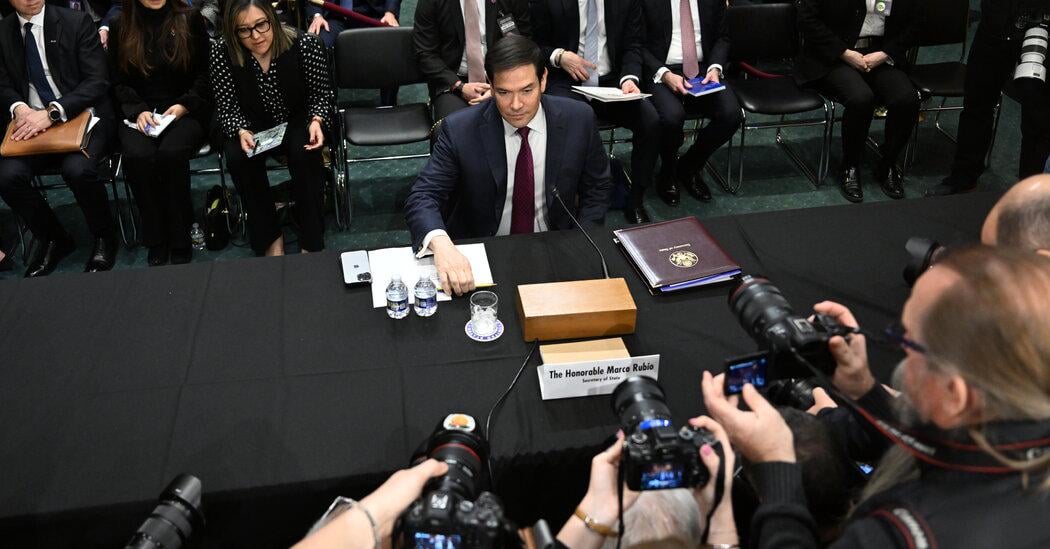
Mr. Rubio detailed the plan during an appearance before the Senate Foreign Relations Committee. It was Mr. Rubio’s first public testimony to Congress since American forces captured Venezuela’s leader, Nicolás Maduro, on Jan. 3, and an opportunity to clarify U.S. policy toward the country. Many questions are sure to persist, however.
Mr. Rubio assured senators, for instance, that the Trump administration had established a “very respectful and productive line of communication” with the government of Delcy Rodríguez, a close ally of Mr. Maduro who assumed power after his removal. As a result, he said, the Trump administration does not “intend or expect” to use military force against Venezuela “at any time.”
Yet Mr. Rubio took a more threatening tone in a written opening statement that he submitted to the committee but did not deliver orally, making brief extemporaneous remarks instead. The written statement warned that the United States was “prepared to use force to ensure maximum cooperation” from Ms. Rodríguez’s government “if other methods fail.”
That cooperation is largely focused on Venezuela’s lucrative oil industry. Mr. Trump has previously said that the United States will control Venezuela’s oil and “run the country,” but Mr. Rubio provided more details.
The United States will help Venezuela’s government fund basic public services by disbursing proceeds from the sale of Venezuelan oil that is subject to U.S. sanctions, Mr. Rubio said. He said that the approach was necessary because of a “fiscal crunch” in Venezuela and that it was a “short-term mechanism” not meant to become permanent.
“They needed money in the immediacy to fund the police officers, the sanitation workers, the daily operations of government,” Mr. Rubio added. “They have pledged to use a substantial amount of those funds to purchase medicine and equipment directly from the United States.”
In an arrangement that he acknowledged was unusual, Mr. Rubio said the funds would initially be held in an offshore account controlled by Qatar before eventual transferral to a U.S. Treasury account.
“I understand it’s novel, but it’s the best we could come up with in the short term,” Mr. Rubio said.
He said a third-party account was necessary because of U.S. financial sanctions on Venezuela and because U.S. creditors to whom the country owes money, mainly from its seizure of American energy company assets roughly 20 years ago, could otherwise make legal claims on the funds that would complicate their disbursement.
Posted by John3262005
9 Comments
Bruh, just call them a vassal state.
>“I understand it’s novel, but it’s the best we could come up with in the short term,” Mr. Rubio said.
Absolute insane to be saying shit like that AFTER you decapitated a foreign government.
Also, I was thinking yesterday about how wild it is that Venezuela and Maduro are old news. We’ve had the entire Greenland kerfuffle and Minneapolis situation since then. It’s been like 3 weeks.
Crazy how so much news has happened in almost a month
Venezuela, Greenland, Minnesota…
Anyway, reading this article is crazy, especially when everything is done hastily like the Qatar account stuff
Maybe you shouldn’t do this stuff until you have everything
Also, they are keeping the money in Qatar so creditors for lost items from back then don’t get the profits. (???)
*Mr. Rubio said a third-party account was necessary because of U.S. financial sanctions on Venezuela and because U.S. creditors to whom the country owes money, mainly from its seizure of American energy company assets roughly 20 years ago, could otherwise make legal claims on the funds that would complicate their disbursement.*
Venezuela Free State
This is some Genghis Khan shit.
IMPERATOR CAESAR MARCVS RUBIVS PADISHAH CAUDILLO LIBERATOR INVICTVS AVGVSTVS PONTIFEX MAXIMVS PERSICVS MAXIMVS VENETIOLICVS MAXIMVS CVBICVS MAXIMVS GROENLANDICVS MAXIMVS RESTITVTOR PAX AMERICANA
https://preview.redd.it/nrhzymmx3bgg1.jpeg?width=800&format=pjpg&auto=webp&s=cab35b966dabad1e059c132961dd3063cc869ab7
I grew up hearing in high school and college about the “US wants South America to be a colony” rhetoric. The discussion around the FTAA echoed as far as the 2010 general elections and probably would have echoed further if not for the explosion in growth during the Lula terms (and the subsequent corruption scandals that derailed the 2010s national politics scenario entirely). It was always mildly funny, a bit dishonest intellectually and led to amused “sure, the CIA is to blame for everything” jokes.
Now? This is a colonial state. A sovereign state needs to have their financial budget approved by another state. They have restrictions on commerce. They have an armada hanging over their heads plus the not-veiled-at-all threat that any administrator can be removed in a whim. This is a colony in almost every possible meaning.
The timeline we are in is extremely weird, indeed.
Oh sweet a new colony
Sometimes I wonder if the treaty clause wasn’t erased while I wasn’t looking.