
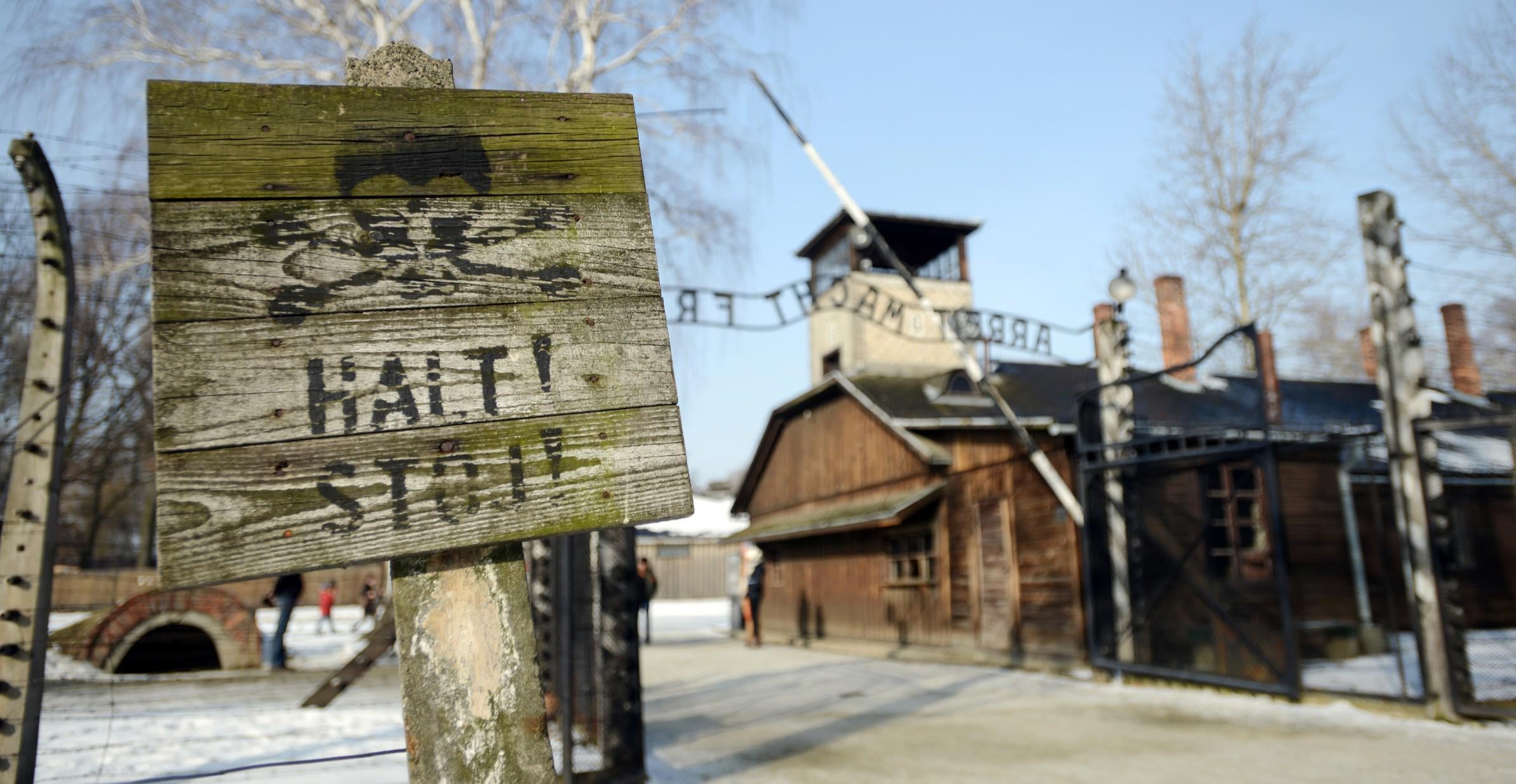
The Auschwitz Museum has criticised the German government for issuing a statement that commemorated various groups of victims of Nazism but failed to mention Poles, millions of whom were killed and who were the first prisoners at Auschwitz.
“It is deeply troubling that the statement commemorating the anniversary of the liberation of Auschwitz failed to mention the Polish victims of the camp,” wrote the museum, which is a Polish state institution, on social media in a message directed to German government spokesman Stefan Kornelius.
The post linked to a statement issued on Wednesday by the German government, one day after International Holocaust Remembrance Day, which is held on the anniversary of the liberation of Auschwitz on 27 January 1945.
In its statement, Germany said that Auschwitz, where over 1.1 million people, the vast majority of them Jews, were killed, “symbolises the immeasurable crimes of the Nazi regime like no other place“.
It also noted that, between 1933 and 1945, “the Nazis systematically murdered over six million Jews” while “millions more people were disenfranchised, persecuted and killed”.
“These included, among others, Sinti and Roma, Jehovah’s Witnesses, members of sexual minorities, political opponents, and people with disabilities,” continued the statement. “Remembrance means taking responsibility for the past and passing it on to future generations.”
The Auschwitz Museum criticised the exclusion of Polish victims from that list. It noted that Auschwitz itself was originally created by Nazi Germany in occupied Poland to house ethnic Polish prisoners. Only later did it become an extermination camp for Jews.
“A responsible approach to historical accuracy should take this into account,” wrote the museum, which recommended that the German government study its online course about the history of the camp.
In total, around 140,000-150,000 Poles were deported to Auschwitz and an estimated 70,000-75,000 of those were killed there. In both cases, those figures are second only to Jews in terms of the number of victims of the camp.
More broadly, during the Nazi-German occupation of Poland from 1939 to 1945, around 6 million Polish citizens were killed, representing 17% of the prewar population – a higher relative death toll than any other country during the war. Around half of those victims were Polish Jews.
Many in Poland argue that the suffering of ethnic Poles during the war has been forgotten by many in the West, including in Germany.
On Tuesday this week, during a speech at Auschwitz on the anniversary of its liberation, Polish President Karol Nawrocki referred to the systematic murder of ethnic Poles by Nazi Germany and the Soviet Union as a “forgotten Holocaust”.
In 2024, the German government itself admitted that “the horrors of Nazi Germany’s occupation of Poland…are still not well known in this country [Germany]”.
In an effort to “close this gap in our culture of remembrance”, the German government has been working on erecting a permanent memorial in Berlin dedicated to Polish victims of Nazi Germany.
Posted by BubsyFanboy
3 Comments
!ping POLAND&EUROPE
**1. Why is this relevant for** r/neoliberal **?**
This is relevant to the Second World War, Nazi war crimes, Polish-German relations and diplomacy.
**2. What do you think people should discuss about it?**
You may discuss the atrocities committed during WW2, Germany’s statement, the Auschwitz Museum’s response and the impact of the recent statements on Polish politics.
**2a. What do you think of the issue at hand?**
Nothing. For once I have no opinion on this.
>Am 27. Januar wird der unzähligen Opfer des Nationalsozialismus gedacht. An diesem Tag im Jahr 1945 befreite die Rote Armee das größte Konzentrations- und Vernichtungslager des NS-Staates, Auschwitz-Birkenau. Dort starben mehr als 1,1 Millionen Menschen – weit überwiegend Jüdinnen und Juden aus ganz Europa, aber auch viele Menschen aus Polen und anderen von Deutschland besetzten Ländern.
January 27 commemorates the countless victims of National Socialism. On this day in 1945, the Red Army liberated Auschwitz-Birkenau, the largest concentration and extermination camp of the Nazi state. More than 1.1 million people died there—the vast majority of them Jews from all over Europe, but also many people from Poland and other countries occupied by Germany.
Literally mentioned people from Poland in the 3rd sentence. Are there upcoming elections in Poland?
Even all these years later, the Poles still don’t consider their dead Jews Polish.