
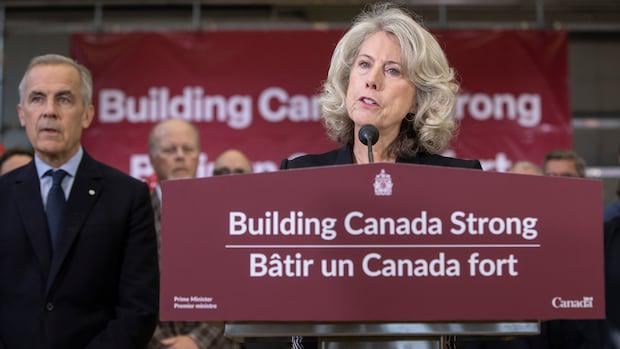
Some recent appointments have bypassed Trudeau's reforms
It's a landmark appointment that could shed new light on the inner workings of Prime Minister Mark Carney's government.
If all goes as planned, Anton Boegman will soon become Canada's first-ever foreign influence transparency commissioner, charged with protecting the country from foreign interference.
However, the process that led to his appointment appears to be in sharp contrast with the appointments reform introduced by former prime minister Justin Trudeau.
Rather than post the opening and call for applications, the Public Safety Department drafted a list of potential candidates. When Public Safety Minister Gary Anandasangaree's office asked for a longer list, it provided more names, including Boegman — then British Columbia's chief electoral officer.
Boegman isn't the only person in recent months who has been appointed to a top government position without an open competition for the job. An analysis by CBC News raises questions about the extent Carney's government is still guided by Trudeau's 2016 reform of governor-in-council and Senate appointments.
The questions come at a time when the government will soon have to fill a number of high-profile positions, including Canada's chief public health officer, heads of agencies, senators and ambassadors to countries like the United Kingdom as well as a successor to Gov. Gen. Mary Simon, whose term is scheduled to end this summer.
In February 2016, Trudeau made good on an election promise to reform the way the federal government makes appointments — countering the perception that who you know in the PMO played a role in getting a job.
The government makes hundreds of governor-in-council or cabinet appointments to a variety of commissions, boards, Crown corporations, agencies and tribunals across Canada. While some positions are part time and paid per diems for days board members participate in meetings, others can be lucrative six-figure jobs heading Crown corporations and government bodies with multimillion-dollar budgets.
Announcing the move, Trudeau said the overhaul would result in "an open, transparent and merit-based selection process." Among the changes were advertising appointment openings and making hundreds of part-time positions subject to a formal selection process for the first time.
"We are committed to raising the bar on openness and transparency in government to make sure that it remains focused on serving Canadians as effectively and efficiently as possible," Trudeau said at the time.
Trudeau also opened up applications from Canadians to the Senate and established a board to advise him on those appointments.
In 2021, he set up a committee headed by Dominic LeBlanc — who was then and is currently in federal cabinet — and the clerk of the Privy Council to suggest a successor to former Governor General Julie Payette.
When Trudeau left office, however, things appeared to change.
Since March 2025, only one position — parliamentary budget officer — has been advertised on the government's appointments website or in the Canada Gazette. For months, the website said it was not accepting applications for any positions. Currently, it says "appointment opportunities will be posted in due course."
At the same time, the Carney government has made 122 governor-in-council appointments. Some of the openings filled were last advertised years ago. Government insiders say previous postings resulted in pools of qualified applicants that can still be tapped for positions.
Some openings, like chief public health officer and official languages commissioner, were publicly advertised before Trudeau left power. The government has still not named a permanent successor to former public health officer Dr. Theresa Tam, who retired in June. Officials won't say if Canada's new official languages commissioner Kelly Burke, who was named last week, was selected through the 2024 open application process.
On March 19, 2025, the governor-in-council (GIC) appointment website advertised 23 job opportunities — some to fill multiple positions.
Ten months later, many are still vacant.
Last week, cabinet approved nine appointments to the new Employment Insurance Board of Appeals. While openings were advertised, they were posted on the board's own website — not the government's GIC appointments page.
While the number can fluctuate from day to day as appointments are made and mandates expire, currently, there are around 251 vacant GIC positions.
In the Senate, seven of 105 seats are vacant and eight more senators are scheduled to retire over the course of 2026. However, the website set up under the Trudeau government to open up Senate appointments and allow Canadians to apply to be a senator has said for months that "new applications, nominations or the creation of new profiles for Senate appointments are not being accepted at this time."
By Tuesday, 24 of the 29 seats on the board Trudeau set up to advise the prime minister on potential senator appointments will be vacant. Only three federal representatives and the two representatives for Nova Scotia will remain.
'Transparent and merit-based' process
Carney's office says that the government is using a "transparent and merit-based selection process" to make appointments.
"Canada's new government is taking a proactive approach to public appointments, with leaders in business, finance, law and civil society stepping up to build Canada strong," press secretary Laura Scaffidi said in an emailed response to questions from CBC News.
Scaffidi pointed to the appointments of Dawn Farrell to head the Major Projects Office, Ana Bailão at Build Canada Homes and Douglas Guzman at the Defence Investment Agency.
"Leading Canadians are playing a critical role in our new government, and building a stronger, more resilient and more independent Canadian economy," said Scaffidi.
Scaffidi said the three were named "on recommendation by the clerk of the Privy Council to the prime minister" and that some of the government's appointments have been made from a pool of candidates that applied both before the last federal election and since then.
The Prime Minister's Office declined a request from CBC News for an interview with the PMO's director of appointments Derek Lipman, the former senior director of election readiness for the Liberal Party of Canada. He was appointed in October — more than six months after Carney became prime minister.
Requests from CBC News regarding the process that will be used to choose new senators and a Governor General were met with a response from the Privy Council Office, which said that the information "will be made available in due course."
Insiders point out that it is important to fill vacancies with high-quality candidates. They say that while Trudeau opened up the process for Canadians to apply, some job competitions didn't attract the calibre of candidate needed and the government ended up recruiting candidates to fill some positions.
Michael Wernick, former clerk of the Privy Council, says the way that government appointments are made has evolved over time and the process has gradually become more transparent.
"Some transparency in government procurement and contracting goes back a long way," Wernick said. "This is part of trying to take nepotism and political favoritism out of governing."
Prior to Trudeau's reform, former Conservative prime minister Stephen Harper tried to have appointments made by an independent commission. However, the proposal and his choice to head the commission proved controversial and it was abandoned.
In the end, Wernick said each prime minister has their own way of making appointments.
"We've had a lot of prime ministers over the years and each one of them has taken a different approach to how they want to gather names and recommendations before they make the final appointment," he said.
"What we saw was Stephen Harper put his stamp on it very early in his administration. Justin Trudeau put his stamp on it very early in his administration. We have yet to see Mark Carney's stamp on the appointments process."
'Dangerous step backward'
Duff Conacher, co-founder of Democracy Watch, said Trudeau may have added the goal of diversity to the government's appointment criteria, but he didn't really make it more open, transparent or merit-based.
He said the way the process is working under Carney's government is cause for concern.
"The Carney Liberals' process for cabinet appointments is a dangerous step backwards to the old, undemocratic, secretive and smelly practices of rewarding friends of the prime minister and the ruling party with patronage jobs, and ensuring that cabinet can have behind-closed-door conversations with applicants for every democracy and law enforcement watchdog position to ensure they won't act independently and will be a lapdog who rolls over and protects the ruling party."
Conacher said all cabinet appointment processes should involve a public job posting and an independent merit-based review of all applicants with a short list of fully qualified people sent to cabinet for the final choice.
In the case of democracy watchdogs and law enforcement officers, Conacher said an all-party committee should make the final choice.
Posted by IHateTrains123
1 Comment
well NOT by asking me
I am curious to see if carney brings back the Harper era committee for picking the GG
aa for the rest look on one hand of course the PM should have who he wants in subordinate roles but even if Not technically independent something like the foreign transparency officer should be independent aa much as possible