
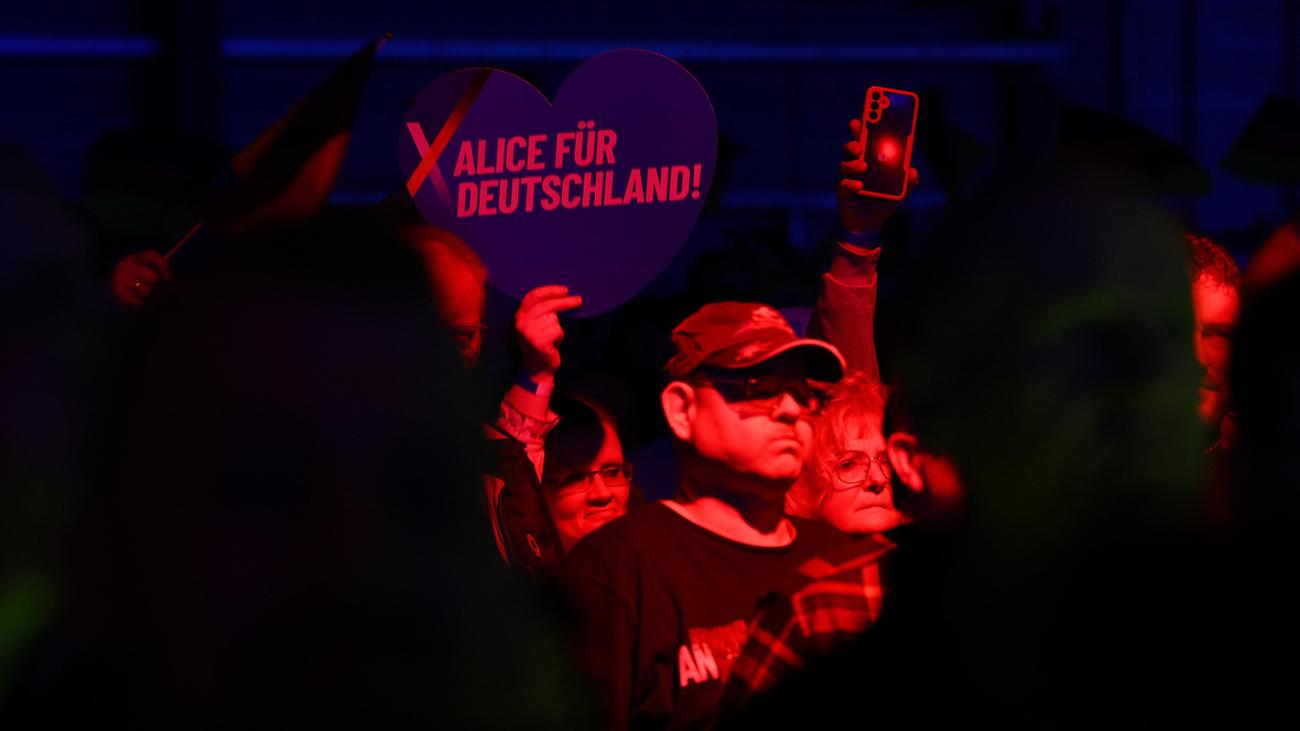
According to polls, up to 40 percent of voters in Saxony-Anhalt would choose the AfD – a party whose now-public draft program for the state elections in September pushes the boundaries of fundamental rights, and possibly goes beyond them.
Because the AfD and its lead candidate, Ulrich Siegmund, can expect hardly any coalition partners so far, they see only one option for reshaping the state according to their vision: governing alone. Mathematically, this could be possible – for the first time in Germany. The state would then face profound change. The AfD government plans to drastically alter society, erect new borders, and restrict freedoms, with consequences for the economy, education, art, and culture.
With great fanfare, the AfD will be pushing its self-assuredly titled "government program" to the public in the coming months at campaign events and town hall meetings, introducing, alongside numerous AfD evergreens, the new term "culturally alien" immigration. It appears no fewer than 13 times in the 156-page document: The term was coined by the document's intellectual father, state parliament member Hans-Thomas Tillschneider, the nationalist spokesperson who once founded the Patriotic Platform within the AfD. Lead candidate Ulrich Siegmund euphorically thanked the Islamic scholar, who writes indiscriminately about "illegal" immigrants and wants to show the door to "culturally alien skilled workers" and migrants. But what exactly constitutes "culturally alien" remains unclear – whether the Polish caregiver or the Syrian doctor is meant is left unexplained in the document. Equally undefined is the concept of "patriotic basic attitude," to which state-funded associations are supposed to subscribe. The commitment to the democratic order demanded of them, however, has long been required, at least in federal funding programs.
The AfD also quotes itself on other standard AfD topics: Former AfD leader Frauke Petry already wanted to transform the right to asylum into "a right of clemency." Sealing Germany off from migration, restricting Islam, reverting society to the 1970s, reducing publicly funded broadcasting to basic news coverage, burning diesel and Russian gas – these are all things that have long been part of the AfD mainstream. All points that are easily entrenched in the mindset of AfD supporters in the rural state of Saxony-Anhalt, where there are few foreigners and numerous wind turbines are visibly spinning. What is kept from these supporters, however, is that much of this is only achievable at the state level through the Federal Council, or not at all.
Could child benefits increase the birth rate?
The AfD's argument focuses heavily on abandoning the concept of skilled worker immigration. Migrant workers are portrayed not as a solution to the skilled labor shortage, but rather as a problem: their integration ties up workers who are then lacking elsewhere. Their often inadequate German language skills, for example in the healthcare sector, are said to endanger patient well-being. While this aligns with analyses from the German Hospital Federation and other expert bodies, the AfD cites as evidence the Magdeburg Christmas market attacker, a mentally disturbed physician who killed six people with an SUV in a fit of psychosis in 2024. He is currently on trial.
The proposed solution is outlined in two short paragraphs: A "birth turnaround" is supposed to combat the skilled worker shortage, supported by an additional state child benefit of €250. However, studies show that financial incentives are not the decisive factor in having children. Furthermore, the aim is to stop the emigration of skilled workers and bring back those who have left the region. "New Germans? – We'll make them ourselves," the AfD (Alternative for Germany) party proclaimed in 2017. But especially in a state like Saxony-Anhalt, which has suffered more from emigration and an aging population than any other since the fall of the Berlin Wall, a short-term increase in skilled workers without migration is difficult to imagine, at least in the medium term.
And of course, the AfD didn't want to forgo including so-called remigration in its platform. The party enshrined this battle cry in its 2025 federal election manifesto, and the initially skeptical party leadership eventually relented. The concept, coined by the far-right Austrian activist Martin Sellner, has many supporters within the party: lead candidate Ulrich Siegmund was present when Sellner presented it in a Potsdam hotel at the end of 2023, and just this week Sellner was a celebrated guest of the AfD in the Thuringian state parliament. The party has so far only shied away from Sellner's idea of deporting German citizens with a migration background.
Combating illegal migration, turning back "asylum seekers" (the draft program deliberately uses the derogatory term) from safe third countries at the border, ending resettlement programs, or deporting criminals – other parties have long advocated for this, and the federal coalition is even putting it into practice.
Directed culture
The extent to which the AfD plans to intervene in everyday life and society is evident in the area of culture: its election manifesto is likely the first to directly address the "extraordinary ugliness" of buildings. Architects of publicly funded new buildings would not only be subject to existing building and design regulations, but also to guidelines of taste and aesthetics, specifically "recognized architectural tradition"—a precedent cited is an executive order from Donald Trump's first term, according to which buildings must be "perceived as beautiful by the majority of the population." Especially in the land of the Bauhaus tradition, this evokes dark times.
A kind of controlled culture would also be expected: The AfD intends to provide state funding only for art that "contributes to the formation of German identity." The model for this "cultural policy shift" is Hungary under the leadership of Viktor Orbán. The plan is not entirely new: The AfD in Saxony also planned in its 2019 election manifesto, likewise described as a government program, to take action "against one-sidedly politically oriented, educational music and spoken theater" should it come to power – at that time, baby bonuses and state childcare allowances were also to be available only to German citizens. While it is quite common to promote certain cultural assets, including German ones, such as dialects or customs, excluding certain movements from funding guidelines for cultural programs could have constitutional implications: Although there is no legal entitlement to cultural funding, as soon as the state subsidizes art and culture, it must do so in a politically neutral manner and treat everyone equally.
The draft program also reinforces one of the AfD's major targets: the churches, which have positioned themselves against the party, classified as right-wing extremist, for years. The party wants to make the churches pay for granting church asylum – where congregations provide humanitarian protection to those facing deportation. The AfD also wants to stop state subsidies for the major religious communities, even though the churches, with their extensive social welfare programs, are a crucial pillar in the care and support of people with disabilities. These permanent subsidies – amounting to €44 million annually in Saxony-Anhalt, the highest per capita figure nationwide – are guaranteed by the Weimar Constitution. However, they have been slated for replacement for decades. So far, all attempts to enact the necessary federal law have failed – most recently, in 2021, the Bundestag rejected an initiative by the FDP, the Left Party, and the Greens. State subsidies cannot be unilaterally terminated, but reductions can be made by mutual agreement – that is, only with the churches' approval. Nevertheless, the AfD's demand could lure voters, especially in the predominantly atheistic east, who do not care about the social, identity-forming function of the churches.
And these are just some of the many points with which the party's platform targets the emotions and feelings of its East German supporters: The demand to abolish gender studies programs is one such example. It's included in the platform even though no such programs exist at universities in Saxony-Anhalt, only supplementary modules and research projects. The premise of expanding Russian language instruction in schools and reviving student exchanges is also likely to resonate. Another proposal is to establish permanent special classes for refugee children "not required to leave the country," to show them: you're only here temporarily. These classes would be taught by refugee teachers. This was temporarily implemented with children of Ukrainian war refugees, who were taught in linguistically homogeneous classes by Ukrainian teachers, but only to prepare them for regular classes. Under an AfD education minister, children with disabilities would also no longer be integrated into regular classes, but instead, as in previous decades, would be supported in special schools.
"Think German!", "Fireworks are culture!", "Show your colors!" – almost every sub-point in the draft election manifesto ends with an exclamation mark. This can be interpreted as a determination to proceed with maximum energy after taking power, even against institutions largely protected by constitutional law, such as freedom of art and science or freedom of religion. The party is already preparing for resistance: The federal leadership is currently forming a kind of task force of lawyers, which, according to a Bild report, is to identify obstacles in order to neutralize potential opposition from incumbent state governments, the federal government, and civil society. The AfD apparently simply wants to govern unhindered.
Posted by IHateTrains123
1 Comment
> These permanent subsidies – amounting to €44 million annually in Saxony-Anhalt, the highest per capita figure nationwide – are guaranteed by the Weimar Constitution.
Slip of the tongue?