
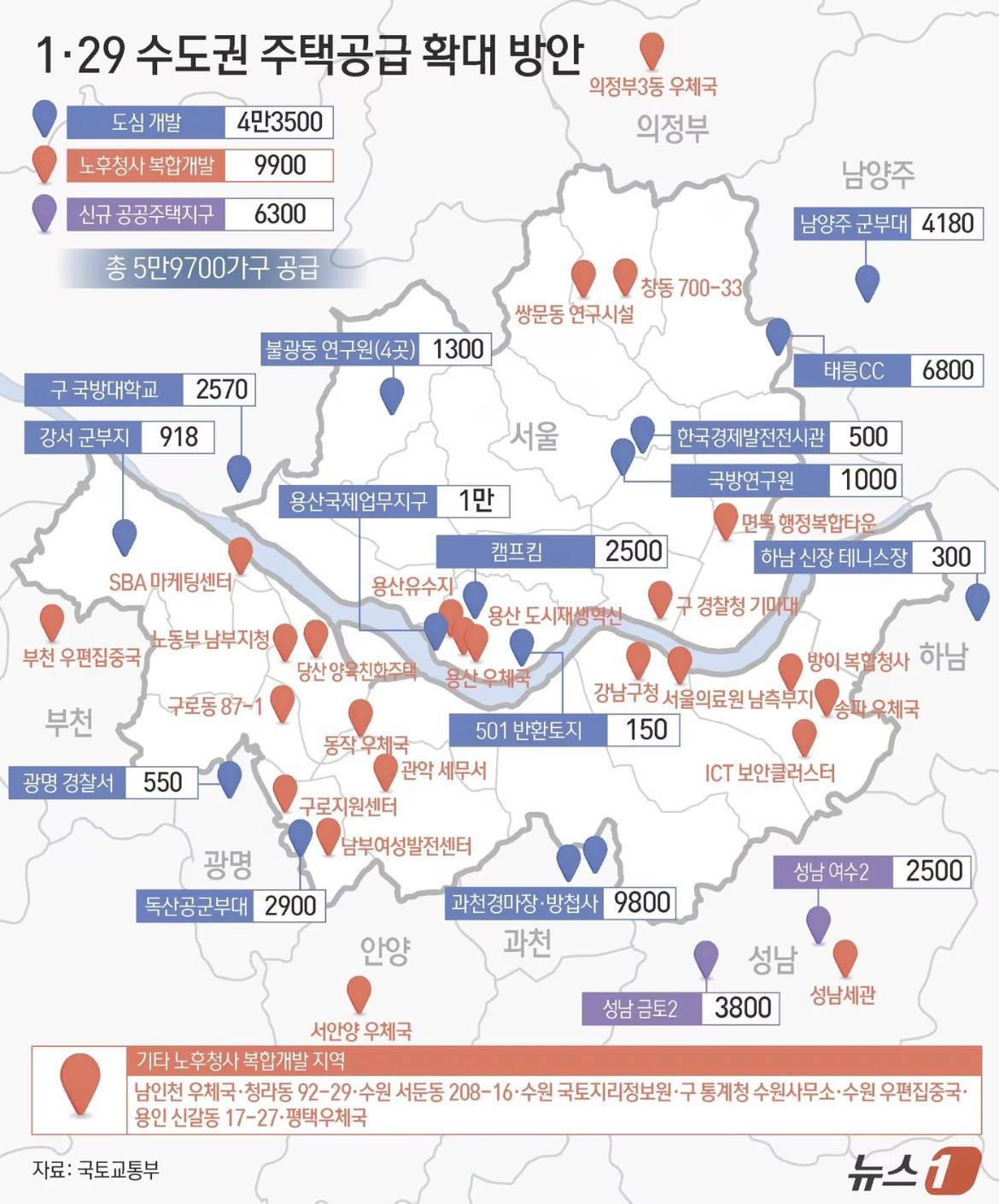
As the government has announced plans to supply 60,000 housing units in urban areas, primarily targeting young people and newly married couples, details on the exact number of units, pricing, and sales methods are expected to be revealed in a housing welfare implementation plan to be announced in March. Industry observers say this plan will serve as a benchmark for determining whether the supply will be large enough to be felt meaningfully by the public.
According to the real estate industry on the 31st, the government plans to supply the 60,000 urban housing units announced in the January 29 housing supply measures, with a focus on young people. The goal is to provide high-quality housing at affordable prices, enabling households to form families without housing concerns, given the reality that housing costs are delaying marriage and childbirth.
So far, however, only the broad direction of the supply targets has been disclosed. The actual breakdown between rental and for-sale units, as well as the specific number of units allocated to young people and newlyweds, is expected to be confirmed in the March housing welfare plan.
Under current law, at least 35% of housing supplied within public housing districts must be public rental housing. However, as the government continues to prioritize expanding public rental housing, the share of rental units may exceed the legal minimum. As a result, there is speculation that a significant portion of the 60,000 urban units could be supplied as rental housing.
The government is also considering diversifying rental housing types. Moving beyond public rental housing aimed primarily at low-income households, it plans to introduce new models that could also appeal to the middle class. A Ministry of Land, Infrastructure and Transport (MOLIT) official said,
“We are considering supply measures that can be preferred not only by low-income groups but also by the middle class.”
Sales methods are also expected to be a key component of the March plan. The government is reviewing a system that would combine general sales with installment-based payment options, designed to reduce upfront financial burdens while enabling long-term homeownership.
One representative model is the shared-equity (equity-accumulation) housing scheme. Under this structure, buyers pay only 10–25% of the purchase price upfront, move in, and gradually acquire the remaining equity over 20–30 years, ultimately obtaining full ownership. This model is considered well-suited for young people and newly married couples with limited initial capital.
Another option under consideration is the profit-sharing housing model. In this approach, residents move in by paying about 80% of the market price, and after a mandatory occupancy period, any capital gains from resale are shared with the public sector.
Kim Yi-tak, First Vice Minister of Land, Infrastructure and Transport, said,
“Affordable housing may include models where people accumulate ownership or pay in installments, designed for those who cannot afford to purchase a home with a large lump sum.”
Affordable housing is defined as housing where housing costs do not exceed 30% of household income.
The real estate industry views the upcoming March plan as a critical turning point for assessing the effectiveness of the 60,000-unit urban housing supply initiative. Analysts say market reactions will hinge not only on target groups and locations, but also on how many units are sold versus rented and under what terms.
Seo Jin-hyung, Professor of Real Estate Law at Kwangwoon University and President of the Korean Association of Real Estate Management, commented,
“The rental-to-sale ratio to be announced in March will be extremely important. If the rental share is excessive, the supply effect may be diluted, making it crucial to find an appropriate balance.”
Posted by Freewhale98
2 Comments
1. Summary
Map of new public housing supply in Metropolitan Seoul. President Lee Jae-myung claimed that private housing supply has too slow and small. So, he decided to redevelop old government & military & state-owned company buildings into public housing while sending those agencies and state-owned companies to other non-Seoul cities to spread out the population.
2. How this is related to the sub
(1) Urban development & Public Housing projects
3. My opinion
I guess only obstacle left is NIMBY from local politicians.
This sounds like a drop in the ocean expecting water levels to change.