
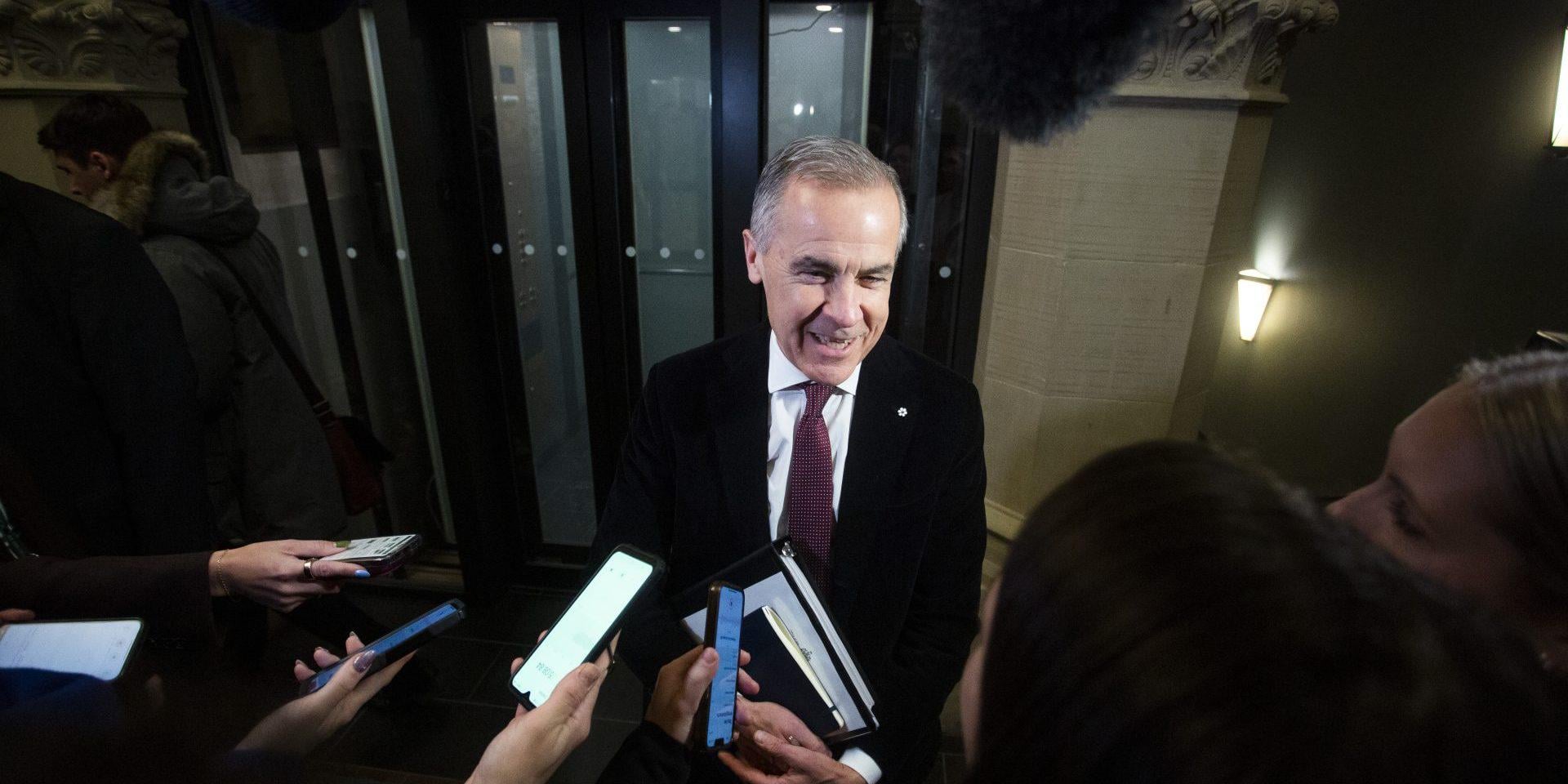
Months away from the review of Canada’s most consequential trade agreement with the United States, MPs are raising the alarm over governmental secrecy and a lack of transparency in trade negotiations.
The Liberals have kept information about trade negotiations close to the vest as Prime Minister Mark Carney (Nepean, Ont.) has frequently remarked that he won’t negotiate in public.
Trade negotiations are under the jurisdiction of the executive branch in Canada, but increasingly, MPs have tried to fight for more transparency.
“Mark Carney is more acting like a CEO than like a prime minister [or] leader of government,” said Bloc Québécois MP Simon-Pierre Savard-Tremblay (Saint-Hyacinthe-Bagot-Acton, Que.), who serves as vice-chair of the House Committee for International Trade.
He said that when the committee hears from government witnesses, they provide little information.
“They are very, very silent, and they never directly answer our questions, which is quite frustrating in the long run,” Savard-Tremblay said.
Conservative MP Jacob Mantle (York–Durham, Ont.), who sits on the Trade Committee, said the default position of the government appears to be that of secrecy and withholding information.
“I’ve seen no indication that the government is going to move to more openness,” said Mantle, a former trade lawyer.
He said that secrecy doesn’t result in good decision-making,
“How can Canadians and parliamentarians make a fair assessment of whether we think a deal that’s on the table is good, bad, or something else if we don’t have an understanding of how Canadians view their interests in the review,” said Mantle, who has been pushing to shine light on secretive consultation submissions for the Canada-U.S.-Mexico Agreement (CUSMA) review.
MPs learned from U.S. media that Carney had a call with U.S. President Donald Trump on Jan. 26. U.S. Treasury Secretary Scott Bessent told Fox News that Carney “very aggressively” walked back comments he made during his much-lauded Jan. 20 speech in Davos, Switzerland. Carney denied Bessent’s account of the call.
On multiple occasions, the PMO has not released readouts of calls Carney has held with Trump, as previously reported by The Hill Times.
Conservative MP Michael Chong (Wellington–Halton Hills North, Ont.), his party’s foreign affairs critic, wrote on X that “Canadians have the right to know,” noting the lack of a readout from the call.
“It is unacceptable that Canadians and journalists learned of this recent call from American media,” he wrote. “In these challenging times, the public interest is best served by accurate, forthright information from government.”
Center for North American Prosperity and Security executive director Jamie Tronnes said that when conducting trade negotiations with the Trump White House, there is a need for Canada to be very clear in its messaging.
“Sometimes that need to control the message about the trade agenda and trade priorities sometimes conflicts with the public’s right to know about what’s being discussed,” she said.
Tronnes said that while releasing a readout is a tradition, it is not a requirement to do so, especially in modern times with world leaders speaking informally more frequently.
“It’s not entirely up to Canada to how and when to provide readouts,” she said. “But that being said, I have been surprised by the sheer number of times that we’ve read about Carney and Trump having a conversation because someone else talked about the conversation they had, and not because there was any communication that they spoke or what they spoke about.”
Feds ignore own transparency policy
To inject greater transparency in the negotiation process, Bloc Québécois MP Mario Simard (Jonquière, Que.) put forward a private member’s bill to require the tabling of a treaty in the House 21 sitting days before ratifying it. Bill C-228 also sought to have the government obtain advice from the House on a trade agreement before it is ratified.
Speaking in the Chamber on Oct. 21, 2025, Simard described the treaty-making process as “undemocratic,” and remarked that Parliament is “relegated to the role of a rubber-stamp chamber.” He said that Canada is “lagging behind” Europe and the U.S. when it comes to transparency in the treaty process.
Parliament does not vote to ratify trade bills; instead, an implementation bill changes domestic laws so that a new pact would acquiesce to them.
Bill C-228 was defeated 302-32 at second reading on Jan. 28. It was supported by the Bloc, the NDP, Conservative MPs Mantle and Matt Strauss (Kitchener South–Hespeler, Ont.), and Green Party Leader Elizabeth May (Saanich–Gulf Islands, B.C.). The Liberals opposed it, as did most Conservatives.
“When we brought the bill,” Savard-Tremblay said, “we were told, ‘we don’t need those kind of laws because we already have the official policy.’”
“But the very day they told us that, they just betrayed their own policy,” he said. “That is one of the main reasons we need a law and not just an official policy.”
The government’s policy sets out that the protocol of a trade pact has to be tabled in Parliament 21 sitting days prior to the introduction of an implementation bill. The government only waited 15 days before it introduced C-13, the implementation bill for the United Kingdom’s accession to the Comprehensive and Progressive Agreement for Trans-Pacific Partnership.
International Trade Minister Maninder Sidhu (Brampton East, Ont.) told the House Trade Committee on Jan. 27 that Canada must diversify its trade “as fast as possible.”
“I think we need to keep that in mind as we move forward that we’re not in normal times anymore,” he said.
He said that Canada is affected by many things from other governments that it can’t control.
“What we control is how fast we open doors, how fast we move in Parliament, how fast we’re able to get workers more opportunities so they can export their goods to other countries around the world,” Sidhu said.
‘A matter of democracy’
Savard-Tremblay told The Hill Times that there would be no change in Canada’s diversification agenda if the bill was implemented in a week or a month, noting that it is a generational project.
“If you have a policy, you should respect what’s in it,” he said. “As parliamentarians, it is a matter of democracy; we have the right to have some surveillance of what the government does.”
Liberal MP Judy Sgro (Humber River–Black Creek, Ont.), chair of the International Trade Committee, said MPs have “plenty of time” to ask questions and to get whatever information is needed, remarking that the minister and officials have been readily available to the committee.
“I think we’ve been providing the information and time,” she said.
Sgro said the committee is feeling the pressure from Canada’s precarious position with the U.S., and the desire to move trade deals along as fast as possible in “an appropriate manner.”
Asked about the decision not to follow the government’s policy by tabling Bill C-13 prior to the completion of 21 sitting days, Sgro said that policy was created when Canada was “in a very different place.”
She said Canadians without jobs aren’t concerned with the committee having a longer study.
“We need to do adequate research and ask adequate questions, and then attempt to be efficient and move the bills forward,” she said.
May told The Hill Times that she doesn’t find the Carney government’s approach to trade transparent, but noted that is echoed in other ways that the government operates, including with the appointment of officials.
“The Trudeau administration set a high bar for transparency in the first round of CUSMA negotiations,” she said, noting that union and industry leaders were represented at the negotiation table.
“It was more transparent than any trade negotiation that I’ve seen in the past,” she said. “I think we’re likely to see Mr. Carney play his cards closer to his vest.”
She said that she hasn’t been offered briefings by the government like she has been in the past.
“In general, this is a very non-transparent government,” May said. “I think it’s going to get a degree of tolerance … because these are tough times we are dealing with Trump—that will keep people from being too angry from the degree that we’ve moved to being a very non-transparent government.”
May said that Carney isn’t used to nor would he welcome the restraints on a prime minister when gaining support from opposition parties.
“He’s shown a real bristling at the degree to which Parliament might slow him down,” she said.
Mantle’s push to unseal consultation submissions
Mantle has put forward a motion to force Global Affairs Canada (GAC) to hand over submissions it received as part of a 2025 consultation for the CUSMA review, as well as an earlier consultation it had in 2024 on the pact. That motion was passed by the House Trade Committee on Nov. 3, 2025.
“It shouldn’t take a production order from the committee to understand what Canadians think about the CUSMA review,” Mantle told The Hill Times.
Mantle said that he has begun to receive submissions from GAC’s initial consultation in 2024, but has yet to receive anything from its 2025 work.
The consultations for the CUSMA review were open to the public in the U.S.
In a committee meeting on Nov. 17, 2025, Mantle pressed GAC’s chief trade negotiator Aaron Fowler for more information about the talks with the U.S.
“I would encourage Global Affairs, you as chief negotiator, and others to offer more information and more transparency to Canadians about this process,” he said. “In your last appearance, you said, ‘I hope that the committee and, more generally, Parliament feel that they are well informed about our agenda.’ My answer is, ‘no, we don’t feel well informed.’”
While Fowler serves as the department’s chief negotiator, he isn’t the chief negotiator for Canada-U.S. trade. That role is held by Canada’s Ambassador to the U.S. Kirsten Hillman who is leaving her post this month.
Fowler told the committee that the government was being sufficiently transparent.
“I believe the level of transparency that has been provided is appropriate to the level of sensitivity that those negotiations entail,” he said at the time.
When GAC officials appeared before the committee for Bill C-13, Mantle told them that their department has a “culture of secrecy.”
“When we have engaged in trade negotiations, there is no public process that is permitted. There are comments that are received often times by the government and then curated reports are issued sometimes about what the government heard,” he said on Jan. 27. “However, there is no transparency about what industries may say to the government or written comments that may be provided to the government.”
Posted by IHateTrains123