
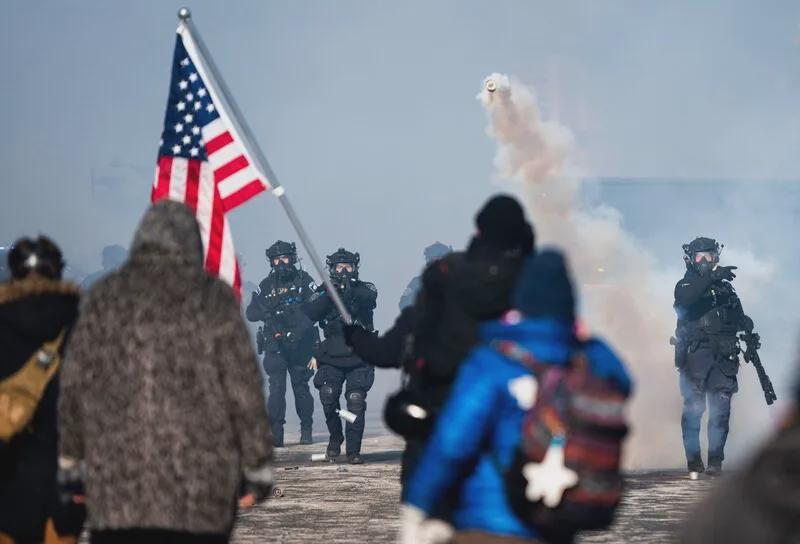
In the United States today, human tragedies caused by the tyranny of the Donald Trump administration continue to unfold. In Minnesota, civilians have been killed one after another by gunfire from federal agents. Masked state authorities carry out indiscriminate stops and arrests in pursuit of “results,” while migrants are dying of illness in detention facilities with appalling conditions. Some have been shot dead while fleeing identity checks; a disabled person died after the father who cared for them was taken away. Barbarism is everywhere.
Across the United States, large-scale protests opposing the Trump administration are erupting day after day. But the problem does not end with Trump himself. Behind him lies a vast system known as “fascism,” operated by a massive far-right ecosystem that has permeated the U.S. government and society, along with supporters who make up as much as 40 percent of the electorate.
The far-right organizational ecosystem sustaining the Trump administration is enormous in scale. Its core components include:
• a MAGA political coalition centered on Trump, the White House, the federal government, and loyalists within the Republican Party;
• policy and lobbying organizations such as the Heritage Foundation and the America First Legal Foundation (AFL);
• religious networks including Protestant churches, various “family values” groups, and youth organizations like Turning Point USA;
• a movement and media cluster led by culture-war figures such as Steve Bannon and Tucker Carlson, alongside extremists like Nick Fuentes;
• and paramilitary groups such as the Oath Keepers, Proud Boys, and Patriot Front.
These forces are loosely connected in a decentralized structure, but they unite when fighting a shared enemy—those they label “anti-state forces,” “communists,” or “terrorists.” Mainstream far-right actors publicly distance themselves from paramilitary groups while tacitly hoping they will carry out overt violence on their behalf. Ultra-radical movements denounce the “reformism” of the mainstream far right, yet still cooperate with them in struggles against Democrats and progressives. Those seeking to defend American democracy are no longer fighting Trump alone—they are confronting the monster that produced him.
Many scholars describe this reality as fascism. Authoritarianism, nationalism, and violence are often cited as its indicators, but these traits are shared by many non-democratic systems such as military dictatorships or one-party states. Fascism has distinctive features:
• mass voluntarism and activism;
• intense emotional mobilization combining fervor and fear;
• the destruction of democracy through democratic means;
• contradictions blending revolution and counterrevolution, anti-elitism and contempt for the vulnerable;
• and ideologies of anti-equality, discrimination, and exclusion.
What makes fascism most terrifying is the pervasiveness of evil. The state amplifies, absorbs, concentrates, and releases violent energies embedded throughout society. Violence from above merges with violence from below.
As these characteristics of fascism re-emerge today, memories of “a hundred years ago” are being invoked. Yet there are crucial differences. First, unlike a century ago, there is no strong left and no revolutionary horizon. Contemporary fascism is not the product of a bourgeois crisis but an offensive rooted in a broad rightward shift of society. Second, whereas fascism a century ago arose amid the “immature democracies” following the first wave of democratization, today it emerges on the historical foundation of “aged democracies” that have passed through the third wave. As a result, fascists now skillfully exploit the language and institutions of democracy and freedom. Third, the fusion of science, technology, and governance has intensified. The U.S. government has constructed systems to collect, analyze, and control population data and employs governance techniques of targeting.
This new form of fascism is a global phenomenon, though it varies by region. In Western Europe, parties labeled as “far-right” or “right-wing populist” have mobilized public anxiety and hatred through anti-immigrant, anti-refugee, and Islamophobic rhetoric. However, since the 2000s they have tended to distance themselves from overt racism, anti-democratic and anti-human-rights positions, and often moderate after taking power. For example, Italy’s Giorgia Meloni government, once described as a “descendant of fascism,” upheld constitutional bans on fascist parties after taking office and expelled youth members who engaged in fascist behavior. In Europe, radical right politics largely operates in a gray zone of ambiguity.
What about South Korea? Since December 3, Korean society has witnessed the contours of a Korean-style fascism, in which a military coup from above combined with mass mobilization from below to shield it. Insurrectionary forces mobilized elite military units and more than 4,000 military and police personnel, and planned mass arrests, detention, torture, and executions. Had the coup succeeded, today’s Korea would resemble Iran more than the United States. Korean-style fascism lacks ideological sophistication, mass support, and strong party politics, but due to the legacy of Japanese colonial rule and military dictatorship, the danger of state violence is extremely high.
There is also a duality to Korea’s democratic resilience. From anti-dictatorship struggles to candlelight protests, Korea has accumulated a historical culture of resistance and social capital. In moments of crisis, countless “democratic reservists” emerge from the trenches of civil society and rush to the National Assembly and public squares. Yet in everyday life, cultures of solidarity and community are weak. Korea does not have an exceptionally strong far right—rather, its far right is simply crude and low-grade. Servility to foreign powers, empty ideological agitation, and corrupt rent-seeking define a third-rate far right. But if such forces gain power and seize the state, their potential for violence would be terrifying.
This age of barbarism will be prolonged. It may mark not merely the end of liberal hegemony in international relations, but a crisis of the long liberal century that began in the 18th century. Humanity is facing, for the first time, an era without a liberal-democratic superpower. During the era of fascism and the two world wars, illiberal states—Germany, Italy, and Japan—challenged a liberal “West” represented by Britain and the United States. Today, the United States itself is openly destroying modern universal norms and values.
There is no path forward except for each society to defend its own democracy, human rights, and peace. South Korea must navigate this storm toward an unknown future. It must consolidate democratic political and social forces, decentralize power structures that could threaten democracy, dismantle privileged military groups with political ambitions, and complete the depoliticization of the armed forces. Resources must be concentrated on policies that reduce insecurity—the soil in which fascism grows—and that strengthen democratic foundations across society. Society must speak clearly against hate-mongering and the mockery of human dignity, leaving such forces with no place to stand.
The message coming from around the world is grave: the age of fascism has arrived. We must prepare for it—and overcome it.
Posted by Freewhale98
2 Comments
As of now South Korea is one of the countries I would trust the most to resist fascism.
[Submission text]
1. Summary
The author declared the world is entering a prolonged era of fascism with the US being its vanguard. It is worse than 1930s because there is no widespread left-wing revolutionaries to counter-balance them nor established liberal bloc to fallback. The fervor of socialism is dead and the origin of fascism in 2020s is the established democracy such as the US. The author warns that although Korea has plenty of “democratic reservists” who are ready to rise up against fascists and Korean fascists lack competency and organization to seizes power. But, he warns the weakness of Korean society’s democratic traditions and institutions make it vulnerable to 21st century fascists and elite infiltration.
2. How is related to the sub
(1) The end of liberal world order and the birth of fascist world: Trump’s America is the vanguard in the rise of new world order centered around the worship of power and fascism.
3. My opinion
The weakness of Korean democracy lies on anti-democratic elites and fragility of its institutions. Post Dec 3rd studies on Korean electorate indicate there is no large scale far-right radicalization of Korean population. Even infamous “Young men in 20s” were “democratic reservists” ready to rise up against the fascism. But, the studies on elites were shocking. Pre-existing reactionary nature of Korean military, security agencies and civil service was amplifying among its elites. It spilled over to PPP where many former bureaucrats and generals end up, leading to mass-radicalization of conservative political leadership.
Korea is witnessing the rise of fascism driven by elites but mostly disconnected with public sentiments. This led to Korean fascists relying on heretical cults such as Moonies and shamans as their power base while begging Trump’s America for intervention.