
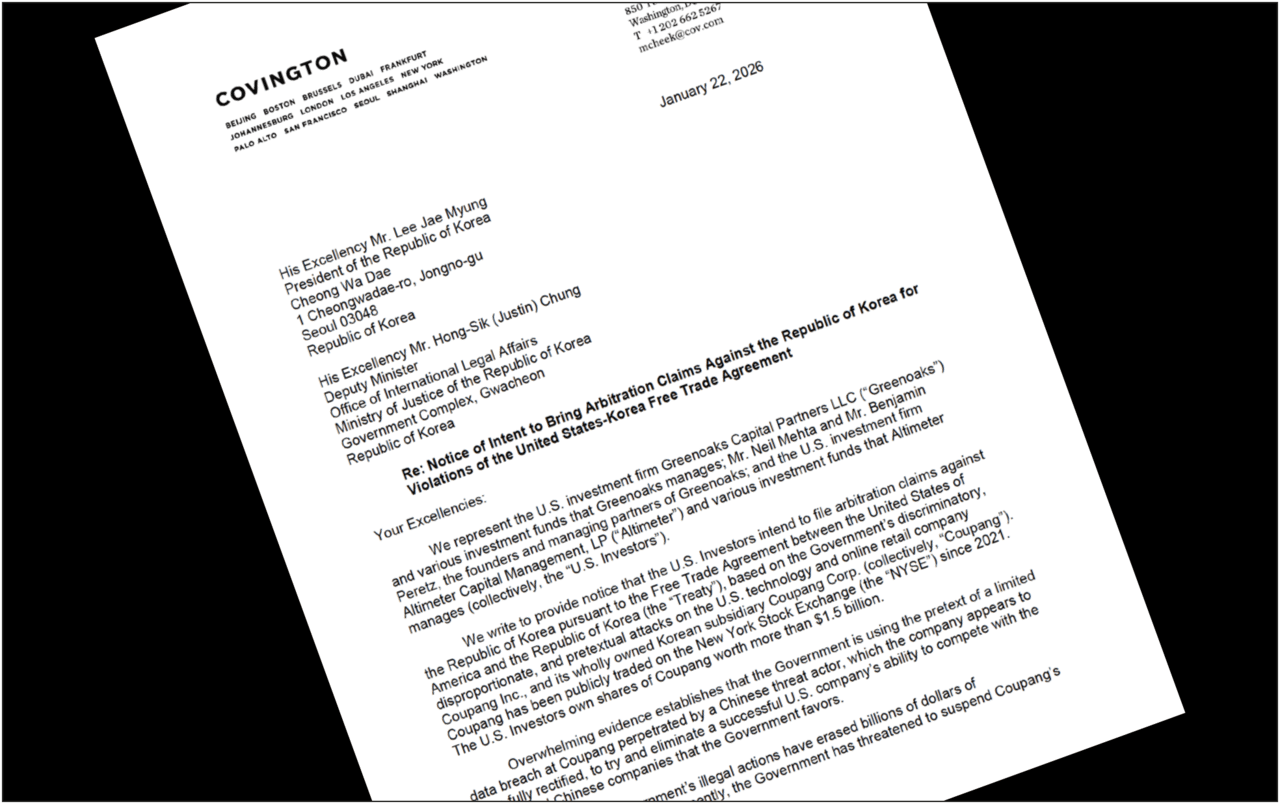
This is the kind of delusional claim one would expect from anti-constitutional extremists or conspiracy theory YouTubers—factually incorrect from the ground up. And yet, these words appear verbatim in a formal international legal document. They are written plainly in a Notice of Intent to Arbitrate under ISDS (Investor-State Dispute Settlement), sent on January 22 by U.S. shareholders of Coupang to President Lee Jae-myung.
ISDS is an arbitration mechanism through which foreign investors can demand compensation from a host state if they believe government actions have unfairly harmed their investments. A notice of intent is effectively a warning: accept our demands, or face massive damages through arbitration. If negotiations fail within a set period after such notice, full arbitration proceedings begin.
Coupang Korea, which operates logistics and e-commerce services in South Korea, is a wholly owned subsidiary of Coupang Inc., a corporation registered in Delaware. Most of Coupang Inc.’s revenue ultimately originates from Coupang Korea—that is, from Korean consumers (see SisaIN No. 958, “100% Authority, 0% Responsibility: The Strange Circuit of Immunity”). Coupang Inc. is listed on the New York Stock Exchange, and its share price rises and falls with the operating performance of Coupang Korea.
Following a massive personal data breach at Coupang Korea, the South Korean government launched intensive investigations spanning data protection, taxation, and fair-trade compliance. The parties that sent the notice of intent—Greenoaks and Altimeter—are investment firms and shareholders of Coupang Inc. They claim that government investigations caused Coupang Inc.’s stock price to fall by roughly 30% compared to late last year, inflicting enormous investment losses. Their demand is simple: South Korea should pay for those losses.
Neil Mehta, head of Greenoaks, is a member of Coupang Inc.’s board of directors. He already realized trillions of won in profit by selling most of his nearly 20% stake at the time of Coupang’s IPO. Now, he seeks compensation because the remaining shares—roughly 3%—have declined in value. Altimeter’s founder, Brad Gerstner, is a powerful hedge-fund figure in Silicon Valley, known as a fierce opponent of tech regulation and a frequent combatant against the U.S. government itself. In their notice, the claimants describe the Korean government’s investigation as an “unprecedented assault” and “harassment.”
Is it not normal for a government to investigate a corporation that has caused social harm? At this point, the claimants introduce a bizarre argument. In their view, the true reason the Korean government is “harassing” Coupang is ideological: the Lee Jae-myung administration and the ruling Democratic Party are “anti-American and pro-China.” Their legal representative is Covington & Burling, a top-tier U.S. law firm.
The Delusion of Chinese Domination
A notice of intent is typically a dry legal document listing alleged violations, factual claims, and damages. Yet the Greenoaks–Altimeter notice overflows with hostility and speculation. It reads less like a legal filing than a piece of political propaganda.
The claimants designated President Lee Jae-myung himself as the recipient—naming South Korea’s head of state as a direct party to a legal dispute. This appears less a legal necessity than a deliberate political provocation.
From the opening lines, the intent is explicit:
“President Lee Jae-myung explicitly stated that Coupang should be punished so harshly that it fears collapse.”
This refers to remarks Lee made on December 12 during a briefing from the Personal Information Protection Commission:
“Because economic sanctions are weak, violations are repeated. Strong penalties are needed—so strong that companies violating rules and harming the public fear they might go bankrupt.”
Lee has long advocated punitive damages—arguing that the cost of violating rules must far exceed the gains—from his days as mayor of Seongnam and governor of Gyeonggi Province. His targets were overwhelmingly Korean corporations. The claim that Coupang is being discriminated against because it is “American” is nonsensical.
Nevertheless, the notice relentlessly insists that Coupang is under investigation because President Lee is anti-American and pro-China. It claims Lee repeatedly made hostile remarks toward the U.S., and Coupang in particular, during his presidential campaign—allegedly raising concerns even among his supporters that South Korea’s orientation might shift from the U.S. to China.
The notice further alleges bias by pointing to appointments of former Naver executives—Han Sung-sook (SMEs Minister), Choi Hwi-young (Culture Minister), and Ha Jung-woo (Senior Secretary for AI Strategy)—arguing that Lee is ideologically anti-American and pragmatically seeking to suppress Coupang in favor of Naver. According to the claimants, when a massive personal data leak involving a Chinese employee occurred, “President Lee seized his opportunity.”
What, then, is the government’s true objective? According to the notice: to destroy Coupang. The claimants assert that Korea’s logistics market was dominated by domestic firms and Chinese firms closely aligned with Lee and the Democratic Party—until Coupang, an American company, entered and gained share. Once Coupang threatened this “historical dominance,” the Lee government allegedly “weaponized the administrative power of the state” to dismantle Coupang.
This is a mash-up of heroic myth and conspiracy theory. In reality, when Coupang grew, the Korean market was dominated not by China but by Korean firms such as E-Mart and Lotte. The claimants invent a fictitious era of Chinese dominance to justify their narrative.
The rhetoric peaks when the notice labels Korea’s investigation an “Orwellian” act—likening law enforcement to the surveillance state of 1984. Korea is portrayed as a totalitarian dictatorship, Coupang as a freedom fighter resisting tyranny. The claimants even assert that such actions could only happen in Venezuela or Russia—not in a democratic ally like South Korea.
Without evidence, they brand South Korea’s president and ruling party as “agents of Chinese capital,” reducing institutions like the National Tax Service and Fair Trade Commission to mere tools of a pro-China agenda.
Why This Narrative Exists
The logic behind this framing is strategic. For U.S. investors to bring ISDS claims, they must rely on the Korea–U.S. Free Trade Agreement. While effectively hollowed out by unilateral U.S. tariffs and investment pressure under the Trump administration, the FTA remains formally in force.
Cruciallys, Chapter 11 includes a crucial exemption:
Investigating data breaches, labor abuse, and tax evasion clearly qualifies as legitimate public policy. To bypass this exemption, the claimants must argue that the investigations were not for public welfare but motivated by political malice—namely, the expulsion of American firms.
This is why the notice repeatedly insists the Korean government is acting to favor Korean and Chinese logistics companies over Coupang.
The Real Objective: Stripping Digital Sovereignty
On January 27, The Wall Street Journal reported that Vice President J.D. Vance warned Prime Minister Kim Min-seok not to punish U.S. tech companies such as Coupang. The article described Coupang as a “U.S.-based e-commerce company operating almost entirely in Korea,” with “powerful allies in the Trump administration and Congress.”
Three days later, President Trump threatened to raise tariffs on Korean autos and pharmaceuticals from 15% to 25%. Reuters reported that Korean regulatory actions against Coupang may have “prompted” Trump.
The United States is applying comprehensive pressure on Korea using Coupang as leverage. The real goal appears to be neutralizing Korea’s authority to regulate platform industries. A White House fact sheet from last November explicitly demands that Korea ensure U.S. firms face no “unnecessary barriers” in digital regulation, network usage fees, data localization, or personal data transfers.
This amounts to a demand for extraterritorial immunity for U.S. tech giants—Google, Meta, Netflix, and Coupang—at the expense of Korea’s digital sovereignty.
What we are witnessing is a direct confrontation: Korea’s digital sovereignty versus U.S. platform capital. Coupang is merely one battlefield in a much larger war.
Posted by Freewhale98
1 Comment
1. Summary
U.S. investors in Coupang have accused South Korea’s government of politically motivated, anti-American bias in an ISDS arbitration threat, portraying President Lee Jae-myung as “pro-China” to justify compensation claims for stock losses. The article contends this narrative is a deliberate distortion designed to evade FTA safeguards that protect public-interest regulation and to pressure Korea into loosening oversight of U.S. tech platforms, making Coupang a test case in a broader struggle over digital sovereignty.
2. How is this related to the sub
(1) Trade coercion & digital sovereignty: Trunp’s Tariff War against Korea should be understood as a coordinated invasion by US tech bro oligarchs to strip Korea of its digital soverignity. They want to extraterritorial immunity for US Big Tech.
3. My opinion
This article clearly indicates Trump’s Tariff War is highly organized and calibrated invasion plan to strip of other nations of its economic sovereignty. This is a well-planned assault for gobal colonization with digital platfrom by the American tech oligarchs. So-called “China threats” are used as a cover and pretext for an American invasion.