
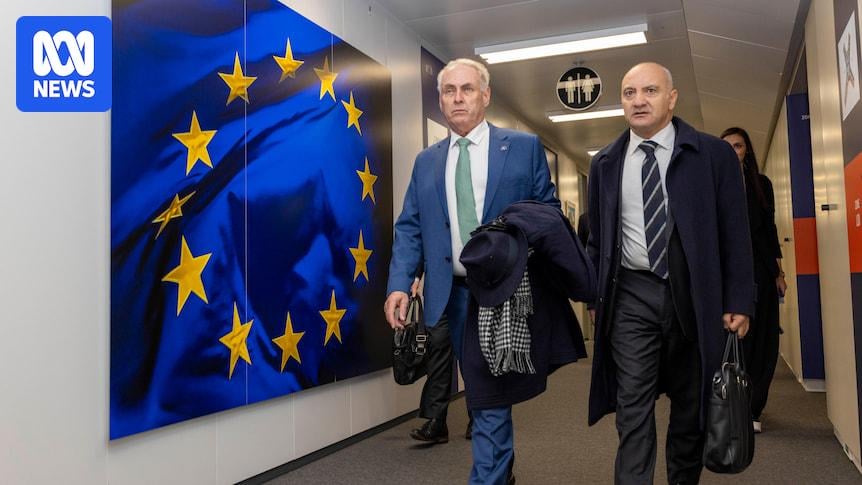
Talks have long been stalled after collapsing spectacularly in 2023, and Trade Minister Don Farrell has been adamant Australia will not sign a deal unless the EU agrees to tear down tariff barriers to larger quantities of agricultural exports such as beef and lamb.
Both sides have also been negotiating over working rights and labour mobility, Australia's luxury car tax, and the use of geographical indicators that could stop Australian producers using labels such as "fetta" and "prosecco".
Earlier this week Senator Farrell flew to Brussels for talks with EU Trade Commissioner Maroš Šefčovič and Agriculture Commissioner Christophe Hansen, as both sides try to break the deadlock and strike a blow for free trade in the face of global economic fragmentation and the Trump administration's tariff assault.
Sources from the EU and Australia said the deal was now close.
Mr Albanese and Ms von de Leyen now have to resolve one outstanding issue — believed to be connected to red meat exports — before the deal can officially be signed.
But farmers' groups in Australia have been fiercely critical of Europe's generous agricultural subsidies, and have urged the federal government to reject any deal that does not provide "significantly increased access" for Australian agricultural exports.
The European Union and member states are also likely to face political pressure from European farmers, with one prominent lobbying group warning earlier this week that the pact should not "expose EU farmers to intensified competition in already fragile markets".
Senator Farrell said he was confident both sides would "reach agreement that benefits both of our economies".
Ms von der Leyen is widely expected to travel to Australia to sign the free trade deal and the security partnership, but it is not yet clear exactly when she will make the trip.
Posted by -Maestral-
4 Comments
It’s always farmers
Submission statement: Free trade is integral component of liberal worldview and pillar underpining progress in material wellbeing of humanity.
From the EU side this is a 2nd FTA that will involve agriculture in some scope, with some trade liberalisation and proposals to cut funding for agriculture in EU budget, the question is how will that impact the sector and rural politics in the EU?
On Australian side the question remains how popular will this FTA be? How comprehensive is it? Does adopting EUs agricultural nomenclature benefit Australia? Should Australia have pushed for higher quotas at the risk of not getting the deal?
>Mr Albanese and Ms von de Leyen now have to resolve one outstanding issue — believed to be connected to red meat exports — before the deal can officially be signed.
Ah, so just the most controversial issue that also caused the collapse in 2023.
once again, farmoids watering this down into a disappointment