
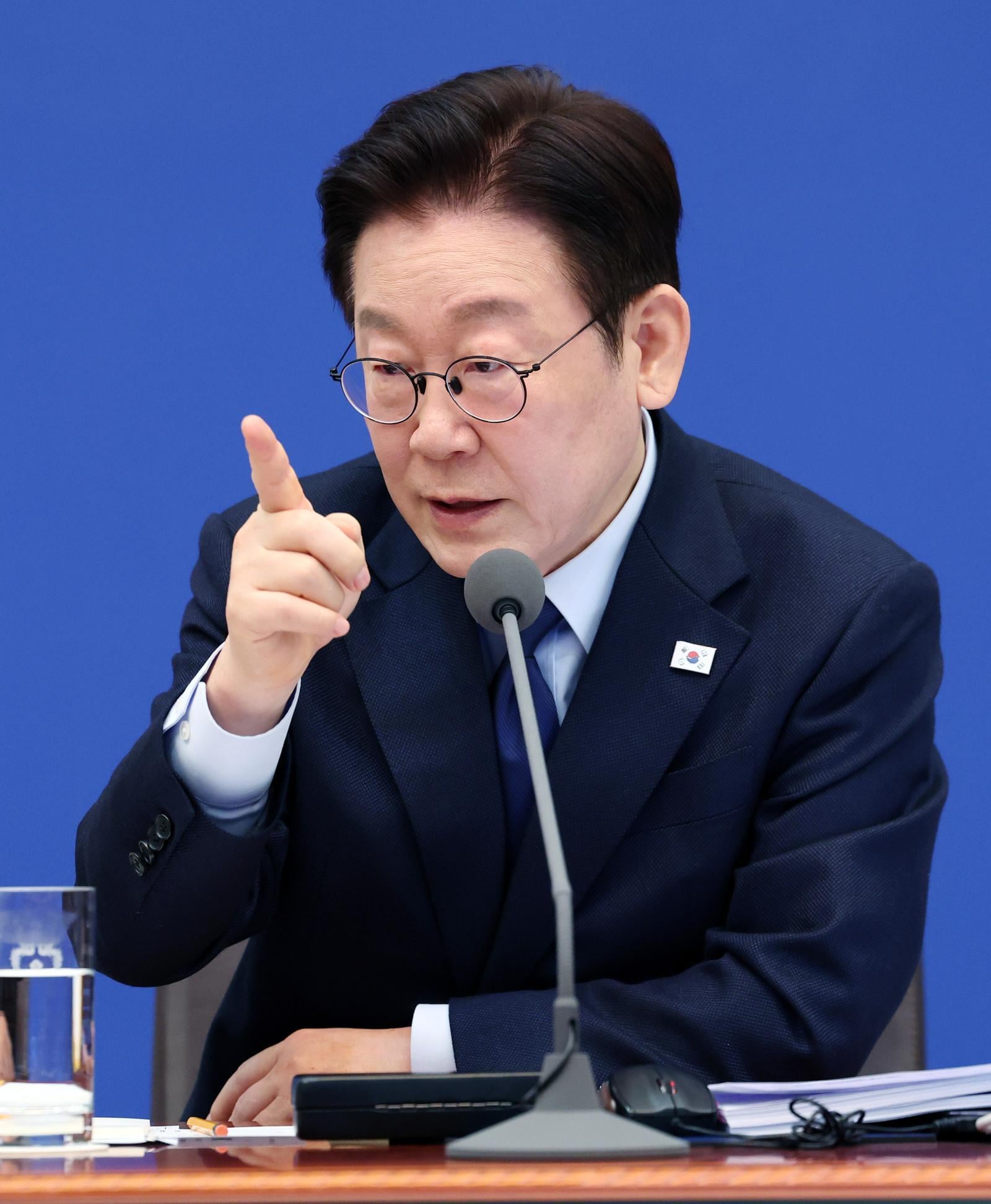
“If multi-homeowners endure and succeed by refusing to take advantage of this favorable capital gains tax reduction opportunity, that would mean this government’s real estate policy, aimed at curbing ruinous property speculation, has failed.”
President Lee Jae-myung emphasized this point on social media (SNS) on the 13th, writing, “We cannot allow the country to continue down a path toward a lost 30 years.” He defined the “holding out” of multi-homeowners as a failure of his administration’s real estate policy. Ahead of the Lunar New Year holiday, he underscored an all-out effort to stabilize the housing market through comprehensive regulations targeting multi-homeowners. A presidential office official stated, “The President once again stressed his determination to do everything possible to normalize the real estate market.”
On SNS, President Lee wrote, “To those who still think holding out will solve the problem,” adding, “Those who follow the rules and respect social order must not suffer disadvantages compared to those who seek unjust gains by breaking the rules.”
He continued, “Korea is now moving toward a normal society where common sense and order are restored,” and stated, “The essence of a normal society is one where law-abiding, decent citizens do not suffer losses, and those who break the rules cannot profit. In a democratic society, fairness is the driving force of growth and development.”
The presidential office also announced that day, “There is a need to examine and improve the practice of routinely extending loans to multi-homeowners,” adding that the government will begin assessing the status of such loans in cooperation with financial institutions and promptly review areas that require improvement.
President Lee posted an additional message directed at multi-homeowners, asking, “Still haven’t made up your mind?” He continued, “Then answer this question: Is the market normal right now? Is this government being unfair?” Along with the message, he shared an article stating that 15% of registered rental business apartments in Seoul are concentrated in the three Gangnam districts (Gangnam, Seocho, and Songpa).
Since the 23rd of last month, President Lee has posted 21 messages on SNS regarding real estate policy — roughly one per day.
Most of his messages have specifically targeted multi-homeowners. In his first SNS message on the 23rd of last month, he stated that he was not considering extending the exemption from heavy capital gains taxation for multi-homeowners, emphasizing the scheduled end on May 9 of the temporary suspension of additional capital gains taxes. After the government announced plans to reimpose heavy capital gains taxes along with supplementary measures, he posted on the 8th of this month that “It is strange that one can buy as many houses as they want simply by registering as a rental business operator,” again targeting rental business owners who hold multiple properties. Amid criticism that permanent capital gains tax exemptions — even after rental registrations are revoked — may encourage “holding out,” he proposed introducing a sunset clause that would eliminate such tax benefits after a certain period.
President Lee also raised the issue of loan extensions for multi-homeowners, calling for stricter lending regulations. This marks an escalation in pressure, moving from tax policy to financial regulation. Presidential spokesperson Kim Nam-jun stated in a broadcast that day, “You really need to calculate this very carefully. I can say with certainty: selling now would be more profitable.”
Within the presidential office, some analysts interpret the President’s series of SNS messages ahead of the Lunar New Year as an effort to make real estate a major topic of holiday discussion. One official explained, “By publicizing the issue of high housing prices in Seoul, the aim is to encourage multi-homeowners to put their properties on the market.”
With 110 days remaining until the June 3 local elections, the government’s active response to the real estate issue — a key variable in public sentiment in Seoul and the metropolitan area — is seen as politically significant. On the 6th, during a visit to Changwon in South Gyeongsang Province, President Lee remarked, “In Seoul, apartments reportedly cost 300 million won per pyeong — does that make sense? Here, that’s the price of an entire apartment.” He added, “Some say the price of one apartment in Seoul could buy an entire apartment building in another region.” He linked soaring Seoul apartment prices to the need for addressing regional concentration and proposed discussing a “5 regions (capital area, Southeast region, Daegu–Gyeongbuk region, central region, Honam region) and 3 special regions (Jeju, North Jeolla, Gangwon)” development framework.
Posted by Freewhale98
1 Comment
1. Summary
Korean President Lee Jae-myung is pushing for heavy taxation on real estate and ban on mortgage loan extensions for home hoarders to bring housing price down. He blames housing crisis caused by real estate speculation for all the socioeconomic ills of Korean society and promises to crush home hoarders.
2. How is related to the sub
(1) Housing crisis: Korean government is taking policy aim to encourage multi-home owners to sell off their spare homes.
3. My opinion
Lee’s housing policy should be understood as combined assaults on housing hoarders. Increase the supply of new public housing while crushing home hoarders so that new housings can distribute more evenly. The ultimate aim of this war on real estate speculation is to bring the money wasted in real estate speculation back to stock markets where capital can be utilized more efficiently.
Would this policy helpful in solving housing? Not sure….we have to see how this unfolds first. The supply policy rely on overcoming NIMBY movement led by Oh Se-huen, the Metropolitan Mayor of Seoul. The financial crackdown on multi-homeowners have potential to destabilize housing rents if that supply policy doesn’t arrive in-time.