
Article link: https://www.thebulwark.com/p/the-trump-affordability-pivot-that-never-came-state-of-the-union-inflation-housing-stock-market
In his record-breakingly-long SOTU, the president spent more time talking about Venezuela than prices.
THERE’S AN OLD JOKE ABOUT two elderly ladies kvetching about a meal. “Oy, the food at this place is really terrible,” one complains. The other responds, “And such small portions!”
The same could be said of President Trump’s affordability comments at last night’s State of the Union, which were both brief and abysmal.
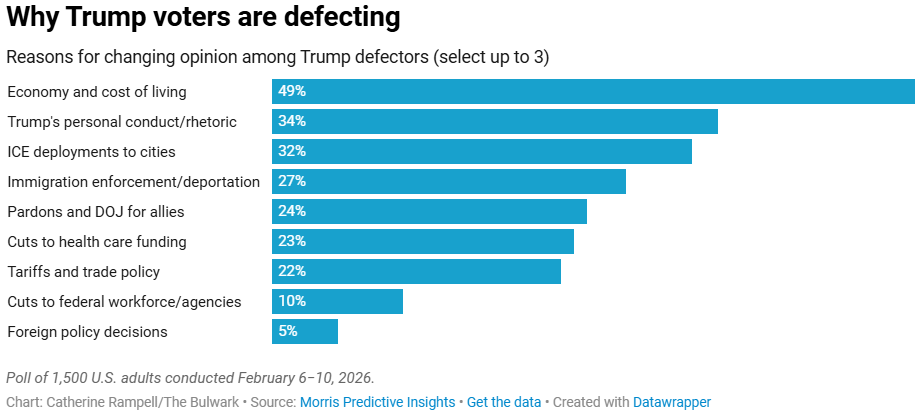
Affordability is the issue for the 2026 midterms. In virtually every poll, with virtually every demographic, some version of “inflation/prices/cost of living/economic problems” tops the list of the most important challenges facing the country. It also tops the list of reasons Trump’s own voters are ditching him, according to polling from Morris Predictive Insights.
And yet, according to the time-keepers from NBC News, in Trump’s record-long 108-minute SOTU speech, he spoke about affordability for a measly 2.9 minutes.
For context, that’s just a few seconds longer than the time he spent celebrating the country’s Olympic achievements (2.2 minutes), and about half the time he spent talking about Venezuela (4.8 minutes). Even if you add in time he spent on the broader economy and taxes, this total (7.1 minutes) is still less than the amount of time he spent talking about national security (8.5 minutes).1
If Republican lawmakers were hoping Trump would spend his ample time on the things their voters care about, they must have been disappointed.
When he did touch on affordability, Trump questioned the very notion that it was a legitimate issue at all. He claimed that “affordability” problems were either created or imagined by Democrats, and naturally, that they have all been solved since he took office:
Now, the same people in this chamber who voted for those disasters suddenly used the word “affordability.” . . . they just used it because somebody gave it to them, knowing full well that they caused and created the increased prices that all of our citizens had to endure. You caused that problem. You caused that problem.
They knew their statements were a lie. They knew it. They knew their statements were a dirty, rotten lie. Their policies created the high prices. Our policies are rapidly ending them. We are doing really well. Those prices are plummeting downward.
This message does not seem to be resonating with voters, most of whom say Trump is making prices and inflation sound like they’re in better shape than they really are.2 And they’re right: Notwithstanding Trump’s claims, prices are not “plummeting downward.”3 Prices are very much still rising—and rising faster than the Federal Reserve’s target of 2 percent. And there’s evidence that Trump’s tariff policies are contributing to that above-target inflation. For example, prices of appliances, furniture, and new cars, all products targeted by Trump tariffs, grew sharply from December to January.
Not to worry. Trump promised that his tariff revenue would be used to defray other American expenses—specifically, that it would “substantially replace” income taxes. This is a mathematical impossibility.
Tariff revenue certainly grew under Trump, totaling $264 billion in calendar year 2025 (more than triple the amount collected in 2024, by the prior administration). Meanwhile, the personal income tax brought in roughly $2.7 trillion in calendar year 2025. Trump can jack up tariff rates as much as he likes, but at some point he’s going to wind up on the wrong side of the Laffer Curve—that is, we’ll reach a tax rate that makes products so expensive that people stop spending, and tariff revenue declines. Given these limitations, one recent paper estimated that the most revenue that could possibly be wrung out of tariffs was in the ballpark of $400 billion to $500 billion, or less than a fifth of the revenue from income taxes.
That wasn’t the only time in the speech that Trump characterized the economic pain he inflicted on the country as a victory. He said he “lifted 2.4 million Americans, a record, off of food stamps.” These people weren’t lifted up so much as kicked off: The figure of 2.4 million is the Congressional Budget Office’s estimate for how many people will lose food assistance in the average month because of Trump’s One Big Beautiful Bill.
Other figures appeared completely made up,4 such as his claims about gas prices. Gas prices have indeed fallen, but the president claimed they were “below $2.30 a gallon in most states.” It’s unclear where he got that figure; data from places like AAA and GasBuddy don’t show gasoline prices averaging below that level in any state.
Trump also offered his standard talking point about the booming stock market, but as I’ve noted before, markets have actually grown a lot more in the rest of the world than they have here. Not to mention that paper stock market gains are cold comfort to people struggling to put food on the table.
To the extent he acknowledged there was any further work to be done on affordability, he rehashed the same promises and ideas he’s repeated before—all of which either wouldn’t help Americans afford the things they need to buy, or would make it more difficult.
One example is his promise to block “institutional investors” from buying single-family homes. As I wrote last week, this idea has purchase (so to speak) among some Democrats as well, but it will not reduce housing costs. Institutional investors, usually defined as landlords with at least 1,000 homes in their portfolio, represent less than 1 percent of all single-family housing stock, and have been selling their holdings on net for most of the past two years. Tellingly, construction- and homebuilder-related stocks took a beating the day after the speech, in part because Trump didn’t even pretend to care about building more housing supply.
There was also a shoutout to Trump’s “Great Health Care Plan,” which he said would “stop all payments to big insurance companies and instead give that money directly to the people so they can buy their own health care, which will be better health care at a much lower cost.” As my colleague Jonathon Cohn has explained, that is bunk. Trump likewise claimed that he’s gotten Americans the lowest drug prices anywhere in the world; this, too, is bunk.
Trump also proposed a nonbinding “ratepayer protection pledge,” in which big tech companies agree to foot the bill for powering their own data centers. Seems like a sensible idea, if it ever gets any teeth, but at least as described, it wouldn’t bring prices down, despite Trump’s claims. At best, it would lessen further price increases.
Finally, while previews of the speech had promised “a new form of corporate and personal tax cuts,” the only “new” tax cut proposal was a retirement tax incentive. Specifically, Trump promised to give workers without 401(k) plans “access to the same type of retirement plan offered to every federal worker.” He said the government would “match your contribution with up to $1,000 each year, as we ensure that all Americans can profit from a rising stock market.”
This actually sounds promising! But it already exists.
The program is known as SECURE 2.0, and it was signed into law by then-President Joe Biden in 2022. Trump wants to “tweak” the program in as-yet-unspecified ways, per Bloomberg correspondent Josh Wingrove.
That’s a lot of hokum Trump managed to cram into a small sliver of his speech. But given the fare on offer, maybe Republicans in the audience should be grateful he didn’t provide more material. The portion size in this case was . . . just enough.
Ramparts
— Also in the speech, Trump said Vice President J.D. Vance would be in charge of a new “war on fraud.” Psst: The call is coming from inside the White House.
— A couple months back I wrote about how the construction industry was curiously silent as Trump’s immigration-enforcement goons rounded up their workers (even those who are U.S. citizens) and busted into construction sites without a warrant. The tide may be turning on that; there have been a few stories of late about homebuilder complaints, although most seem to quote the same handful of voices. One of those voices, the executive director of the South Texas Builders Association, appeared recently on my MS NOW show. I asked him why the only lawsuit over these issues seems to be one filed by a U.S.-citizen construction worker, rather than the builders, particularly when the government argues that only the construction companies have standing to sue. Watch his answer here.
— This horrifying story reminds me of attics in Amsterdam.
— Some good news on energy: U.S. power plant developers and operators plan to add 86 GW of new utility-scale electric generating capacity to the U.S. grid in 2026. This would be a record. Solar power makes up 51 percent of the planned 2026 capacity additions, followed by battery storage at 28 percent and wind at 14 percent.
Posted by IHateTrains123
1 Comment
Epstein is included in the second category?