
After more than a decade of plodding progress, Canada has officially hit the NATO spending target of two per cent of GDP set during the Wales Summit of 2014.
According to data in the NATO Secretary-General’s annual report released this morning, Canada spent more than $60 billion on defence in 2025 – an amount that adds up to two per cent of the country’s gross domestic product.
Prime Minister Mark Carney says that amount is the highest level of defence spending relative to the size of the Canadian economy since the fall of the Berlin Wall.
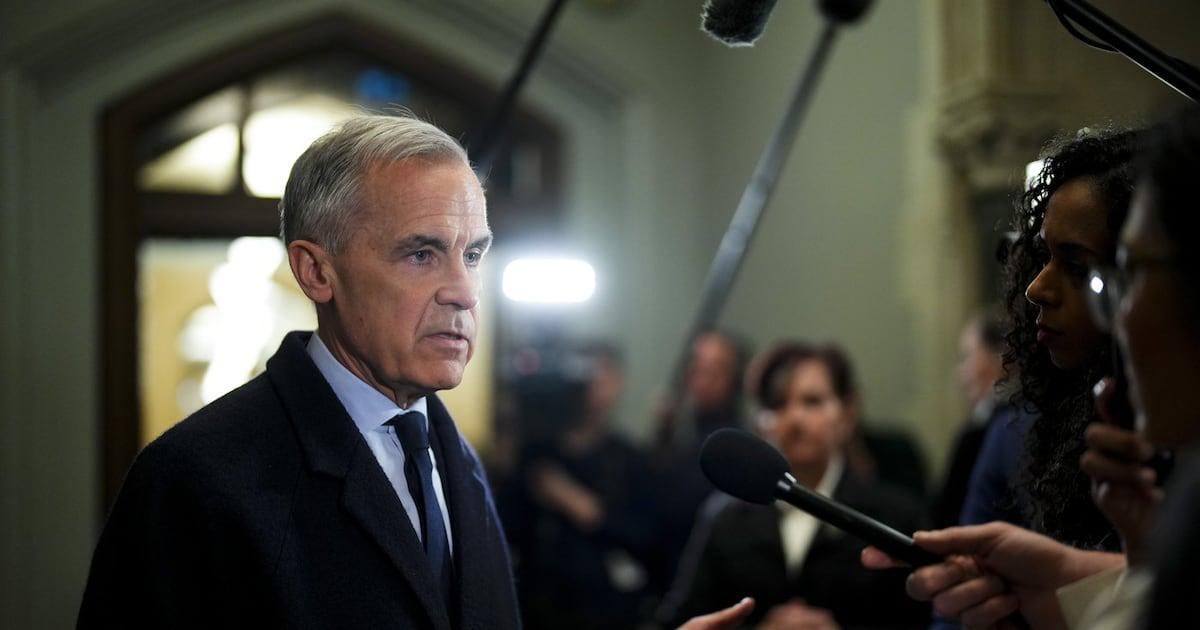
“We embarked on this mission to defend Canadians, to defend our territory and to protect our borders, and to boost our sovereignty, because we control our destiny,” Carney said at CFB Halifax on Thursday where he made the announcement.
The NATO milestone was reached at least five years ahead of the plans of his predecessor Justin Trudeau.
“For the last 10 months, Canada’s new government has been working with unprecedent speed and scale. In 10 months, we have invested more than $60 billion in our defence and security. That’s the largest year-on-year increase in defence investment in generations,” Carney said.
The end of the federal government’s fiscal year is March 31 but spending estimates were submitted to NATO earlier.
In 2024, Canada was spending 1.47 per cent of GDP on defence. According to NATO data, it was one of 11 member nations that did not meet the target.
This year’s report shows that all 32 alliance members have met the guideline set in Wales.
“For too long European allies and Canada were too reliant on U.S. military might. We did not take enough responsibility for our own security but there has been a real shift in mindset,” NATO Secretary-General Mark Rutte said in his opening remarks.
Rutte continued to credit U.S. President Donald Trump for pushing countries such as Spain, Italy, Belgium and Canada toward the two per cent target and for motivating the alliance to pledge to reach five per cent by 2035.
Trump effect
Trump’s bellicose diplomacy toward NATO was first seen in 2018 when he threatened to pull the U.S. out of the alliance multiple times if partners did not make their commitments. At that time only seven NATO members were contributing two per cent.
Then in 2024, during his second presidential campaign, Trump suggested America would not defend NATO members if he deemed their military investments insufficient.
Amid Trump’s launch of a trade war and persistent threats to annex Canada, Carney set the goal of reaching the two per cent target by the end of fiscal 2025, by announcing a plan to “rebuild, rearm and reinvest” in the Canadian Armed Forces.
In June, Carney announced that the government would spend an additional $9.3 billion on defence to meet its NATO pledge.
Two-billion dollars went toward pay raises for Canadian Armed Forces personnel, while the rest of the money went toward buying new equipment such as aircraft, armoured vehicles, ammunition, and drone and communication technology. Money was also set aside to improve housing on military bases and repair existing ships and aircraft.
To speed up the procurement process, the Carney government created the Defence Investment Agency which would be responsible for assessing bids valued at $100 million or more.
The government also released a new defence industrial strategy, which aims to reduce reliance on the United States by building up domestic capacity to build weapons and transform Canada from a buyer to an exporter of advanced military technology.
‘Riding on America’s coattails’
Carney’s plan is in stark contrast to his predecessor.
Former prime minister Justin Trudeau had previously said that the country would be on track to meet its NATO target by 2037, a race that drove criticism of Canada out into the public sphere.
In April 2024, secret Pentagon documents leaked to the Washington Post revealed that Trudeau privately told NATO officials Canada “will never meet the military alliance’s defense-spending target” without a massive shift in public opinion.
Then a month a later, a bipartisan group of 25 U.S. senators sent a letter to Trudeau, pressuring him to come up with a plan to reach two per cent. The target was no longer considered a ceiling, but a baseline commitment.
The senators wrote that “Canada will fail to meet its obligations to the Alliance, to the detriment of all NATO Allies and the free world, without immediate and meaningful action to increase defence spending.”
Then on the sidelines of the 75th annual NATO summit later that summer, U.S. House Speaker Mike Johnson called Canada “shameful” for not hitting the two per cent mark and accused it of “riding on America’s coattails.”
Effective military ally?
While criticism of defense spending may have peaked under Trudeau, it began during Conservative Prime Minister Stephen Harper’s tenure.
NATO first set the two per cent GDP spending goal at the 2014 summit. Other leaders pledged to reaching the target within 10 years, but Harper was noncommittal.
“I’m not certainly going to spend on a massive military expansion just for the sake of doing so … but our allies are assured that Canada will spend what is necessary – obviously to protect ourselves,” Harper said.
NATO calculations show that in 2014, Canada spent one per cent of its GDP, or $20 billion annually, on the military.
Now 12 years later, spending has more than tripled.
Carney, along with other members of the alliance, has pledged to reach the new NATO target of five per cent of GDP spending by 2035. Achieving that goal would cost Canadian taxpayers about $150 billion annually.
According to defence analysts, much more rebuilding is needed before Canada can be seen as an effective military ally on the world stage.
“We came under way more scrutiny and faced more reputational consequences with our allies than official Ottawa was willing to admit for many years,” says David Perry, president and CEO of the Canadian Global Affairs Institute.
Perry says earlier reluctance to fund the military has resulted in a lack of readiness. Despite an uptick in recruiting, Perry says there is a still a shortage of trained soldiers who are combat ready.
Then there’s the equipment issue.
“Whether [it’s] airplanes, army vehicles, or boats, we have a military where only one of piece of equipment out of two can be deployable.”
For example, Trump’s demand that NATO allies help with unblocking the Strait of Hormuz is a mission Canada would be hard-pressed to assist.
“What could we contribute? We may not be able to send a frigate. The few number that are deployable have already been assigned (elsewhere),” Perry said.
Posted by IHateTrains123