
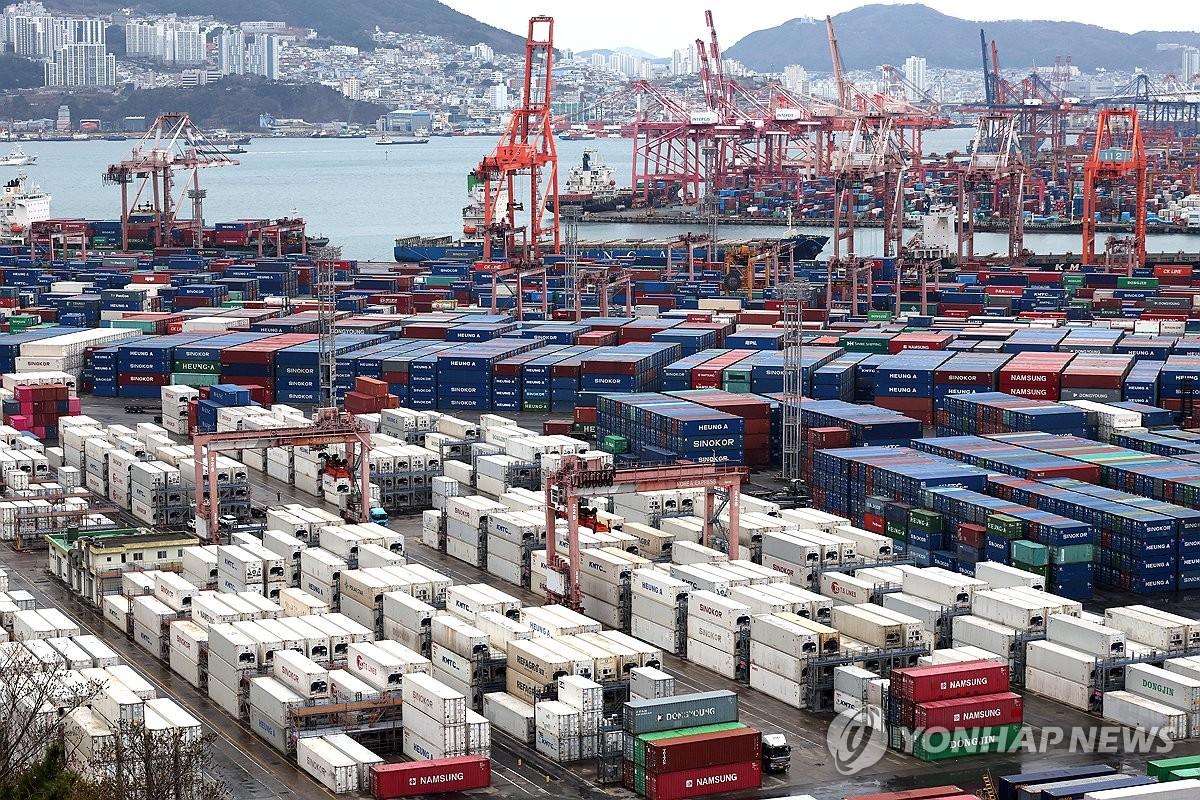
South Korea’s exports soared nearly 50 percent to a record high in March, driven by robust demand for semiconductors.
According to data released by the Ministry of Trade, Industry, and Resources on Wednesday, the country’s outbound shipments reached $86.13 billion in March, up 48.3 percent from the same period a year ago. This marks the highest monthly export figure ever.
The March figure far surpassed the previous record of $69.5 billion set in December last year, effectively propelling exports straight into the $80 billion milestone without passing through the $70 billion range.
Monthly exports have continued their record-breaking streak for 10 consecutive months since turning to year-on-year growth in June last year.
Semiconductor exports jumped 151.4 percent to $32.83 billion in March, marking the first time the category exceeded $30 billion in a single month.
While memory prices remained high, semiconductor exports surpassed the previous record of $25.1 billion set just a month earlier, driven by a simultaneous surge in investment demand for both artificial intelligence (AI) servers and general-purpose servers.
Automobile exports increased 2.2 percent to $6.37 billion.
Despite some logistical disruptions caused by the war in the Middle East, exports of eco-friendly vehicles—such as electric vehicles (up 32 percent) and hybrid vehicles (up 38 percent)—helped maintain growth.
Amid growing concerns over crude oil supply due to the blockade of the Strait of Hormuz caused by the conflict, petroleum product exports rose 54.9 percent to $5.1 billion.
Although export volumes declined, export value increased sharply as the sharp spike in oil prices significantly drove up unit export prices.
Exports of gasoline, on the other hand, fell 5 percent, diesel 11 percent, and kerosene 12 percent year on year following export control measures introduced on March 13.
Petrochemical exports increased 5.8 percent in March, but weekly export volumes fell by around 20 percent from the fourth week of March, when the impact of the conflict intensified.
Outbound shipments of computers rose 189.2 percent to $3.42 billion, while those of secondary batteries increased 36.0 percent to $870 million.
By destination, exports to China rose 65 percent to $16.5 billion, extending their growth streak to five consecutive months, supported by a rise in shipments of semiconductors — the country’s key export item — alongside strong performance in other sectors such as petrochemicals and wireless communication devices.
Exports to the United States also climbed 47.1 percent to $16.34 billion, driven by sharp increases in semiconductor and computer exports.
Exports to ASEAN went up 34.3 percent to $13.75 billion and the European Union up 19.3 percent to $7.47 billion thanks to robust semiconductor demand, while those to the Middle East fell 49.1 percent to $900 million due to logistical disruptions.
Imports in March rose 13.2 percent to $60.4 billion, resulting in a trade surplus of $25.74 billion, marking 14 consecutive months of surplus.
Energy imports declined 7 percent to $9.37 billion, while non-energy imports increased 17.9 percent to $51.02 billion.
“Despite severe external conditions such as the Middle East war and the spread of protectionism, March exports exceeded $80 billion for the first time, supported by balanced growth in key items such as semiconductors and promising consumer goods,” said Industry Minister Kim Jung-kwan. “As uncertainties surrounding export conditions are increasing due to the prolonged conflict, we will activate a whole-of-government response system and swiftly implement stabilization measures.”
Posted by Korece
1 Comment
Relevance: Korea is a major bellwether of global trade. Its March export data shows global trade, especially in tech, has been resilient despite the Iran War disrupting global energy markets.
Also: Korea may become the fourth country after the US, China, and Germany to hit one trillion dollars in goods exports this year. The economy has been recovering and the stock market booming since last year thanks to an explosion in demand for Korean chips, ships, autos, and weaponry. Its control over high bandwidth memory in particular is becoming an extremely valuable bottleneck that has remained largely unaffected by growing protectionism. I predict countries with specialist chokeholds will win in the new trade environment over generalist producers competing on cost.