
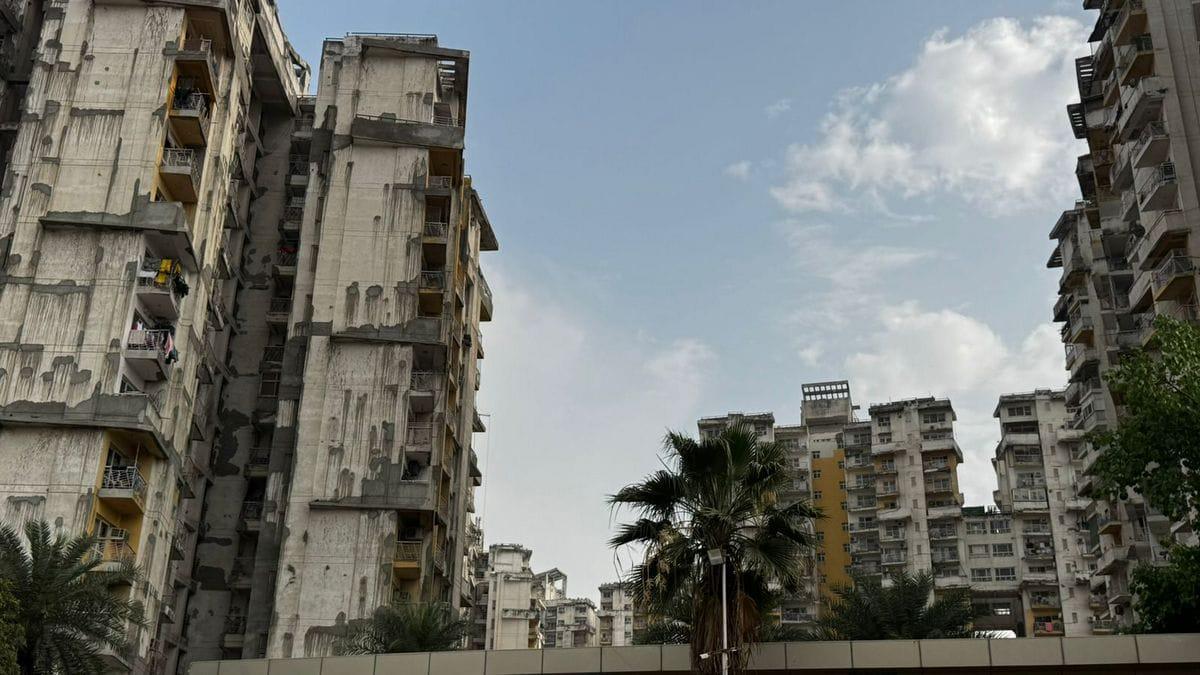
despite its title this is not just about Faridabad this is the tale of two cities, Faridabad and Gurugram. one city in the 70s was a thriving industiral metraopolis the other was a backwater by comparsion and now Gurugram is one of the most developed cities in haryana and north india. So what made Gurugram contiune to improve while Faridabad stagnated.
I think this is an interesting look into indian urbanism why some cities thrive and others struggle. Berucracy, land use investment corruption.
Faridabad and Gurgaon (renamed Gurugram in 2016) were the same district until 1979. And nobody would have bet on Gurgaon. Faridabad had the factories, the railway line to Delhi, fertile land along the Yamuna, and a population that had nearly tripled in the previous decade. Gurgaon was still a rocky hinterland.
Yet over the next decade, Faridabad lost the momentum it had built. A potent mix of political, economic, and institutional factors “conspired to provide tremendous advantages to Gurgaon but not to Faridabad till the mid 2000s,” wrote economists Bibek Debroy and Laveesh Bhandari in a 2009 paper for Stanford’s Center on Democracy, Development, and the Rule of Law.
One was a series of blows to the industries that formed the backbone of Faridabad—a dense web of ancillary factories feeding larger manufacturers. A small-scale industrialist, Pawan Mehtani, who manufactures mop wheels and flap discs, recalls how these units once served companies like Maruti and Hero Honda. A turning point was in 1983, when Maruti set up its first factory in Gurugram. Hero Honda followed over a decade later.
“These manufacturers opened their own ancillary units, and they no longer needed Faridabad,” Mehtani said. “Politicians focused their attention on Gurgaon, and Faridabad was left behind.”
After the Delhi airport corridor opened up, builders like DLF and Unitech followed. Gurugram got a head start for the 21st century with its IT companies and corporate headquarters.
“Gurugram had the first-mover advantage. It was closer to the airport, and when Maruti set up there, things went downhill for Faridabad,” said Virbhan Sharma, president of the IMT Faridabad Industrial Association.
Land was at the bottom of this. In Gurugram, as Debroy and Bhandari note, the political class and private developers like DLF owned large tracts. They had a direct incentive to convert farmland into high-value urban plots. Counterintuitively, Gurugram’s lack of an urban local body in those early decades worked in its favour. With no municipal corporation until 2008, decisions quickly went through the Chief Minister’s office.
Faridabad was the opposite. It already had a municipal corporation, which added layers of bureaucracy and “countervailing checks”. And crucially, the political elite owned little land there.
“Why could Faridabad’s elite, members of a much larger city with a strong manufacturing base, not lobby for greater investments in their city? The answer lies in the differential incentive structure emanating from differential land owning patterns,” noted Debroy and Bhandari. “In Faridabad, those who would have gained the most did not have the wherewithal to push for rapid changes. But in Gurgaon those who owned the land found a willing partner in the political class.”
The rest of the article goes into the struggles the grime the attempts to get things done and the general rot that comes from bad incompetent government.
also ngl big shoutout to Satinder Duggal by all accounts (from this newspaper article) seems like hes doing right. Shows how civic engagement can work.
also occupational liscencing stuff kind of comes up with the struggles of starting up a small buisness.
Posted by ewatta200
1 Comment
**Faridabad**: At the district court in Faridabad, advocate Satinder Duggal carries two files. One is for his cases. The other is an indictment of his city, which stays tucked inside his leather bag until someone mentions Faridabad. Then, almost by habit, he pulls it out, adjusts his spectacles, and begins to list the problems: erratic electricity, broken roads, crumbling infrastructure, unmanaged waste.
[](https://vdo.ai/contact?utm_medium=video&utm_term=theprint.in&utm_source=vdoai_logo)
Faridabad is the poor, neglected cousin of the Delhi-NCR suburban story. In stories of shining growth, Gurugram gets talked about as the millennium city and Noida as the first planned suburb. But Faridabad has failed to capture the imagination. Its tragedy is that it is rarely talked about at all, whether for its success or failure.
“I am a resident of Greater Faridabad. But there is nothing ‘great’ about this region. There is no power substation even today, the sewage treatment plants are dysfunctional, and we are still struggling for basic services,” grimaced Duggal, who has lived here for 12 years and is an executive member of the advocacy group Greater Faridabad Association (GREFA).
The silence finally broke on March 1. Faridabad is in the spotlight now. An anonymous account, u/RakeshK32229480, posted an expletive-laden critique on X calling Faridabad “the most disgusting place on earth”. He wrote he had moved there as an intern and was shocked by the “horror” of collapsing services and a “corrupt and vile” political and administrative leadership. The post hit 2 million views. Others posted their own complaints. RakeshK claimed he received threat calls, but he hasn’t stopped. He now posts daily updates on potholed roads, overflowing drains, garbage, and waterlogging.
“We celebrate UPSC toppers. This is the service babus provides to the general public. In Meethapur Sector 91 road,” read one post. In another, he wrote that he had been called to the police station and asked to tone down his language.
From dinner tables to resident welfare meetings in Faridabad, the account has become a talking point. Its daily posts have lent urgency to long-simmering frustrations, pushing RWAs, waste contractors, activists, and even ward councillors to speak more openly about the city’s slide into decrepitude.
‘Rakesh’ told ThePrint that he comes from a tier-3 town in Uttar Pradesh and was “shocked” by what he found in Faridabad.