
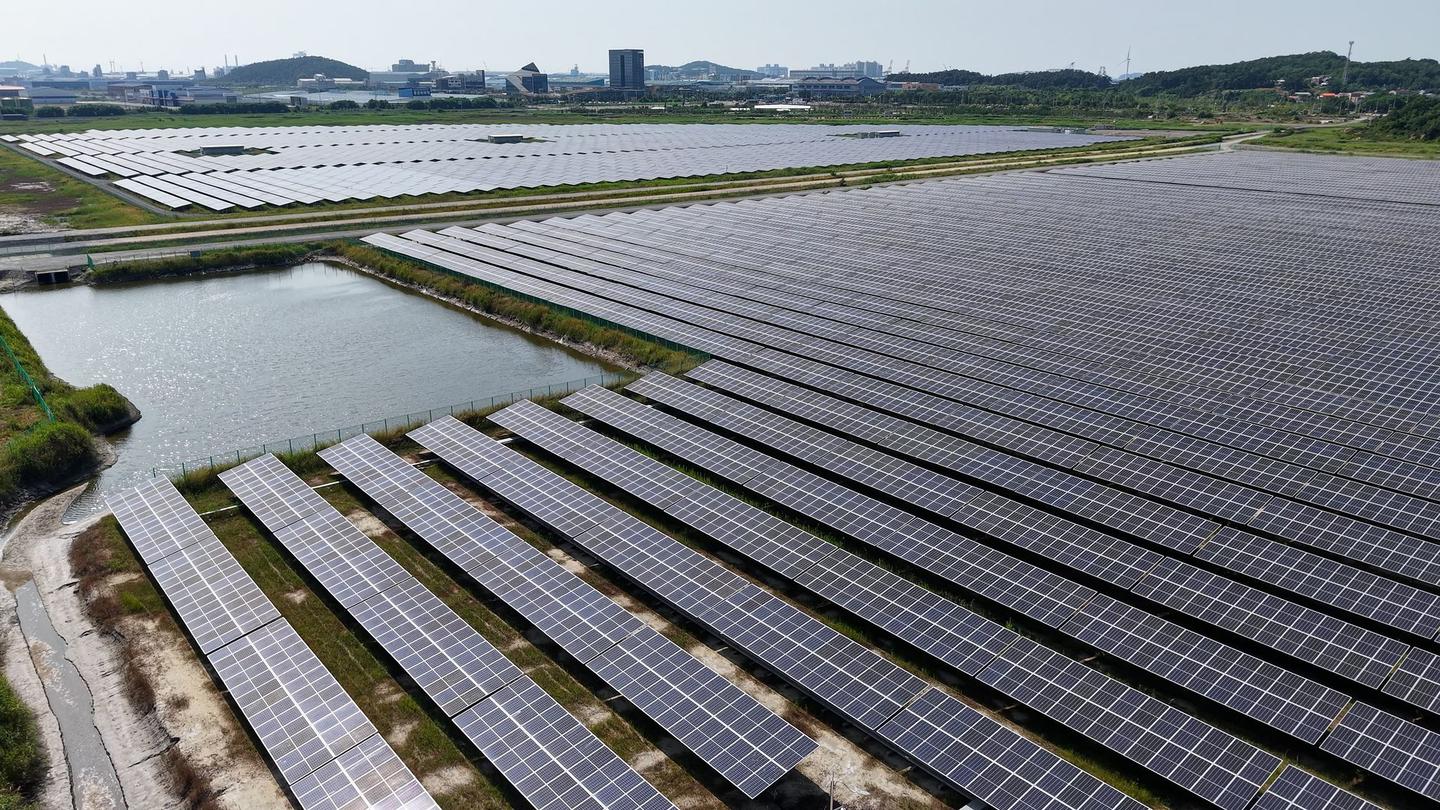
The government [of the Republic of Korea] will move to mandate solar panels on the rooftops of new factories, as part of a broader push to accelerate Korea’s transition to renewable energy, officials said Monday.
The plan, presented to the Cabinet by the Ministry of Climate, Energy and Environment, comes as President Lee Jae Myung frames the Middle East crisis as a turning point for Korea’s energy strategy.
“We must move faster, recognizing that transforming our energy grid could determine the nation’s fate,” Lee said.
At the core of the government’s vision is a rapid expansion of renewable energy. It aims to reach 100 gigawatts in installed capacity ahead of its original 2030 target. With current capacity at about 37 gigawatts, that would require nearly tripling output within four years.
To get there, policymakers are betting on solar power, which can be deployed relatively quickly. Alongside rooftop mandates for new industrial complexes and large factories, the government plans to expand agro-photovoltaic systems on farmland and floating solar installations on reservoirs.
The plan also seeks to broaden public buy-in by sharing profits with local communities. Under a proposed model, residents would receive a share of project revenues and be allowed to invest in transmission infrastructure. Officials estimate that about 10 million people could benefit from such income streams.
Lee argued that idle farmland could generate higher returns through solar projects than traditional agriculture.
Still, questions remain about whether the targets are achievable. Meeting them would require adding 56 gigawatts of solar capacity over the next four years, or more than 14 gigawatts annually. Last year, only 3.9 gigawatts were added, according to the Korea Energy Agency — which means capacity increases would need to triple.
Grid constraints pose another major hurdle. Even if capacity expands, limited transmission lines and substations could restrict the flow of electricity to demand centers.
“The key issue is expanding the grid’s capacity to absorb power at the regional level,” said Lee Won-ju, a senior official responsible for energy transition policy, adding that the government will scale up energy storage systems and other flexible resources to ease bottlenecks.
Variability in solar generation also remains a concern.
Output peaks during daylight hours and drops sharply at night, creating the so-called duck curve, which requires fossil fuel generation to ramp down and then quickly back up. Extreme weather and seasonal shifts can further amplify volatility, placing additional strain on the grid.
Moon Joo-hyun, an energy engineering professor at Dankook University, questioned the plan’s feasibility.
“Both the speed and scale of expanding solar capacity lack realism,” Moon said. “Policies like solar income schemes could ultimately push up electricity prices.”
He added that boosting renewable capacity without sufficient investment in storage could further destabilize the grid.
Beyond electricity, the government plans to accelerate electrification in heating and transport. It will begin managing heat energy, which accounts for 48 percent of total consumption, at the national level, shifting residential and industrial heating from LNG toward electricity and renewable sources. This includes expanding the use of heat pumps that draw on air, geothermal and water-based energy.
In transport, officials aim to raise the share of electric and hydrogen vehicles to 40 percent of new car sales by 2030, with a focus on fleets such as police cars, taxis, rental vehicles and corporate cars.
The government also plans to phase out coal-fired power plants by 2040, while keeping 21 plants with remaining operational life as backup capacity in case of spikes in global fuel prices or disruptions to renewable generation.
Posted by Korece
5 Comments
Relevance: Electrostate pursuer bros, we are back, baby. We are fucking BAAAAAACK
Yeah I don’t know, this is a weird policy. What differentiates solar panels on rooftops versus, say, on a flat plot of land some distance away? The effort to expand solar is nice but this seems like needless mandating of placing solar panels specifically on rooftops. The only benefit of this policy I see is saving land, with the downside of regulatory barriers to factories being built.
Although I agree with the intent of the policy, to increase renewables, I’m unsure if this will actually be positive. Solar is already competitive cost wise, the only thing that limits their expansion is canibilization and lack of storage. This will likely mean that on a sunny day, the price of electricity will collapse to 0 or below, and likely forcing many of these panels to be disconnected. If rooftop solar is given preferential pricing in some way, ie being able to sell back to the grid at the cost of usage, this will send the price deeply negative and putting the grid under strain.
We should increase renewables but this should be done through market mechanisms, such as pricing that reflects grid conditions and possibly some form of carbon fee on non renewable electricity producers. But enforcing rooftop solar is not the way to go, especially as it will likely negatively effect existing solar projects which may be financially sustainable at the moment but not when solar suply is artificially increased.
>“The key issue is expanding the grid’s capacity to absorb power at the regional level,” said Lee Won-ju, a senior official responsible for energy transition policy, adding that the government will scale up energy storage systems and other flexible resources to ease bottlenecks.
I think heat storage, at least for residential use will become a thing in the near future. I was thinking about a heat battery of parafin, it melts at 60 °C and requires a shit ton of eneery to melt, but also releases a lot of heat.
(sings) I see a rooftop and I want it photovoltaic black