
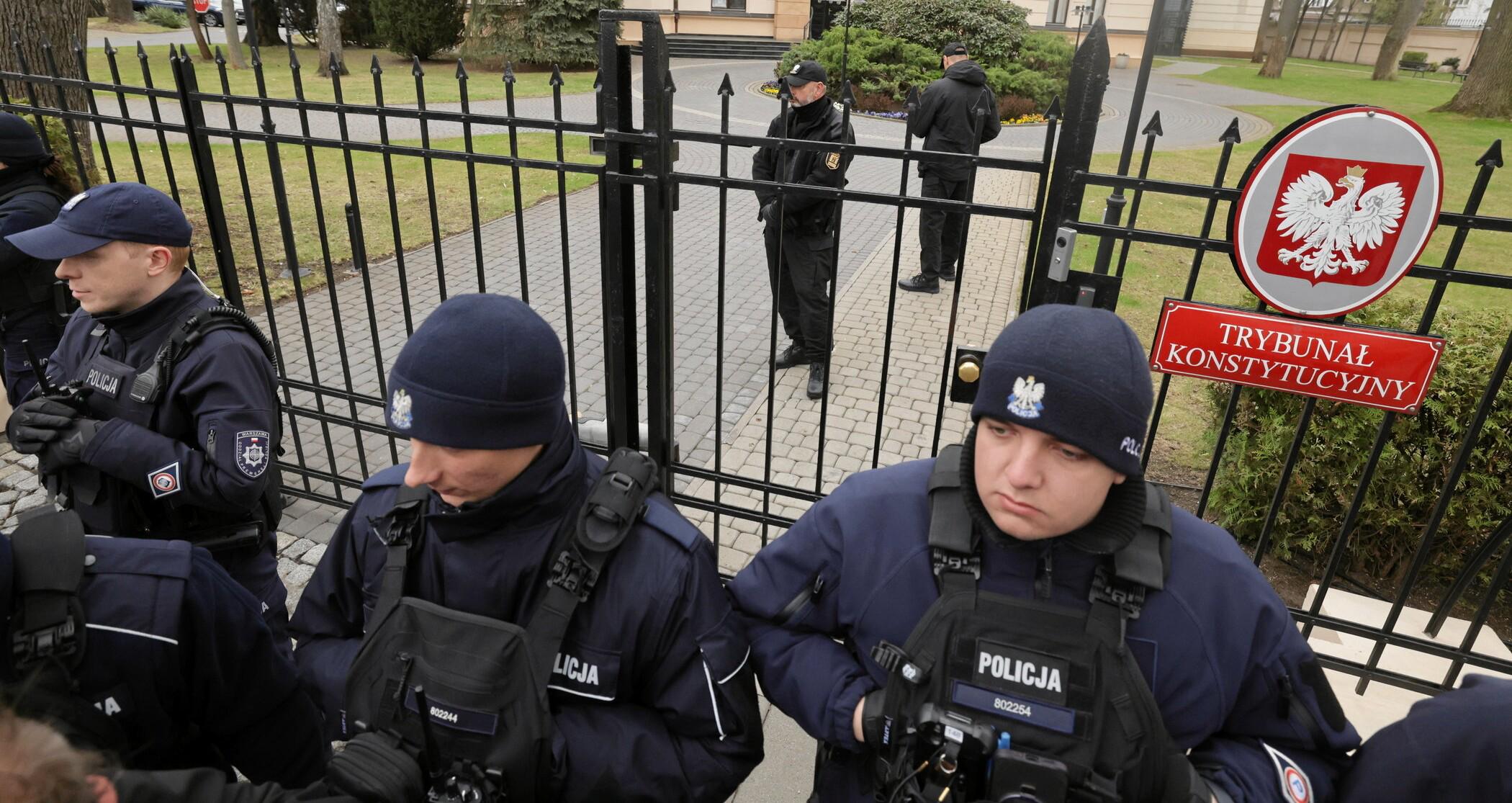
The chief justice of Poland’s Constitutional Tribunal (TK), Bogdan Święczkowski, has refused to accept four new judges after they arrived at the court today following a controversial swearing-in ceremony in parliament.
Święczkowski noted that, although the judges were elected by the government’s majority in parliament, they had not, as required, taken their oath before opposition-aligned President Karol Nawrocki, who has raised doubts over their appointment.
The chief justice’s decision, which was widely expected, deepens an unprecedented standoff over the court – and Poland’s judicial system more broadly – between the government and officials aligned with the national-conservative opposition Law and Justice (PiS) party, which ruled Poland from 2015 to 2023.
Last month, the ruling coalition’s majority in the Sejm, the more powerful lower house of parliament, chose six new judges to fill empty seats on the TK, which since December has had only nine of its 15 positions filled. At least 11 judges are required for the court to have a valid bench.
Under the law, new TK judges must “take an oath before the president” before taking up their seats on the court. However, last week, Nawrocki invited only two of the six judges, Dariusz Szostek and Magdalena Bentkowska, to take an oath in the presidential palace.
His chief of staff, Zbigniew Bogucki, said that the president had done so, despite doubts about the legality of the judge’s appointment by parliament, because adding two judges would bring the TK up to its valid bench of 11. He also noted that only two TK vacancies had opened up since Nawrocki became president.
However, many legal experts have rejected those arguments, saying that if Nawrocki accepted two of parliament’s appointments as valid, he must also accept the other four. Last week, PiS suspended one of its own MPs, Krzysztof Szczucki, a doctor of law, who had agreed with that opinion.
On Thursday, after repeatedly asking Nawrocki to receive their oath, the four remaining judges – Anna Korwin-Piotrowska, Krystian Markiewicz, Maciej Taborowski and Marcin Dziurda – decided instead to organise their own ceremony in the Sejm, to which they invited the president.
Bogucki condemned their decision as an “ostentatious and conscious…violation of the law”. But the four judges went ahead anyway, and were joined by Szostek and Bentkowska in a show of support. Four former chief justices of the TK also attended the ceremony.
After swearing their oath in the presence of a notary, the six judges delivered the documentation to the presidential chancellery. They then proceeded to the TK itself, where dozens of protesters had gathered outside amid a heavy police presence.
There had been some speculation that Święczkowski, who served in the former PiS government and has regularly clashed with the current government, might seek to prevent the judges from entering the building. However, all six made their way inside, where they met with the chief justice.
Around two hours later, Święczkowski spoke to the media, saying that, while he had “congratulated all six on their election”, he had only allowed the two judges who had sworn oaths before Nawrocki to take up their positions on the court, where they had already been assigned cases.
Meanwhile, he had informed the other four that “unfortunately I cannot recognise…[them] as judges of the Constitutional Tribunal as I have not been informed by the president that they took the oath before him”.
He also criticised them for taking part in today’s alternative swearing-in ceremony in parliament, which he described as ” a performance, a media spectacle, organised, in my opinion, for the benefit of politicians”.
In response to Święczkowski’s remarks, a government minister, Maciej Berek, said that, by congratulating all six judges on their election by parliament, the chief justice had confirmed they were legally appointed.
That, said Berek, undermines Nawrocki’s claims that there are doubts over their legality and confirms that he has “usurped a non-existent presidential power” by deciding who can or cannot be a TK judge.
Meanwhile, before Święczkowski’s statement, justice minister Waldemar Żurek told broadcaster TVN that the government has a “plan B” if four of the judges were not accepted onto the TK. However, he refused to say what this would involve.
Later, in a press conference of his own, Bogucki said that Nawrocki would ask the TK itself to rule on the dispute between parliament and the president over the appointment of the four remaining judges.
“Until the Constitutional Tribunal issues a position, the president will not act,” said Bogucki, quoted by news website Onet. He also called today’s actions by the four judges “a grotesque farce”.
However, even if the TK does rule on the issue, its decision is likely to be ignored by the ruling coalition, which regards the TK as illegitimate since it contains judges unlawfully appointed when PiS was in power. The current government has refused to recognise – or even publish – TK rulings.
Daniel Tilles is editor-in-chief of Notes from Poland. He has written on Polish affairs for a wide range of publications, including Foreign Policy, POLITICO Europe, EUobserver and Dziennik Gazeta Prawna.
Supplementary article – Polish parliament hosts swearing in of constitutional court judges in defiance of president
Poland’s rule-of-law crisis took a new twist today, as parliament – which is controlled by Prime Minister Donald Tusk’s ruling coalition – hosted the swearing-in of four Constitutional Tribunal (TK) judges whose oaths opposition-aligned President Karol Nawrocki has refused to accept.
Nawrocki condemned the move as illegal, pointing to a provision of Polish law requiring that new TK judges be sworn in “before the president”. The government, however, has accused Nawrocki of himself violating the law by refusing to swear in legally appointed judges.
Given that the TK’s chief justice is also aligned with the opposition, it appears likely that he will, like Nawrocki, refuse to accept the four judges sworn in today in parliament. That may lead to a standoff at the court when the judges attempt to take up their seats.
Last month, the ruling coalition’s majority in the Sejm, the more powerful lower house of parliament, chose six new judges to fill empty seats on the TK. It was the first time in four years that new judges had been chosen, as Tusk’s government had previously been boycotting the court.
That was because it regards the TK as illegitimate since it contains judges unlawfully appointed under the rule of the former Law and Justice (PiS) government and PiS-aligned President Andrzej Duda. Tusk’s government has refused to recognise – or even publish – TK rulings.
As a result, since December 2025 – when one judge’s nine-year term expired and another retired for health reasons – only nine of the TK’s 15 seats have been filled. That is below the figure of 11 judges required for the court to have a full, valid bench.
Under the law, new TK judges must, after being elected by parliament, “take an oath before the president” before taking up their seats on the court. Given that Nawrocki is aligned with PiS, there were doubts as to whether the president would invite the six new judges to be sworn in.
Last week, Nawrocki made the unusual move of inviting just two of the six judges, Dariusz Szostek and Magdalena Bentkowska, to the presidential palace and witnessing their oaths.
The president’s chief of staff, Zbigniew Bogucki, said that Nawrocki had done so, despite doubts about the legality of the judge’s appointment by parliament, because adding two judges would bring the TK up to its valid bench of 11. He also noted that only two TK vacancies had opened up since Nawrocki became president.
However, many legal experts have rejected those arguments, saying that if Nawrocki accepted two of parliament’s appointments as valid, he must also accept the other four. Last week, PiS suspended one of its own MPs, Krzysztof Szczucki, a doctor of law, who had agreed with that opinion.
On Wednesday, news emerged that the four remaining judges – Anna Korwin-Piotrowska, Krystian Markiewicz, Maciej Taborowski and Marcin Dziurda – had decided to take their oaths in parliament shortly on Thursday. They sent invitations to Nawrocki to attend the ceremony.
On Thursday morning, Bogucki issued a statement on behalf of the president in which he said that the move would be an “ostentatious and conscious…violation of the law” and a “challenge to the powers assigned by statute and the constitution to the president”.
The president’s position was also supported by Poland’s commissioner for human rights, Marcin Wiącek, who told news website Wirtualna Polska that, according to the law, “the president must swear in Constitutional Tribunal judges”.
However, deputy prime minister Władysław Kosiniak-Kamysz on Wednesday told broadcaster TVN that it is in fact Nawrocki who is “committing a violation” by refusing to undertake his duty under the law to receive the oath of legally appointed judges.
Despite the president’s opposition, today’s ceremony went ahead. The four judges took their oaths in the presence of a notary and Sejm speaker Włodzimierz Czarzasty, a Tusk ally. Szostek and Bentkowska also took their oaths again alongside their colleagues in a show of solidarity.
Meanwhile, four former TK chief justices, Marek Safjan, Jerzy Stępień, Bohdan Zdziennicki and Andrzej Zoll, also attended the ceremony. Stępień told broadcaster TVN ahead of the ceremony that it was Nawrocki who had “forced the judges to take the oath in this manner” by “breaking constitutional custom”.
“In this situation, the newly elected judges had to choose a different form of taking the oath,” continued Stępień. “They did, and I greatly admire them for it, and I believe it was the right thing to do.”
The four judges will now seek to take up their seats on the TK. However, the court’s chief justice, Bogdan Święczkowski, a former member of the PiS government who has regularly clashed with the current government, is almost certain to refuse to admit them.
Święczkowski has already threatened disciplinary action against Szostek and Bentkowska for so far failing to turn up to work after being sworn in by Nawrocki last week, reports Wirtualna Polska. They had been waiting for their four newly appointed colleagues to also be sworn in.
Last week, interior minister Marcin Kierwiński even suggested that, if Święczkowski refuses to admit the new judges to the court, the police could be used to ensure they are allowed to take up their seats.
Daniel Tilles is editor-in-chief of Notes from Poland. He has written on Polish affairs for a wide range of publications, including Foreign Policy, POLITICO Europe, EUobserver and Dziennik Gazeta Prawna.
Posted by BubsyFanboy
1 Comment
!ping POLAND
**1. Why is this relevant for** r/neoliberal **?**
This is relevant to Polish politics, democracy and judiciary.
**2. What do you think people should discuss about it?**
I think people should talk about Poland’s Constitutional Tribunal (TK), the decade+ long fight over it, the president’s, parliament’s and government’s influences, the latest moves by all of the above and TK’s judges, including the swear-in of the remaining judges and TK’s decline of it and the potential future ramifications.
**2a. What do you think of the issue at hand?**
I do agree that a constitutional reform is necessary. I don’t think I would support most of what those parties want though.
Anyway – play obstructionist games, win bypass prizes. Once again a PiS-endorsed president is willingly violating the constitution to get their way, only this time a Tusk/KO government is bypassing everything. Now we’ll have to wait and see if this means the police will force allowing the judges in.