
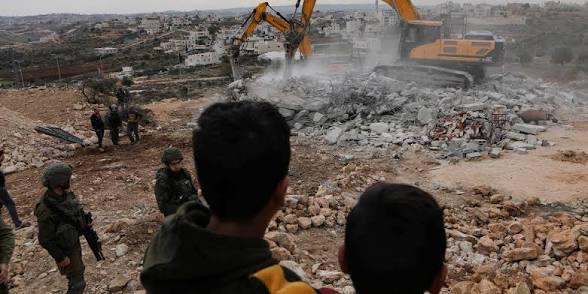
This practice is carried out under Regulation 119 of the Defense (Emergency) Regulations, a law originally enacted in 1945 by the British Mandate authorities to suppress revolts, which Israel retained and continues to use exclusively against Palestinians in the West Bank and East Jerusalem, leading critics to characterize it as an element of an apartheid system.
Human rights analysts argue that Israel utilizes this policy as a mechanism to expand its territorial control, noting that demolitions are heavily concentrated in strategic zones like East Jerusalem and Area C of the West Bank, which remains under full Israeli military and civil jurisdiction. According to organizations like B'Tselem, systematically reducing the Palestinian housing stock in these areas serves to restrict Palestinian community expansion while simultaneously facilitating the growth of Israeli settlements, thereby shifting the demographic and territorial balance.
Furthermore, while the stated goal of the Israeli military is deterrence, many security experts including former members of the Israeli security establishment question whether the policy achieves this, or if it produces the opposite result.
Independent researchers note that displacing entire families creates immediate economic desperation and social instability, forming widespread structural grievances and a lack of legal recourse that extremist groups exploit for recruitment. This dynamic leads to a self-perpetuating cycle of violence and subsequent military crackdowns, leading to the conclusion that the state is fully aware of the radicalization this policy creates and uses the resulting extremism to justify ongoing military actions and what the icc classify as war crimes in Palestine.
Posted by eyyov