
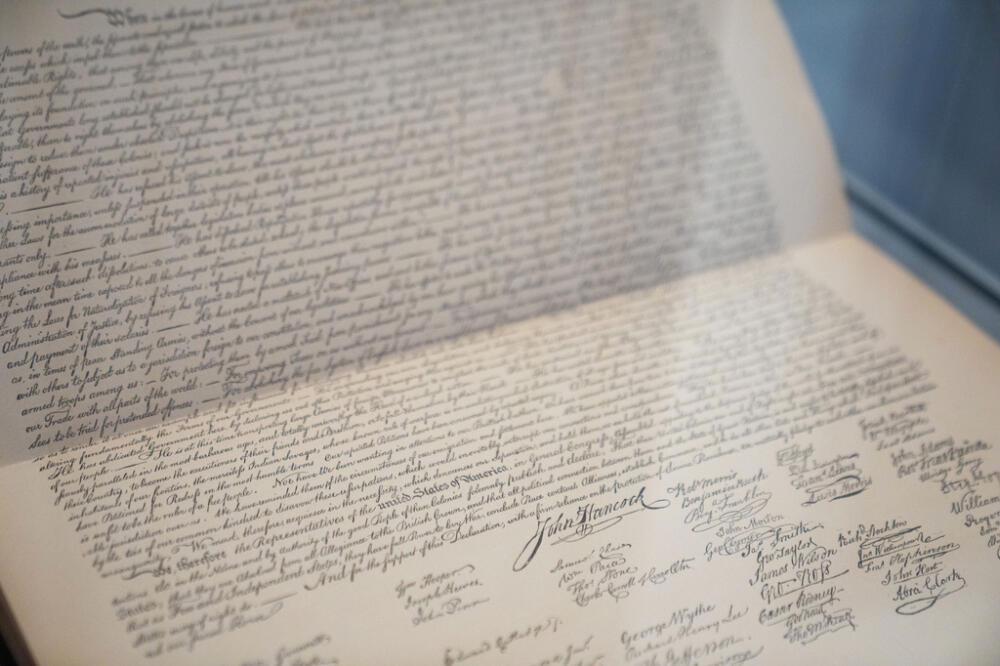
It's been 250 years since we got this banger:
When in the Course of human events, it becomes necessary for one people to dissolve the political bands which have connected them with another, and to assume among the powers of the earth, the separate and equal station to which the Laws of Nature and of Nature's God entitle them, a decent respect to the opinions of mankind requires that they should declare the causes which impel them to the separation.
We hold these truths to be self-evident, that all men are created equal, that they are endowed by their Creator with certain unalienable Rights, that among these are Life, Liberty and the pursuit of Happiness.–That to secure these rights, Governments are instituted among Men, deriving their just powers from the consent of the governed, –That whenever any Form of Government becomes destructive of these ends, it is the Right of the People to alter or to abolish it, and to institute new Government, laying its foundation on such principles and organizing its powers in such form, as to them shall seem most likely to effect their Safety and Happiness. Prudence, indeed, will dictate that Governments long established should not be changed for light and transient causes; and accordingly all experience hath shewn, that mankind are more disposed to suffer, while evils are sufferable, than to right themselves by abolishing the forms to which they are accustomed. But when a long train of abuses and usurpations, pursuing invariably the same Object evinces a design to reduce them under absolute Despotism, it is their right, it is their duty, to throw off such Government, and to provide new Guards for their future security.
Let's discuss it in this post. Let's also discuss the United States as a nation and as an idea. What are your thoughts on this particular Fourth of July?
—
250 years ago, the Second Continental Congress voted to declare independence from the British Crown (on July 2nd, except for the abstaining New York, who took until the 9th to make it unanimous), and on July 4th, issued a statement that would become a defining document of both American and liberal values.
The US Declaration of Independence defined a right to revolution, and in its most famous sentence, enshrined the natural rights of everyone that governments are supposed to protect. It also demonstrated that the previously separate colonies were able to function as a whole–the “United States” already existed in spirit.
Did the writers and signers mean "everyone"? Well, "everyone" thought it applied to them, and have been using the text to fight for their rights ever since. The meaning of the Declaration of Independence is what Americans have read into it, from the moment it was printed to the present day. It is not law; it is an argument–one that has been frequently ignored–and yet it has been called "American Scripture".
—
At the time of its writing, the colonies had been at war with Britain for over a year. The colonies were largely already self-governing; the governors appointed by Britain had been forced out or had fled their duties, leaving sometimes hastily-formed state governments to pick up the slack. The Second Continental Congress convened to not only deal with the big issues–should we declare independence?–but also the small–how to keep the states from fighting with each other? how to keep the soldiers fed?
And yet, it took some time for the colonists and the Congressional delegates to be convinced that a full break from the Crown was their solution. The colonists' primary complaints had been with Parliament. The First Continental Congress had petitioned the King to free them from the tyrannical lords, but King George III, in his post-Glorious Revolution wokeness (or unwillingness to get his ass handed to him), stuck by Parliament’s prerogative. The King even went further and declared the colonies in “open and avowed” rebellion, said he would look for foreign help in bringing them back under control, and approved of the British navy patrolling and blockading the colonial coasts.
The real kicker, though, was when the royal governor of Virginia, Lord Dunmore, offered freedom to all slaves or indentured servants who joined the British military. This made the southerners very very mad. Now the powerful Virginians were truly ready to team up with the scrappy troublemakers from Massachusetts and ditch the Crown for good. Then, in January 1776, Thomas Paine publishes Common Sense, arguing in plain language for the separation of the colonies from Britain. It is still one of–if not the–best-selling American piece of writing of all time relative to population. The Second Continental Congress decides to officially support new governments and begin drafting a formal resolution declaring independence.
Thomas Jefferson was selected to write the first draft of the Declaration of Independence because he was a Virginian and a good writer. (Also, Congress was still bogged down with committee work on the “little stuff” and Jefferson was young and ambitious, so I kinda think they just stuck him with unpaid overtime.) Jefferson admitted himself that nothing in the document was original; he had previously written A Summary View of the Rights of British America, which was his draft of grievances against the Crown, as well as George Mason’s Virginia Declaration of Rights on hand, from which he freely drew. The most famous sentence of the Declaration of Independence is a re-editing of Mason’s opening:
That all men are by nature equally free and independent and have certain inherent rights, of which, when they enter into a state of society, they cannot, by any compact, deprive or divest their posterity; namely, the enjoyment of life and liberty, with the means of acquiring and possessing property, and pursuing and obtaining happiness and safety.
Those documents themselves were based in a Lockean tradition and a tradition of English declarations, most notably the Declaration of Right of 1689, which laid out the grievances of the English against monarchy.
Local jurisdictions were writing their own Declarations, too. There was a lot of chatter and scribbling and experimenting throughout the colonies, to various extents. In many colonies, townspeople were encouraged to assemble and discuss independence amongst themselves. Although they differed on how much of the “rabble” they wanted to include in deliberations, the delegates to the Continental Congress were very interested in ensuring public support for independence. They were quite concerned about acting outside of their mandate. (I cannot help but note the contrast with the present day.)
Jefferson’s draft was heavily edited by the rest of the drafting committee and by the Congress as a whole. Most notably, they removed a screed he wrote blaming the Crown for the institution of slavery in the colonies. Jefferson may be history’s most notorious hypocrite.
Who was the Declaration written for? It wasn’t written for the King or Parliament. Parliament and later historians tried to align the list of grievances with actual acts–some are obvious, other grievances seem to have been merely rhetorical generalizations. Ostensibly such a Declaration was written for potential allies in the war, namely the French. However, the copy of the Declaration meant for King Louis XVI got lost in the mail and didn’t arrive until after Europe had already been talking about it for months. Perhaps America’s first foreign policy oopsie. King Louis is unlikely to have been swayed by talk of revolution, anyway. He wanted to stick it to the Brits, and needed to be assured that the States could hold their own. It would take Benjamin Franklin’s brilliant diplomacy to finally convince him to formally pitch in.
The Declaration was largely written for the American people. Jefferson likely always intended for it to be read aloud, in assemblies and other gatherings. It demonstrated that the new government could be a capable alternative to the Crown, and its aspirational rhetoric secured support for the war, which would continue for several more years.
—
As I wrote above, the Declaration is not law. So why is it so important? Because its readers made it important. In the early Republic, the Declaration is rarely mentioned and is not incorporated into governing documents. Internationally, however, the act of declaring independence and revolting against the current government caught on quickly and continued through the 20th century. Many declarations of independence from other nations draw from the US document.
Domestically, the text of the Declaration was very quickly coopted by those who wanted to expand rights. Danielle Allen, a prominent historian and scholar of politics describes of the signing of the Declaration as a spark for the abolition movement. (Listen to her on a recent episode of On Point: https://www.wbur.org/onpoint/2026/06/01/declaration-of-independence-250-years-later) Jamelle Bouie recently wrote a column on this for the NYT, which I encourage everyone to read: https://www.nytimes.com/2026/07/01/opinion/declaration-independence-jefferson-douglass-lincoln.html
In his famous speech, “What to the Slave is the Fourth of July?”, Frederick Douglass calls out the hypocrisy in the stated values of the Declaration and calls upon the people of the States to uphold them, thus further elevating the text to a set of aspiration values. https://en.wikisource.org/wiki/What_to_the_Slave_Is_the_Fourth_of_July%3F
(Friend of the sub John Brown wrote his own imitation of the Declaration–the “Declaration of Liberty” https://www.digitalhistory.uh.edu/active_learning/explorations/brown/planning3.cfm)
It was finally Lincoln who secured the status of the Declaration of Independence as the enduring statement of the values and principles of the United States. In his famous debates with Stephen Douglas, he expands the meaning of “all men are created equal” to mean, quite literally “all men”; an oratorical sleight-of-hand that obscured historical complexity to create a national system of belief. He would further ingrain this belief with his Gettysburg Address:
Four score and seven years ago our fathers brought forth on this continent, a new nation, conceived in Liberty, and dedicated to the proposition that all men are created equal.
(It’s been said many times, but holy shit Lincoln was a great president.)
—
Some books:
The go-to is Pauline Maier’s American Scripture, Making the Declaration of Independence. I mostly drew from here.
Danielle Allen: Our Declaration, A Reading of the Declaration of Independence in Defense of Equality
David Armitage: The Declaration of Independence, A Global History
Posted by hypsignathus