
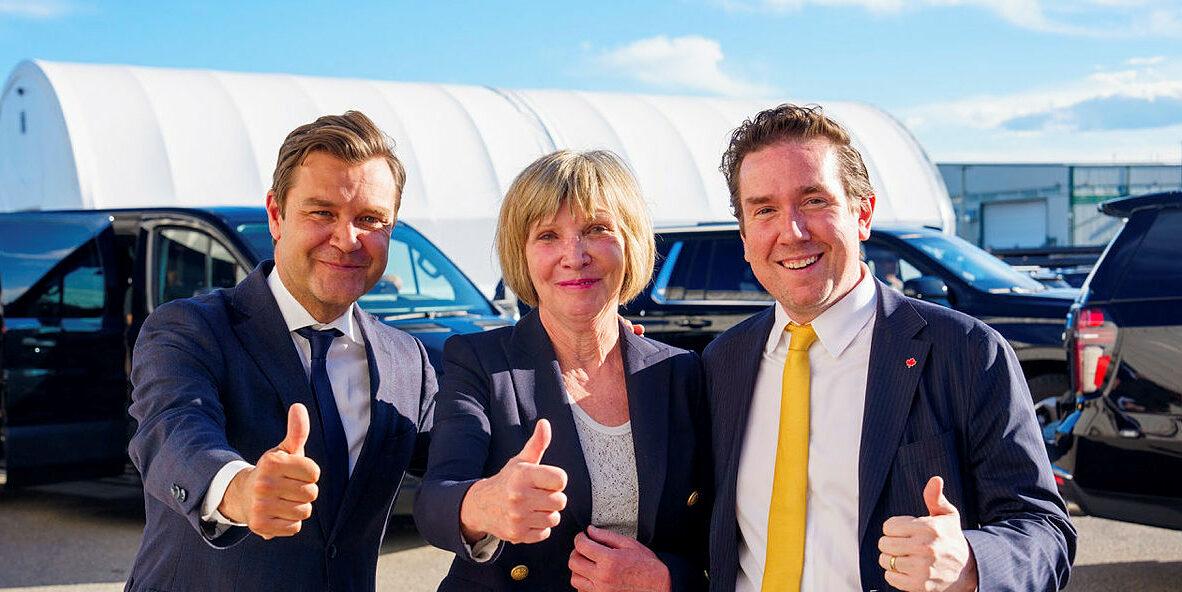
The Alberta Liberal caucus holds weekly Zoom meetings with PMO senior adviser Morgan Breitkreuz about the fall separation referendum and other key issues related to the province, says Liberal MP Corey Hogan.
Prime Minister Mark Carney’s newly minted senior adviser, Morgan Breitkreuz, provides weekly briefings to Alberta’s three Liberal MPs on the upcoming separation referendum while co-ordinating the federal government’s response and helping officials in Ottawa better understand Alberta’s political landscape, according to Liberal MP Corey Hogan.
In an interview with The Hill Times, Hogan (Calgary Confederation, Alta.) said that Breitkreuz makes sure that he, in his role as parliamentary secretary to the natural resources and energy minister, Emergency Management Minister Eleanor Olszewski (Edmonton Centre, Alta.), and Liberal MP Matt Jeneroux (Edmonton Riverbend, Alta.), in his role as special adviser to Carney (Nepean, Ont.) on economic and security partnerships, are “abreast of the issues in Alberta, particularly on separatism, but not exclusively at this point.”
“We meet with him regularly, and he makes sure that there’s activity that’s occurring and that things are co-ordinated,” Hogan added.
Back in May, Alberta Premier Danielle Smith announced that her province’s Oct. 19 referendum, which will include questions about issues such as immigration and constitutional reforms, will also ask residents whether they want to go ahead with a separate and binding referendum on Alberta leaving Canada. The question will read: “Should Alberta remain a province of Canada or should the Government of Alberta commence the legal process required under the Canadian Constitution to hold a binding provincial referendum on whether or not Alberta should separate from Canada?”
Smith has announced publicly that she’s on the “stay” side, and wants Alberta to continue to be a part of Canada. Even though the referendum is only a couple of months away, it was not known as of last week who will lead the “stay” side campaign. Carney and other cabinet ministers have been travelling regularly to Alberta to discuss energy and other issues with the provincial government, but there is still no official organization or individuals representing the “stay” side in the referendum debate.
Most recently, Carney went to Calgary on July 11 to attend the city’s annual Stampede, where he participated in several events, including a meeting with First Nations groups. He also attended a Laurier Club gathering in Calgary that drew about 200 Liberals. According to a Liberal source who attended the event, Hogan served as the master of ceremonies, Olszewski introduced Carney, and Jeneroux thanked the prime minister for attending. Breitkreuz accompanied the prime minister during this trip.
The federal cabinet will also hold its summer retreat in Calgary from Sept. 9 to 11.
Former Conservative prime minister Stephen Harper has announced that he will campaign for the “stay” side. Conservative Party Leader and relatively new Alberta MP Pierre Poilievre (Battle River-Crowfoot, Alta.) has also delivered speeches in the province making a case for remaining in the federation.
Breitkreuz began his political career as a field organizer for the federal Liberal Party in Alberta during the 2015 election before being promoted to director of operations for the party. During the 2025 election campaign, he served as campaign director for the Prairies and the North. Breitkreuz, who is a nephew of former Reform MP Clifford Breitkreuz, was unavailable for an interview last week.
Between 2021 and his recent appointment to the Prime Minister’s Office (PMO), Breitkreuz held several senior roles as a ministerial staffer. Before his current appointment, he served as chief of staff to Olszewski.
Without getting into specifics, Hogan told The Hill Times that the Alberta Liberal caucus meets with Breitkreuz on Zoom, and the meetings are generally slotted for a half-hour but sometimes go longer depending on the week’s issues. Breitkreuz’s previous work in Alberta has given him an extensive network of contacts and relationships that are proving valuable in his current role, Hogan said, adding that Breitkreuz also helps officials in Ottawa better understand Alberta’s political culture and perspectives.
Hogan said the proposed separation referendum remains a top-of-mind issue for Alberta MPs and many residents. Breitkreuz is responsible for ensuring that files related to Alberta continue to move through the federal system efficiently and for co-ordinating that work across government, Hogan said.
“We [Albertans] have a unique political culture. It goes way, way back,” said Hogan. “It’s not about one moment, but literally since this province was founded, there’s been an Alberta way, and there’s been a way that Alberta thinks about the province, and there’s been specific sensitivities that exist [that] people don’t intuit necessarily if they’re not from here. And so, both as an Albertan and as a political operator from Alberta, Morgan really gets that. And otherwise, you might come across various issues and maybe not even know that it ties to some long-held Alberta concern or grievance.”
Alberta’s economy is heavily dependant on natural resources, including oil, gas, mining, forestry, and agriculture.
A vast majority of Albertans on the “leave” side believe that federal Liberal policies, especially in the last decade under then-Liberal prime minister Justin Trudeau, have harmed Alberta’s key industries through restrictions on pipeline development, environmental regulations, and carbon pricing. They say Ottawa neither understands nor properly values the province’s economy and culture. The “leave” side proponents also say that Alberta contributes more to federal coffers than it receives in return, particularly as compared to provinces such as Quebec, and they resent what they consider as other provinces benefitting from other financial contributions to federal coffers while opposing its energy sector.
Hogan said the Alberta Liberal caucus also holds meetings on “an ad hoc basis” with Carney to discuss issues related to the province and the referendum. Hogan said the Alberta separation movement is a top priority for the PMO, with both Carney and his chief of staff closely monitoring developments surrounding the referendum. He added that the PMO is committed to providing Alberta Liberal MPs with whatever support and resources they need as the issue continues to unfold.
When asked if the PMO is helping out MPs in messaging and media monitoring, Hogan said: “The PMO obviously has people who work in communications, people who work in media monitoring. That naturally captures a lot of this work … I don’t know how people are dividing their time behind that curtain. But I feel very satisfied just with the level of detail and analysis. And if we have a question, they are always able to answer it in a timely fashion.”
Breitkreuz is ‘doing a great job’: Alberta’s Voice founder Stephen Carter
Stephen Carter, a prominent Alberta political strategist, told The Hill Times that he has known Breitkreuz for years, and speaks with him regularly since his PMO appointment to discuss the upcoming fall referendum.
Carter said he’s launched a third-party advertising group called “Alberta’s Voice” in support of keeping Alberta in Canada, which raised more than $50,000 as of last week. He said his advertising group is raising about $1,000 every day, and his aim is on some days to raise $5,000 or $10,000. The spending limit for third-party groups in this referendum is $607,000 and Carter’s target is to raise about $300,000.
He said Breitkreuz makes an effort to stay in regular contact with stakeholders on the “stay” side of the referendum, and remains informed on these groups’ activities and strategies.
“Morgan is the point person,” said Carter. “He’s the one who’s supposed to reach out [to stakeholders, and I think he’s doing a great job.”
Breitkreuz’s appointment last month began a series of senior staffing changes in the PMO. Other high-profile personnel changes since then include the departure of principal secretary Tom Pitfield and deputy chief of staff Braeden Caley. Pitfield has been appointed to the Senate, while Caley has been appointed as the Liberal candidate in the upcoming North Vancouver–Capilano byelection in British Columbia.
Scott Gilmore has succeeded Pitfield as principal secretary, while Tim Krupa has assumed the dual role of deputy chief of staff and chief economist. Carney has also appointed Jennifer MacIntyre as his deputy chief of staff.
Another rising staffer in the Prime Minister’s Office is Maia Johnson, who has been named chief operating officer, a newly created position that had not previously existed in either the PMO or a federal minister’s office. The responsibilities of the role have not yet been publicly outlined. Before her promotion, Johnson served as senior special adviser for United States-related stakeholder strategy in the PMO. Johnson, an American citizen, previously worked at Bloomberg and has also worked on Democratic Party campaigns in the U.S., including Hillary Clinton’s 2016 presidential campaign.
After making changes in the PMO’s senior ranks, the next step for Carney, political insiders have predicted, is that he will call byelections in the coming days for at least a few of the ridings whose seats are currently empty. Some suggested last week that byelections could be called as early as July 19. As of last week, four seats were vacant and three more are expected to become vacant before the House returns for the fall sitting on Sept. 21.
Political insiders speculate that after the byelections, Carney will shuffle his cabinet before the fall sitting. Following the shuffle, the prime minister will likely shuffle the ranks of parliamentary secretaries and then committee chairs.
Posted by IHateTrains123