
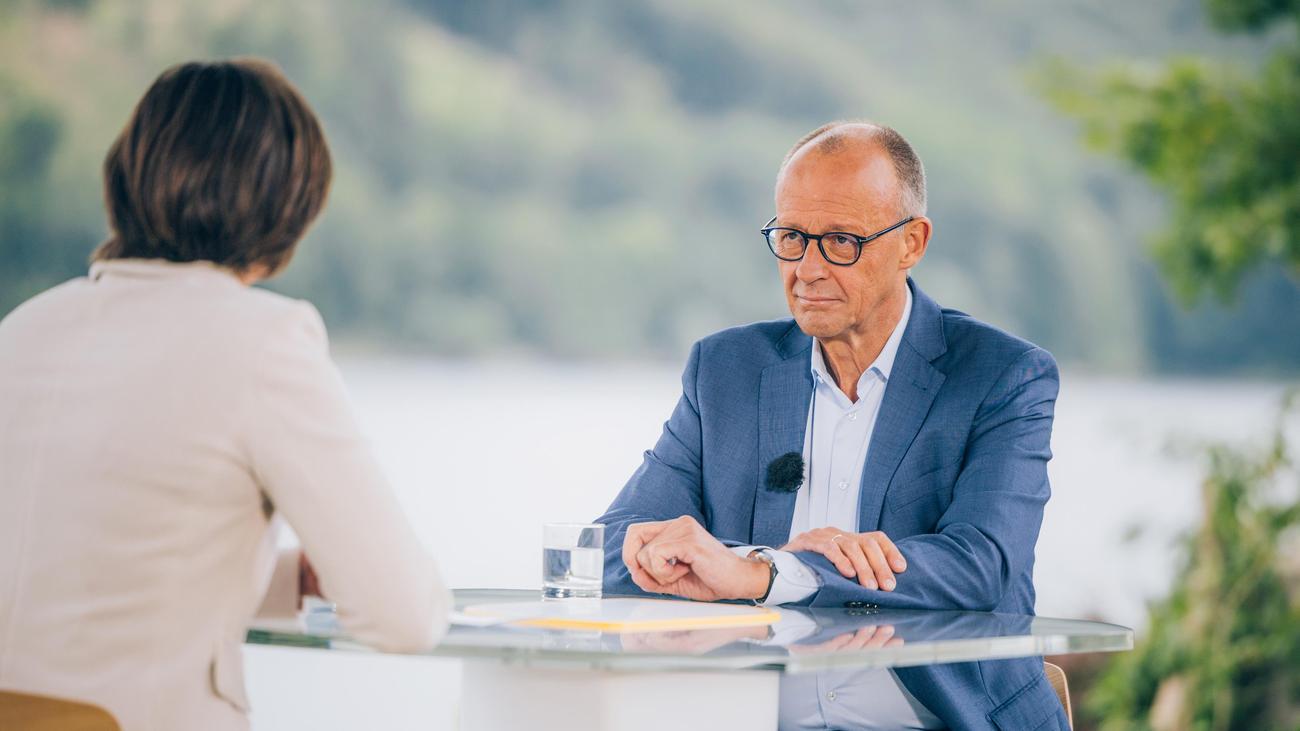
No, Friedrich Merz is certainly not sad about Jens Spahn’s downfall. The ZDF summer interview offers a rare sight: a chancellor celebrating a victory.
When Friedrich Merz says the same sentence four times, he means to make a point.
"It could be an opportunity."
"It could be an opportunity."
"It could be an opportunity."
"It could be an opportunity to rethink the composition of the federal government."
No, Friedrich Merz certainly does not appear sad during Sunday’s ZDF summer interview about the resignation of his parliamentary group leader the day before. And it is true: Jens Spahn’s forced, surprise departure opens up a host of—well—fine opportunities for the Chancellor and CDU chairman. He can finally maneuver a trusted ally to the helm of the Union parliamentary group—a position previously blocked by an ambitious rival—and potentially reshuffle a cabinet post or two in the process, such as that of the Chief of Staff, who has faced repeated criticism of late. But a rare opportunity presents itself for us viewers, too.
The way chancellors celebrate victories reveals a great deal about them. Yet, just over a year into Merz’s chancellorship, there have been few opportunities to observe him celebrating a win. That alone makes the 19-minute-50-second conversation—conducted by Diana Zimmermann, head of the ZDF capital studio, in Merz’s constituency in the Sauerland—well worth watching.
It has become interesting this weekend to observe Friedrich Merz as a man of power—almost in passing. After all, on Saturday, the Chancellor executed a swift, decisive maneuver of the sort frequently seen under Angela Merkel but witnessed here with Merz for the first time: he sidelined a rival. Just before Spahn could release his letter of resignation, Merz’s camp let the media know that the Chancellor himself had urged Spahn to step down. It is the ultimate power move, and it raises a question that has been the undoing of many a power tactician: what becomes a victor better—flaunting one’s triumph or downplaying it?
How fortunate, then, that the summer interview is on the television schedule this Sunday.
Angela Merkel liked to let her rivals run into a dead end. Roland Koch, Christian Wulff, and Edmund Stoiber were among them—as was a certain Friedrich Merz. Whenever one of these men stumbled over his own ambition, the CDU chairwoman never let her satisfaction show. That—as can be revealed right at the start without giving too much away—is different in the case of Friedrich Merz.
"You look very satisfied": That is how interviewer Zimmermann sums up her guest's mood after the first quarter of the program, which is dedicated to the Spahn affair and its fallout.
This marks Merz’s third major media appearance in roughly three weeks. Earlier this month, he appeared on Maybrit Illner’s program to discuss the coalition’s reform package, and just last Wednesday, he headed into the summer recess following the traditional chancellor-style appearance at the Federal Press Conference. On each occasion—much to the frustration of those asking the questions—he played the same role: Merz the stereotype, a political operator devoid of any real resonance, more party functionary than chancellor.
The head of the ZDF capital bureau is now adopting an approach of engaged relentlessness. Warm in tone yet unswerving in her questioning, she seeks to determine the extent of the Chancellor’s share of responsibility for the collapse of his parliamentary group leader’s credibility: Did he not have a ten-day head start on the parliamentary group, the coalition, and the public—ten days during which he was already aware that a surrogate mother in the USA was carrying the child of Jens Spahn and his husband, Daniel Funke? Should Merz not have realized the implications of the contradiction between Spahn’s private conduct and his political stances for the CDU’s credibility? What steps did the Chancellor take to preempt the damage?
Spahn occupied a strange dual role in Merz’s inner circle—half favorite, half persona non grata.
No matter how Zimmermann phrases her questions, Merz’s answers always boil down to the same conclusion: it was Spahn’s doing. "After all, none of us really had a chance to talk to him about it," says Merz, adding that he had hoped his parliamentary group leader would handle the communication regarding his decision well and explain it effectively to the public. It sounds a bit as though Friedrich Merz had attended a couples’ workshop and adopted an attitude of pseudo-concern—following the motto: "Jens, I want to leave that entirely up to you."
Spahn and Merz once vied against each other to succeed Merkel as party leader—only for both to lose at the 2018 Hamburg party conference to the third contender in the race, the short-lived chairwoman Annegret Kramp-Karrenbauer. More recently, Spahn occupied a peculiar dual role in Merz’s inner circle—part protégé, part detractor: whether to prop up the Chancellor or to topple him—one got the impression the parliamentary group leader asked himself this question anew with every coalition crisis. Regarding the reform package of recent weeks, he had just opted to lend his support once again. Now, he himself has been toppled.
And his boss has to explain it to the country. Striking the right balance in communication does not always come easily to Merz. Prone to self-pity one moment and sudden abrasiveness the next, his quest for the right tone and a steady stance often turns into a slalom ride. For instance, during his first year as Chancellor, he complained to *Der Spiegel* that none of his predecessors had been treated as shabbily as he had. Yet at other times, he is quick to lash out forcefully.
"I'm just sick of it!"
This man finds it difficult to strike a softer tone. Zimmermann asks if he can understand why a voice from the ZDF community might wish for the Chancellor to show "more care for a wounded nation"? Certainly, certainly, the Chancellor insists, "but there is no point in trying to wish something healthy when it is not healthy at the moment." Brusqueness seems to be his default setting; an outburst is his preferred form of emotional expression. And some things may simply sound brusque because reality itself is currently harsh: "Overall, we need to deliver better performance in this country. And I stand by that," says Merz in the interview.
At one point in the conversation, Zimmermann plays a clip of Merz sounding off against the country’s perpetual naysayers and asks: "Why such a harsh tone, Mr. Merz?" His reply echoes the words of the writer Ödön von Horváth: "I am actually quite different; I just rarely get the chance to show it." Yet only moments later, Merz’s combative alter ego erupts again: "This constant grumbling, this endless carping, this badmouthing and tearing down of our country—on occasions like this, I think I’m allowed to say: I’m simply fed up with it!"
Zimmermann interjects: "But sometimes you speak ill of the Germans, too…" He notes that the Chancellor accuses them of laziness, suspects them of feigning illness to take sick leave, and has upset many with the debate over the cityscape. Now it is Merz’s turn to express hurt regarding the media—ZDF included: "You always show only those who criticize me!" Always and only?
"You’re always mean to me"—anyone who complains like that shows the world that they still carry the pain of past injustices within them. Could it be that the person is simply longing for recognition?
And he reproaches the interviewer: "You rarely show those who say it is exactly the same way…" Merz leaves the sentence hanging. Did he seriously mean to say: ZDF too rarely shows citizens who say they view the situation exactly the way the Chancellor does?
Despite such flare-ups, the 19 minutes of television coverage regarding the Spahn crisis and the opportunity for restructuring also reveal a quieter side of Merz—one that rarely gets public exposure. Perhaps, as viewers, we simply need to grant him the benefit of the doubt: to accept that he is speaking from a place of genuine conviction rather than acting as a mere puppet in the Chancellor’s office. Suddenly, one can sense the very quality his remaining supporters often highlight: a sincere determination to do his utmost to tackle today’s crises, coupled with an equally honest sense of despair at how hard it is to break through. "We cannot let the country slip away from us," he says at one point.
This Sunday, Friedrich Merz strikes his own unique balance on the precarious tightrope between arrogance and catastrophism: "It could be an opportunity." And, in a way, this balancing act suits him rather well. Is a "Merz style" perhaps emerging in his second year as Chancellor—one that reconciles his starkly contrasting traits? A Chancellor who neither indulges in false self-pity nor treats his country with cold indifference—that would be something. A Chancellor with his own brand of cool edge—it could, indeed, be an opportunity.
Original and free text: https://archive.fo/nwVXW.
Translated by Google Translate, all mistakes are my own.
Posted by IHateTrains123