
President Lee Jae-myung has issued messages for three consecutive days emphasizing that his administration will “look after young people.” Political observers say the move comes as Lee’s approval rating continues to decline, with particularly troubling signs of weakening support among voters in their 20s and 30s. Even within the ruling party, some are warning that “if the younger generation turns away from us, there will be no hope in the general election two years from now, or in the presidential election after that.”
On Saturday, Aug. 8, when he had no official engagements, Lee wrote on X, formerly Twitter, “There must never be a situation in which our young people hesitate to marry because of government policy.” He said he had ordered officials to “closely examine and report on any institutional disadvantages people may face as a result of getting married.”
In the post, Lee listed 22 issues that he said should be addressed as priorities to improve housing access and asset-building opportunities for young people. These included easing income eligibility requirements for the Didimdol home-purchase loan program and expanding eligibility for special housing allocations and home loans for newlyweds. Lee said, “We intend to carefully examine each issue to determine whether improvements are needed and whether the proposed measures can provide fair and meaningful assistance to everyone.”
At a policy review meeting with senior aides on Aug. 7, Lee ordered a comprehensive reconsideration of proposed reforms to Individual Savings Accounts (ISAs) and the so-called “Stock Price Suppression Prevention Act,” both of which have drawn strong opposition from younger people and individual investors. At a meeting with senior secretaries on Aug. 6, he described young people as a “vulnerable group” and called for faster implementation of various youth policies. For three consecutive days, Lee has focused his attention on public sentiment among younger voters.
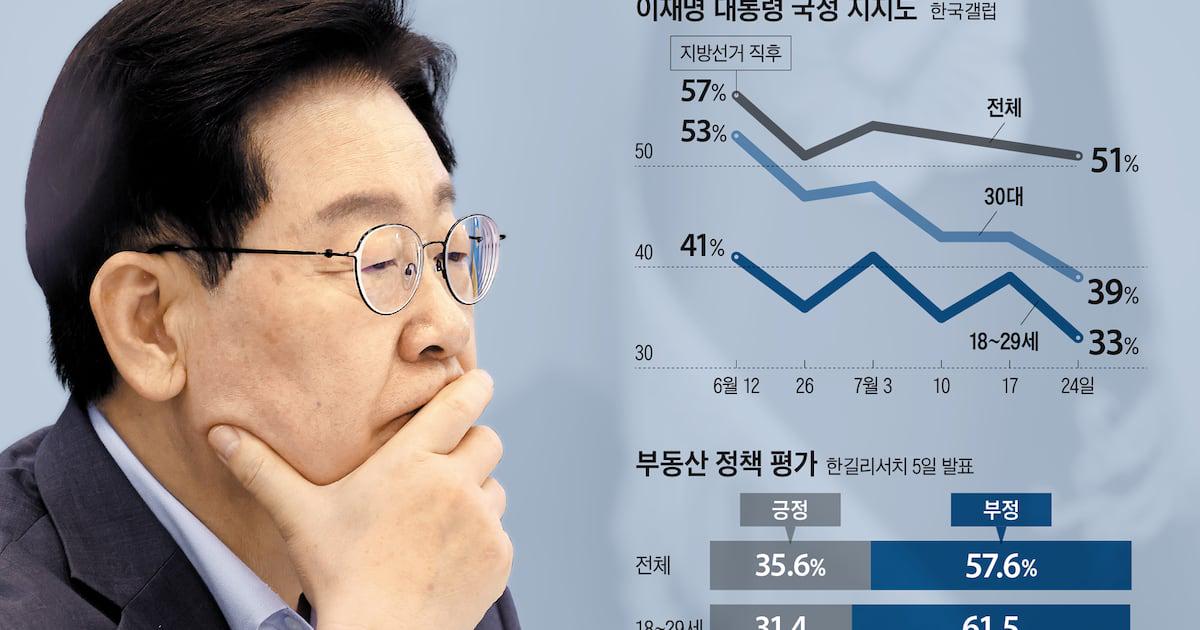
Political observers say this reflects increasingly serious signs that voters in their 20s and 30s are moving away from the president. According to Gallup Korea, the share of respondents who said Lee was “doing a good job” fell by 6 percentage points, from 57% on June 12, shortly after the local elections, to 51% on July 24. Among people in their 30s, however, Lee’s positive job rating plunged 14 percentage points, from 53% to 39% over the same period. Among those aged 18 to 29, it fell 8 percentage points, from 41% to 33%, meaning both groups recorded steeper declines than the overall population. Among voters in their 30s, 46% said Lee was “doing a poor job,” 7 percentage points higher than the 39% who said he was doing well. Among those in their 20s, 39% rated his performance negatively, compared with 33% who rated it positively.
Since his time as mayor of Seongnam, Lee has pursued policies aimed at younger generations, including a “youth dividend,” and has enjoyed particularly strong support among young women. Recently, however, signs have emerged that voters in their 20s and 30s are turning away from him amid market volatility, employment concerns and, increasingly, housing issues.
In a Hangil Research survey released on Aug. 5, seven out of 10 respondents in their 30s said Lee was doing a poor job of managing state affairs. The same proportion gave a negative assessment of his housing policies, suggesting that dissatisfaction with housing policy is also affecting his overall approval rating. A ruling-party official said, “As the government tightens lending restrictions, younger people feel they have been deprived of the opportunity older generations had to buy homes using borrowed money. They cannot afford to buy homes, and now there are signs that jeonse deposits and monthly rents are also surging. Public frustration among young people is approaching the breaking point.”
Signs of fragmentation have also emerged among women in their 20s and 30s, who had been a particularly strong source of support for the current administration. Even in the 2022 presidential election, which Lee lost, exit polls conducted by broadcasters showed that women in their 20s and 30s gave more votes to Lee than to his opponent. Recent polling, however, shows the gap between positive and negative assessments narrowing. Gallup’s combined polling results for March this year showed that 70% of women in their 30s approved of Lee’s performance as president. In the combined July results, that figure had fallen to 47%.
Choi Byung-cheon, an adjunct professor at Myongji University, wrote on Facebook on Aug. 8, “Unless the current direction of housing policy is comprehensively reconsidered, the government will face not merely a backlash from the three Gangnam districts, but resistance on the scale of an ‘uprising’ from people in their 20s, 30s and 40s protesting soaring jeonse and monthly rents and lending restrictions.”
Within the Democratic Party, some have also warned that “the spread of anti-Democratic Party sentiment not only among people in their 20s and 30s, but also among teenagers, is a serious problem.”
Posted by Freewhale98