
TL;DR
„I originally came across a number of these claims through Professor Jiang’s statements. Rather than accepting them at face value, I went through them one by one and tried to verify them independently.
What follows is not a repetition of everything he claims.
I have deliberately excluded points for which I could not find reliable evidence, weakened claims where the sources did not support the strongest interpretation, and separated documented relationships from speculation.
The purpose of this post is therefore simple:
to summarize the parts of this network that can actually be supported by public records, original videos, official statements, financial disclosures, organizational material, reputable journalism and historical sources.
My conclusion is not that there is one secret organization controlling all of these actors.
What the evidence does appear to show is a decentralized network of overlapping religious, political and financial interests involving parts of Chabad, Israeli political and settler networks, wealthy donors, Christian Zionists and figures connected to the Trump administration.
The long section below lays out the evidence in detail.“
I have spent some time trying to understand a political-religious network that at first looked almost impossible to describe without immediately sounding conspiratorial.
My conclusion is not that Chabad controls the United States, that Jews collectively control American politics, or that Donald Trump, Benjamin Netanyahu, evangelical Christians, West Bank settlers and Temple activists secretly answer to one central authority. I have found no evidence for such a command structure.
What I have found is more interesting and, in my opinion, more defensible:
There are several independent religious, political and financial networks whose goals overlap at important points. These actors repeatedly meet, fund one another, lobby one another, campaign for one another and cooperate on specific projects. They do not need to agree about everything or even share the same ultimate theology for that cooperation to have political consequences.
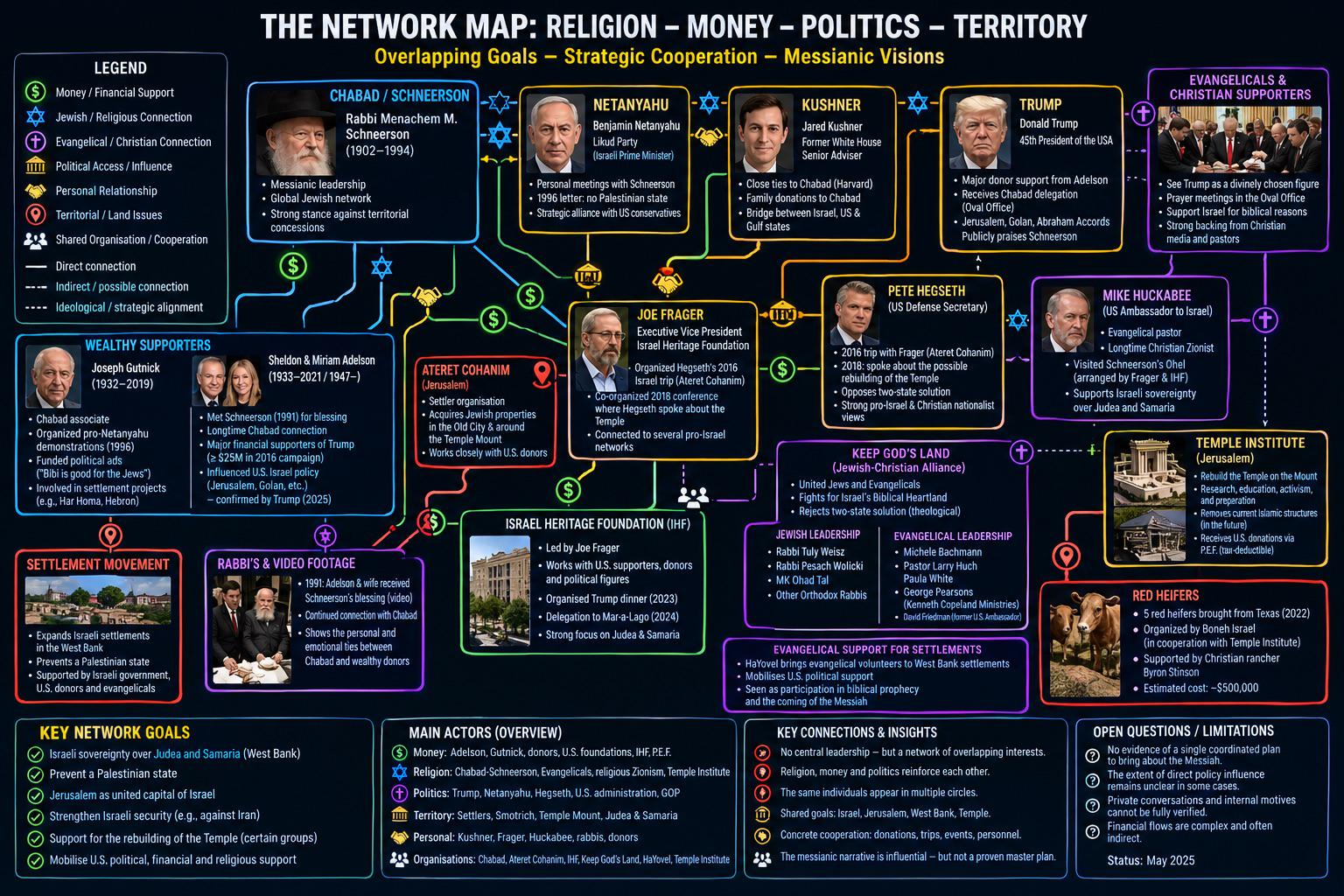
The network map accompanying this post is an attempt to visualize those relationships.
The central subjects are Chabad-Lubavitch and the legacy of Rabbi Menachem Mendel Schneerson; Benjamin Netanyahu; Donald Trump and Jared Kushner; wealthy donors such as Sheldon and Miriam Adelson and Joseph Gutnick; American evangelical figures including Pete Hegseth and Mike Huckabee; Israeli settler organizations and advocates; and organizations explicitly dedicated to Israeli sovereignty in the West Bank or preparation for a future Jewish Temple.
What follows is the evidence behind the map.
1. Start with Chabad and Menachem Mendel Schneerson
Chabad-Lubavitch is a Hasidic Orthodox Jewish movement. Under its seventh Rebbe, Menachem Mendel Schneerson (1902–1994), it developed an extraordinary international outreach structure.
Thousands of Chabad emissaries were eventually sent across the world to establish religious centers, campus organizations and Jewish community institutions.
This matters politically because an organization built around personal outreach and relationship-building naturally develops connections with influential people as well as ordinary members of the public.
Schneerson was also intensely focused on the coming of the Moshiach, the Jewish Messiah. In 1990, for example, he described his generation as the final generation of exile and the first generation of redemption and urged Jews to expect the Messiah imminently. At the same time, Schneerson took strong positions concerning Israeli territory.
Chabad’s own publication of his teachings states unequivocally that he opposed surrendering territory captured after 1967. In one 1990 discourse, he described the Land of Israel as an eternal inheritance of the Jewish people and argued that no part should be surrendered.
There is an important complication here. Schneerson repeatedly insisted that his practical opposition to territorial concessions was based primarily on pikuach nefesh, the preservation of Jewish life and security, not on a claim that retaining territory was necessary to trigger the Messiah. Chabad’s own documentation explicitly preserves that distinction.
That distinction is important because it prevents us from simply saying:
“Schneerson wanted territorial expansion in order to cause the apocalypse.”
The evidence does not establish that.
What it does establish is that the same leader simultaneously held:
strong messianic expectations
and an uncompromising territorial/security position regarding Israel.
Those ideas subsequently existed within the same religious-political milieu.
2. Schneerson and Benjamin Netanyahu
The relationship between Schneerson and Benjamin Netanyahu is not speculative. They met personally on multiple occasions.
One particularly interesting recorded encounter occurred in 1990. Netanyahu was already a prominent Israeli political figure. In the exchange, Schneerson told Netanyahu that the Messiah had still not arrived and urged him to do something to hasten his coming. The significance should neither be exaggerated nor dismissed.
It does not prove that Netanyahu subsequently organized his political career around bringing the Messiah. But it does establish that one of the most important Israeli politicians of the modern period personally interacted with Schneerson in an explicitly messianic framework.
Netanyahu has also publicly recalled advice Schneerson gave him during his period representing Israel at the United Nations.
So the connection here is stronger than:
“Netanyahu once took a picture with a rabbi.”
It was a recurring personal relationship involving political advice, religious symbolism and messianic language.
3. Chabad moved from religious influence into very concrete Israeli electoral politics
The 1996 Israeli election gives us one of the clearest examples. Chabad openly campaigned for Netanyahu with the famous slogan:
“Netanyahu. It’s good for the Jews.”
The National Library of Israel preserves the campaign material and explicitly identifies it as Chabad advertising intended to mobilize Orthodox and traditional voters for Netanyahu.
The campaign becomes even more interesting when we look at Joseph Gutnick, an Australian mining magnate closely associated with Chabad.
Contemporary Jewish Telegraphic Agency reporting describes Gutnick as a Chabad-affiliated businessman who organized pro-Netanyahu demonstrations and sponsored political advertising during the 1996 campaign.
That same report connects Gutnick economically to Har Homa, a controversial East Jerusalem settlement project.
So here we have something quite concrete:
religious network → wealthy supporter → electoral mobilization → territorial political interests.
There was also a written political commitment.
During the 1996 campaign, Netanyahu wrote to senior Chabad figure Rabbi Shmuel Heffer. Netanyahu’s office later confirmed that he had promised that a government led by him would prevent the establishment of a Palestinian state.
This is important because it shows that Chabad-related political support was not occurring in a vacuum. Territorial policy was part of the discussion.
But there is also valuable counterevidence.
Netanyahu subsequently entered arrangements involving territorial withdrawal, provoking anger from Chabad figures and Gutnick.
That tells us something important about the nature of the network: Influence existed. Control did not.
And that distinction will recur throughout this investigation.
4. Jared Kushner provides a direct bridge from Chabad networks into Trump’s family
Jared Kushner’s relationship with Chabad predates Donald Trump’s presidency.
At Harvard, Kushner was a regular participant at Harvard Chabad. His rabbi recalled him as unusually involved and described Kushner personally giving Chabad an $18,000 check while still a student.
The Kushner family’s financial relationship was much larger.
Tax-filings reported by JTA showed that the Charles and Seryl Kushner Family Foundation donated approximately $342,500 to Chabad institutions and projects over ten years, including $150,000 to Harvard Chabad and $78,000 to the visitor center at Schneerson’s Ohel.
This does not make Kushner an agent of Chabad.
What it does establish is that Trump’s son-in-law and later senior White House adviser had a long-standing personal, religious and financial relationship with Chabad institutions before entering national government.
That makes Kushner a genuine network bridge:
Chabad religious milieu = Kushner family = Trump family = White House.
5. Sheldon and Miriam Adelson form another major bridge and this one includes enormous political money
Another striking connection involves billionaire casino magnate Sheldon Adelson and his wife, physician Miriam Adelson.
Before their marriage, the couple personally visited Schneerson and received his blessing.
Chabad’s own account of Adelson’s life describes his continuing relationship with Chabad rabbis and institutions afterward. Decades later, the Adelsons became extraordinarily important Republican donors.
An analysis of FEC records by the Center for Public Integrity found that Sheldon and Miriam Adelson each contributed roughly $10.2 million to efforts supporting Trump’s 2016 presidential campaign—about $20.4 million combined, making them his largest outside individual backers in that analysis.
The Washington Post similarly calculated approximately $21.2 million supporting Trump’s presidential run.
The politically important point is not simply that rich people donated to a politician.
The Adelsons were intensely engaged with Israel policy.
And in 2025 Trump himself publicly credited Miriam and Sheldon Adelson with repeatedly lobbying his White House and helping shape major decisions concerning Israel, including the recognition of Jerusalem as Israel’s capital and recognition of Israeli sovereignty over the Golan Heights.
This is one of the strongest connections in the entire map because we have all four components:
personal relationship with Schneerson/Chabad
→ massive financial resources
→ direct political access to Trump
→ policy influence acknowledged by Trump himself.
Again, what we do not have is evidence that Chabad ordered the Adelsons to lobby Trump.
The evidence supports a network relationship, not a chain of command.
6. Trump himself developed an unusually visible relationship with Schneerson’s legacy
Trump’s relationship to Chabad cannot be reduced to Kushner or the Adelsons.
On October 7, 2024, Trump personally visited Schneerson’s grave, the Ohel, in Queens.
The following year, the official White House proclamation for Education and Sharing Day went substantially further.
Trump wrote that during the visit he had drawn:
“spiritual guidance and replenishment”
from Schneerson’s message.
The White House repeated and expanded the praise in 2026, describing Schneerson as one of the most influential Jewish leaders in modern American history and stating that Trump’s administration was “proudly advancing the Rebbe’s vision” in the field of education and moral values. Then in September 2025 Trump hosted a large Chabad rabbinical delegation in the Oval Office.
The attendees are striking: alongside Chabad leadership were Jared Kushner, Stephen Miller, Commerce Secretary Howard Lutnick, White House faith officials and other senior administration figures. This does not demonstrate that Chabad determines American policy.
It does demonstrate something more modest but still significant: Chabad possesses direct access to the highest levels of the current U.S. administration.
7. Trump also sits inside a separate evangelical religious network
This is where the network begins to intersect with Christian Zionism.
Trump has long enjoyed extraordinary support among white evangelical Christians.
There are also documented examples of religious leaders literally laying hands on Trump and praying over him in the Oval Office.
A widely circulated July 2017 photograph shows roughly 30 evangelical leaders meeting Trump; topics during the meeting included religious freedom, judicial nominations and support for Israel. Jared Kushner was also present.
Reuters separately photographed faith leaders laying hands on Trump during an Oval Office prayer in September 2017.
Within parts of the evangelical movement, Trump has been described not merely as a preferred politician but as a man chosen or anointed by God, sometimes compared with the biblical Persian king Cyrus.
That does not mean evangelicals generally believe Trump is Jesus or the Messiah. They do not.
But it creates what sociologists might call sacralized political authority: a political leader framed as playing a providential role in God’s plan.
That symbolism became even more explicit in 2026.
On April 12, Trump’s verified Truth Social account posted an AI-generated picture depicting him as an apparently Christ-like healer. Reuters archived the post; it was subsequently deleted.
That does not establish a coherent Trump theology.
But it shows that religious imagery portraying Trump in quasi-sacred terms is not restricted entirely to supporters outside his political operation.
8. Pete Hegseth takes Christian Zionism into explicitly Temple oriented territory
The case of Pete Hegseth, Trump’s current Secretary of Defense, is particularly relevant.
In a 2018 speech in Jerusalem, Hegseth spoke positively about the possibility of a new Jewish Temple on the Temple Mount.
He said:
“There’s no reason why the miracle of the re-establishment of the temple on the Temple Mount is not possible.”
He added that he did not know how it would happen but believed that it could. By itself that would establish an ideological position. But Hegseth’s earlier relationships make the statement more interesting.
In 2016, Joseph Frager helped organize a factfinding trip to Israel for Hegseth in cooperation with the American Friends of Ateret Cohanim. The delegation toured areas including Jewish settlement in Jerusalem’s Muslim Quarter and the Jewish community in Hebron.
Frager is not merely an acquaintance.
He has served as chairman of the executive committee of American Friends of Ateret Cohanim and executive vice president of the Israel Heritage Foundation.
Ateret Cohanim works to strengthen Jewish residential presence in and around Jerusalem’s Old City, including disputed areas of East Jerusalem.
So Hegseth’s Temple rhetoric emerged within a broader network of Jerusalem activism, settlement advocacy and American pro-Israel conservatism.
That still does not prove that Hegseth’s decisions as Defense Secretary are intended to build the Temple.
There is no evidence establishing that.
But his worldview concerning the Temple Mount is a matter of public record.
9. Joseph Frager is one of the most interesting bridge figures in the entire network
Frager connects several of the circles on the map.
His Israel Heritage Foundation (IHF) advocates strongly for Israel and specifically for Israeli sovereignty in parts of the West Bank.
In 2023 the organization hosted Trump at a private gala at Trump National Golf Club Bedminster.
IHF’s own account states that Frager emphasized the organization’s advocacy for “Judea and Samaria” and sovereignty in Area C.
In February 2024 an IHF delegation led by Frager again met Trump, this time at Mar-a-Lago, thanking him specifically for the Jerusalem embassy decision, Golan recognition and Abraham Accords.
Frager also connects this network to another major evangelical Trump figure:
Mike Huckabee.
10. Mike Huckabee connects evangelical Zionism, Trump’s diplomacy and Schneerson’s Ohel
Before being confirmed as Trump’s U.S. ambassador to Israel, Mike Huckabee visited Schneerson’s Ohel in March 2025.
Who escorted him?
Joseph Frager and the Israel Heritage Foundation.
Chabad officials greeted Huckabee at the site.
Huckabee is a longtime evangelical Christian Zionist who has rejected much of the conventional vocabulary surrounding the Israeli-Palestinian conflict. He has publicly argued that the “West Bank” should instead be understood as the biblical Judea and Samaria, and has rejected the characterization of Jewish communities there as settlements.
Now notice the network connection:
Frager connects Israeli settlement/Jerusalem advocacy with Hegseth,Trump, and Huckabee,
while Huckabee is simultaneously brought into direct symbolic contact with Schneerson’s legacy at the Ohel.
That is exactly the kind of bridge our network map is intended to show. It does not mean all four men share identical theology. They plainly do not.
But the personal and organizational overlap is real.
11. This Jewish-Christian alliance is sometimes completely explicit
This is perhaps the strongest evidence against the idea that the whole pattern exists only because unrelated events are being connected retrospectively. There are organizations that openly describe their mission as an alliance between Jews and Christians for Israeli territorial sovereignty.
One is Keep God’s Land, associated with Israel365 Action.
The organization states:
“Christians and Jews must stand together”
to defend Israel’s biblical heartland, and explicitly identifies its ultimate goal as Israeli sovereignty over Judea and Samaria.
Its theological reasoning is equally explicit: it rejects a two-state solution partly because dividing the land would, in its view, contradict God’s will.
Its leadership includes both Orthodox Jewish activists and prominent evangelical Christians.
Its parent/associated advocacy network, Israel365 Action, is even more direct. It describes its mission as mobilizing Jews and Christians to secure Israeli control over what it calls “all of God’s land” and rejects the two-state solution. Reuters independently investigated this phenomenon in 2024.
Settler leaders told Reuters that cultivating relationships with American evangelical Republicans had become a major priority. Religious Zionist politician Ohad Tal put it bluntly:
“We are fighting the same battle.”
Reuters described Keep God’s Land as part of this effort to align Israeli settler interests with the American religious right.
This is important because it demonstrates that our basic model different theological traditions + overlapping territorial objectives = political cooperation is not something imposed on the evidence by the network map.
Some of the actors themselves explicitly describe their cooperation in almost exactly those terms.
12. The Temple Institute represents the most concrete form of Jewish Temple activism
The Temple Institute in Jerusalem should not be confused with Chabad.
They are separate organizations with distinct histories. But the Temple Institute is important because its objective is unusually explicit.
The organization states that its ultimate goal is to see Israel rebuild the Holy Temple on Mount Moriah the Temple Mount.
Its own statement of principles says that its work includes: education, research, activism and actual preparation.
It has reconstructed ritual vessels, researches priestly requirements and has worked on architectural planning for a future Temple.
This is not a claim made by critics.
It is the organization’s declared mission.
It also explicitly invites people who pray for the fulfillment of biblical prophecies concerning the reestablishment of the Temple to participate in supporting its efforts.
That makes Hegseth’s positive statement about the possibility of rebuilding the Temple politically interesting even though we currently have no evidence that Hegseth belongs to or receives instructions from the Temple Institute.
The connection is ideological, not organizational—unless further evidence establishes otherwise.
13. The red-heifer project shows what Jewish-Christian Temple cooperation can look like in practice
One of the strangest examples is also one of the most concrete. According to biblical ritual law, the ashes of a perfectly red heifer are required for a particular purification ritual.
Temple activists therefore regard finding suitable red heifers as relevant to restoring Temple worship.
In 2022, five red heifers were brought from Texas to Israel with the involvement of evangelical Christians and Jewish Temple activists.
Reporting identified evangelical Texas involvement in supplying the cattle, while the Temple Institute had long treated the search for a suitable red heifer as part of its preparations.
This is a useful example because it moves beyond:
people sharing ideas online
into: Christians and Jewish religious activists cooperating on a physical project intended to satisfy a prerequisite for future Temple ritual.
Again, that does not mean the U.S. government is participating in a project to rebuild the Temple.
It means specific American Christians and Israeli religious activists are.
14. Evangelical support also extends directly into West Bank settlements
Another example is HaYovel, an American evangelical organization that has brought Christian volunteers to work on Jewish farms in West Bank settlements.
Reuters documented evangelical volunteers harvesting in Israeli settlements that advocates hoped Israel would eventually annex.
Other reporting has followed both the volunteer labor and financial/political support flowing from evangelical communities into the West Bank.
For some participants, this is explicitly connected to biblical prophecy.
So here we again see:
religious conviction → material assistance → territorial consequences.
This is stronger evidence than merely finding two politicians who attended the same conference.
15. The settler movement and the Israeli government increasingly overlap on the question of Palestinian statehood
This is where the religious networks intersect with actual state power. Israel’s current Finance Minister Bezalel Smotrich, leader of the Religious Zionism party, has openly opposed a Palestinian state and promoted extensive settlement expansion.
In 2025 he presented proposals for applying Israeli sovereignty to large portions of the West Bank. Reuters reported him advocating “maximum territory and minimum [Palestinian] population.”
At an August 2025 event promoting the E1 settlement plan, Smotrich went even further.
Asked about Trump and Netanyahu, he claimed that his activity in Judea and Samaria was being carried out in coordination with Netanyahu and with friends in the Trump White House, specifically naming Ambassador Huckabee. That is Smotrich’s statement, not independent proof that every individual policy had been personally approved by Trump. That distinction matters.
But it shows how Israeli settlement advocates themselves perceived their relationship with the American administration. By September 2025 Netanyahu publicly declared:“There will be no Palestinian state to the west of the Jordan River.”
He also stated that his governments had doubled Jewish settlement in Judea and Samaria.
And by July 2026 Israel’s security cabinet had approved 1.3 billion shekels for 34 additional West Bank settlements. Smotrich explicitly described settlement expansion as a means of preventing a Palestinian state.
This is why I am careful with the phrase “Greater Israel.” There is no single authenticated document called The Greater Israel Project jointly signed by all the people on this map.
Different people also mean different things by “Greater Israel.”
But there are unquestionably powerful Israeli political movements seeking permanent Israeli sovereignty over much or all of the West Bank, and some frame that project in explicitly biblical terms. That is the claim the evidence can support.
16. Settlement expansion is not merely theoretical
Whatever one’s political position, the underlying territorial transformation is measurable.
The International Court of Justice concluded in its 2024 advisory opinion that Israel’s continued presence in the occupied Palestinian territory was unlawful and stated that Israel must immediately cease new settlement activity. Israel rejects key aspects of this legal interpretation.
Meanwhile, settler violence has increased dramatically.
The UN Office for the Coordination of Humanitarian Affairs reported that by late August 2026 more than 1,040 Palestinians had been injured in the context of settler attacks during that year, alongside continuing displacement and property destruction.
Earlier in July, OCHA had already documented more than 1,260 settler incidents resulting in casualties or property damage, averaging roughly six per day.
This should not be collapsed into the rest of the network.
There is no evidence that Chabad, Adelson, Hegseth or American evangelicals collectively organize settler violence.
That would be an unsupported claim.
What is relevant is that the violence occurs within a much broader process of settlement expansion and territorial consolidation, while several of the political-religious networks examined here advocate precisely that expansion.
So what does the network actually show?
This is where I think the conclusion becomes clearer. I do not see evidence of a pyramid with one leader sitting at the top. I see something closer to an ecosystem.
Chabad brings a worldwide religious network, Schneerson’s legacy, strong relationships with political and wealthy figures and within Schneerson’s teachings a powerful combination of Jewish messianic expectation and opposition to territorial concessions.
Netanyahu brings state power and a decades-long relationship with Chabad circles, while depending politically on religious-nationalist constituencies.
Gutnick demonstrates how a wealthy Chabad-associated individual could translate religious-political commitments into election advertising and settlement-related investment.
Kushner connects a long-standing Chabad milieu directly to Trump’s family and White House.
The Adelsons connect Schneerson/Chabad relationships to enormous financial resources and direct lobbying of Trump on Israel policy.
Trump provides presidential power while simultaneously drawing support from an evangelical movement in which parts of the community interpret his political career through providential or even quasi-messianic imagery.
Hegseth provides a direct example of a senior American official who has spoken approvingly about the possibility of a restored Jewish Temple.
Huckabee connects Trump’s diplomatic apparatus, evangelical Christian Zionism, West Bank territorial ideology and symbolic engagement with Schneerson’s legacy.
Frager connects settlement/Jerusalem organizations to Hegseth, Huckabee and Trump.
Organizations such as Keep God’s Land and Israel365 Action explicitly construct Jewish-Christian coalitions around opposition to Palestinian statehood and support for Israeli sovereignty in Judea and Samaria.
The Temple Institute openly prepares for a future Temple.
Evangelical groups and donors provide political advocacy, money, volunteers and in the red-heifer case even material resources to Israeli religious and territorial projects.
That produces the following mechanism:
Different motivations → overlapping intermediate goals → cooperation → greater political influence.
A Chabad Hasid and an evangelical Christian may profoundly disagree about the identity of the Messiah.
A secular Israeli nationalist may not care about the Messiah at all. A billionaire donor may be motivated primarily by Israel’s security. A settler may believe the West Bank was divinely promised to the Jewish people. An American politician may care about evangelical votes. A Temple activist may want to restore biblical worship.
But all of them could potentially support the same immediate policies:
Israeli control of Jerusalem, opposition to Palestinian sovereignty, expanded Israeli presence in the West Bank, a hard line toward Israel’s regional enemies and, for a narrower subset, greater Jewish control of the Temple Mount and eventual Temple reconstruction.
They do not need a secret meeting to coordinate their ultimate theology. They only need enough agreement on the next step.
What I am notclaiming
This part is essential.
I am not claiming that Jews as a group are responsible for these policies. American and Israeli Jews have enormous political and religious diversity, and many vigorously oppose settlements, Netanyahu and Trump.
I am not claiming that Chabad equals the settler movement or the Temple Institute. They are distinct movements.
I am not claiming that Christian Zionists all want Armageddon. Evangelical motivations vary enormously.
I am not claiming that Trump, Netanyahu, Hegseth or Kushner are secretly taking orders from Chabad.
I am not claiming that the wars involving Israel and Iran were initiated in order to summon the Messiah. I have found no evidence sufficient to establish that causal claim. And I am not claiming that every financial donation produces a policy decision.
The claim is narrower:
Publicly documented relationships reveal a real, decentralized network in which religious ideology, elite access, political donations, lobbying, settlement advocacy and messianic expectations repeatedly overlap. That seems to me to be worth examining regardless of one’s politics.
Posted by Fuzzy_Breadfruit59