
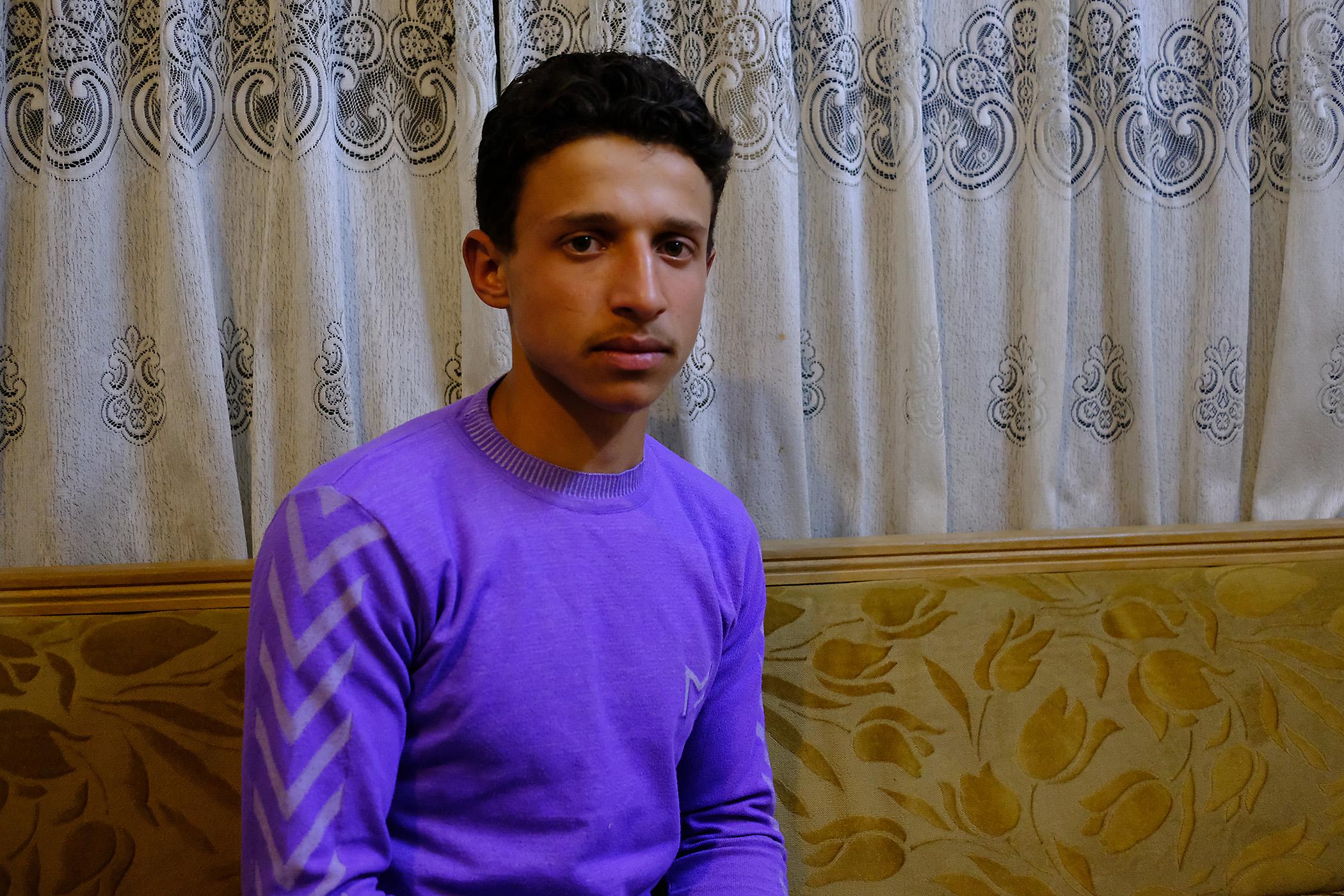
After a video showed Hassan Diab in the aftermath of a chemical attack on Douma, Syria and Russia pushed him to call it a fiction. Eight years later, he and his family finally feel safe enough to speak out
Hassan Diab was so small he had to be helped onto his chair. The 11-year-old, along with his father and a group of Syrian medics, had been flown from Damascus to the Hague to speak at a conference in April 2018. Sitting at a long white table, they all had one thing in common: they had appeared in a video filmed in the aftermath of an apparent chemical attack on the city of Douma.
The video, filmed only three weeks earlier, showed medics treating men women and children, including young Hassan, for the apparent symptoms of chlorine gas inhalation. There were also clips showing the inside of an apartment building. Numerous bodies appeared strewn on a landing and in a hallway.
Sitting at that conference table in the Hague was Alexander Shulgin, not only Russia’s ambassador to the Netherlands but its permanent representative to the Organisation for the Prohibition of Chemical Weapons (OPCW) in the Hague. Beside him was his Syrian counterpart and all the witnesses flown in from Damascus, who told the world’s press they had got it wrong: there had been no chemical attack. The video was fake, they said. It had all been staged.
Eight years later I travelled to Syria, newly open to the world after the sudden fall of the Assad regime, to meet Hassan.
The buildings in Douma, a 20-minute drive north-east of Damascus, still show the pockmarks of war. Down a narrow dusty street lined with concrete apartment buildings, Hassan comes out to greet us. Now 19, with a slight figure and youthful face, he is still recognisable as the boy at the press conference in 2018.
He welcomes me into the modest apartment he shares with his mother, Rawaa, and his father, Omar. Over several cups of cardamon-infused coffee, they describe their experience that April, when the regime of the Syrian president, Bashar al-Assad, was pounding the city with relentless airstrikes.
When the Arab spring had erupted in 2011 and protesters began calling for more freedom and democracy, the regime responded with unrestrained brutality. Syria had quickly descended into civil war and Assad’s government lost control of most of the country to rebel groups. It was only with the intervention of the Russian and Iranian militaries that he was able to begin regaining some territory.
By 2018, Douma was one of the last rebel strongholds near the capital, Damascus. It had managed to hold out against the bombs because, beneath the rubble, its residents had knocked through basements to create a labyrinth of subterranean passageways, allowing them to traverse the city underground.
On the evening of Saturday 7 April, Hassan and his sister and mother were hiding with others. “Relatives and neighbours, all of us sheltered together, that’s how it was: barely any food, or drinking water,” Rawaa recalled. As the family waited for a lull in the bombing, they heard someone shout a warning: “Chemicals, chemicals!”
Locals knew what that meant. By then, the Syrian government had already been accused of using chemical weapons on its population. The most notable occasion was in 2013, when Assad’s forces dropped the nerve agent sarin on the suburbs of Ghouta, only a few kilometres from Douma, killing hundreds of people. It had done the same the previous year in the northern town of Khan Sheikhoun, killing about 80 people. The regime had also been known to use chlorine gas.
As a weapon, chlorine is cheap and easy to make. Its effects are less deadly than sarin and its main purpose is as a disbursal tool. Heavier than air, it sinks into tunnels and cellars, and so is often used to clear out rebel fighters sheltering underground.
That night, when the cry of “chemicals” echoed through the passageways, Rawaa could smell chlorine. She grabbed her two children and began running. “It was dark but I could see thin smoke, like a haze. After that, our eyes were streaming and we were coughing, throwing up and struggling to breathe,” she said.
They made it to a nearby hospital, along with a crowd of others. The World Health Organization would later say about 500 people that night had reported “signs and symptoms consistent with exposure to toxic chemicals”.
The Syrian first responders known as the White Helmets were at the hospital collecting evidence and filming on their phones. The resulting videos showed Hassan, along with other children, being hosed down with water and offered inhalers by medics. Another video showed the interior of a building where the bodies of more than 40 men, women and children lay, foam crusted around their mouths and noses.
When the White Helmets published the videos online, they caused an international outcry. Soon afterwards, in retaliation for the suspected attack, western states bombed several Syrian government sites.
Assad, however, denied any chemical weapons had been used. Instead, his government claimed the incident had either been faked or was a “false-flag operation” in which the rebels had gassed their own side in order to blame the regime.
In the days after the attack, the Syrian army took control of the city and began rounding up everyone who had appeared in the White Helmets’ video. Omar, who had been serving a short prison term at the time for stealing food from an abandoned building, was called into the local mosque and asked by Syrian intelligence officers to identify his son in the video. When he confirmed it was Hassan, he was told to bring his family to the general intelligence service headquarters in the capital.
At street level, al-Khatib, also known as Branch 251, looked like an ordinary government office, with a cafe nearby and a sportswear shop across the road. But below ground it housed one of the most notorious dungeons and torture facilities in the country. The Diab family spent two weeks in a cell there.
Hassan and his sister were still suffering from the symptoms of chlorine gas when they were examined by a prison medic. “I told him it was chemical weapons,” Rawaa said. “And a guy who was standing behind me whispered in my ear, ‘For your sake, you have to stop saying that’. After that I told the children to say it was ordinary smoke.”
Another Douma resident, Bassel Oyoun, was also held al-Khatib. Oyoun was an ambulance worker who could be seen in the video treating patients. He recalled that residents had “yellow and foamy and acidic secretions, they were choking on them. It was a fearful scene.”
At the detention centre, Oyoun was told to wait his turn outside an interrogation room. Inside, he could see the interrogator speaking to a man he recognised as Abu Ali Bakrieh. On the night of the chemical attack, Bakrieh had become separated from his family, who were sheltering in the building where the video showed bodies lying on the floor. His wife, five children, brother, sister-in-law and six nieces and nephews had all died there. Bakrieh was the sole surviving member of his family.
Oyoun recalled treating Bakrieh at the hospital, and now he saw the interrogator asking Bakrieh questions such as: “How did you lose your children?” Bakrieh replied that it was from a chemical attack. “The officer responded that if he heard the term ‘chemical attack’ again he would hang him from the ceiling by his neck,” Oyoun recalled. The officer told Bakrieh: “‘Let’s try again. How did your kids die?’ Bakrieh started crying. “In the bombardment,” he said. “That’s good,” the officer told him.” The Observer has spoken to Bakrieh, who confirmed Oyoun’s account.
‘It was dark but I could see thin smoke, like a haze. After that, our eyes were streaming and we were coughing, throwing up and struggling to breathe’
In the interrogation facility, the detainees, including Oyoun and the Diab family, were photographed and issued with passports. Then they were taken to the airport. None of them had been outside the country before and they were not told where they were going. “We were too scared to speak to each other on that journey,” Rawaa recalled.
The group was flown to Moscow, where they were paraded before Russian journalists and then flown to the Netherlands. According to Hassan’s father, Omar, it was only when they stepped into the conference room and the microphones were attached to their shirts that the group realised they were expected to speak to the press.
Sitting at that long white table, beside the Syrian and Russian ambassadors, they gave false accounts of what had happened in Douma a few weeks earlier. Hassan recalled being nervous because he knew he was expected to stick to a specific story and he was concerned he might make a mistake.
Everyone on stage said the same thing: that they had not experienced or seen anyone display the effects of chemical exposure; that the whole thing had been faked by the White Helmets with the backing of British and US intelligence agencies, to justify bombing the Syrian state.
The Observer has spoken to several employees of the OPCW, who did not want to be named but said they had been extremely frustrated by the staged press conference.
One former staffer said a group of them had considered sneaking combs into the Syrians’ hotel rooms to try to gather hair samples so they could test them for evidence of chlorine contamination. But they were warned by lawyers that obtaining human samples without permission would render them inadmissible in any legal setting. “We were also very concerned that these Syrians might face repercussions if we suddenly announced that we had obtained evidence of their exposure to chemicals,” one source said.
The OPCW did interview six of the witnesses who appeared on that panel, but their testimony was not used as part of the official investigative record, and it did nothing to alter the eventual conclusion: that the Syrian airforce was guilty of dropping chlorine canisters on Douma that night, resulting in the deaths of 43 people.
Yet the press conference, weeks after the chemical attack, remains a seminal moment in one of the most successful disinformation campaigns of the Syrian war. Russian media argued for years afterwards that the testimony given by Hassan and the other Syrian witnesses proved the western narrative about Douma was fabricated, and as one chemical attack was being lied about, it was likely the Syrian government was not responsible for any of them.
It wasn’t just Kremlin outlets doing the amplifying. In the UK, professors, retired military officers and former diplomats – people whose credentials lent an air of authority – helped launder the disinformation too, sharing clips of the press conference on “alternative” media as proof the west had made it up. It fed a broader “anti-imperialist” story: that Assad was being smeared for daring to defy Washington and London. And it left behind an argument that still circulates today: that the OPCW was a corrupted, western-controlled institution. This narrative was anchored by one image that did more work than any of the diplomatic language around it: a child, alone at a conference table, telling the world the attack had never happened.
The Russian mission to the OPCW told The Observer that the witnesses of the Douma incident were now in a “delicate, complicated situation” with regards the new administration in Damascus – insinuating that they may have been forced to retract their initial statements.
But Hassan Diab and his family say that, for years after that staged conference, intelligence officers continued to check on them to make sure they were sticking to their story. More than a year after the fall of the Assad regime, Hassan and his family say they are finally able to speak freely.
Even so, they are not free from what happened. They say their trip to Europe marked them for life, stigmatising them in the eyes of their community. “They say we lied for the regime,” Rawaa said. “These days people call us traitors, but we were just trying to protect our family.”
Posted by IHateTrains123