
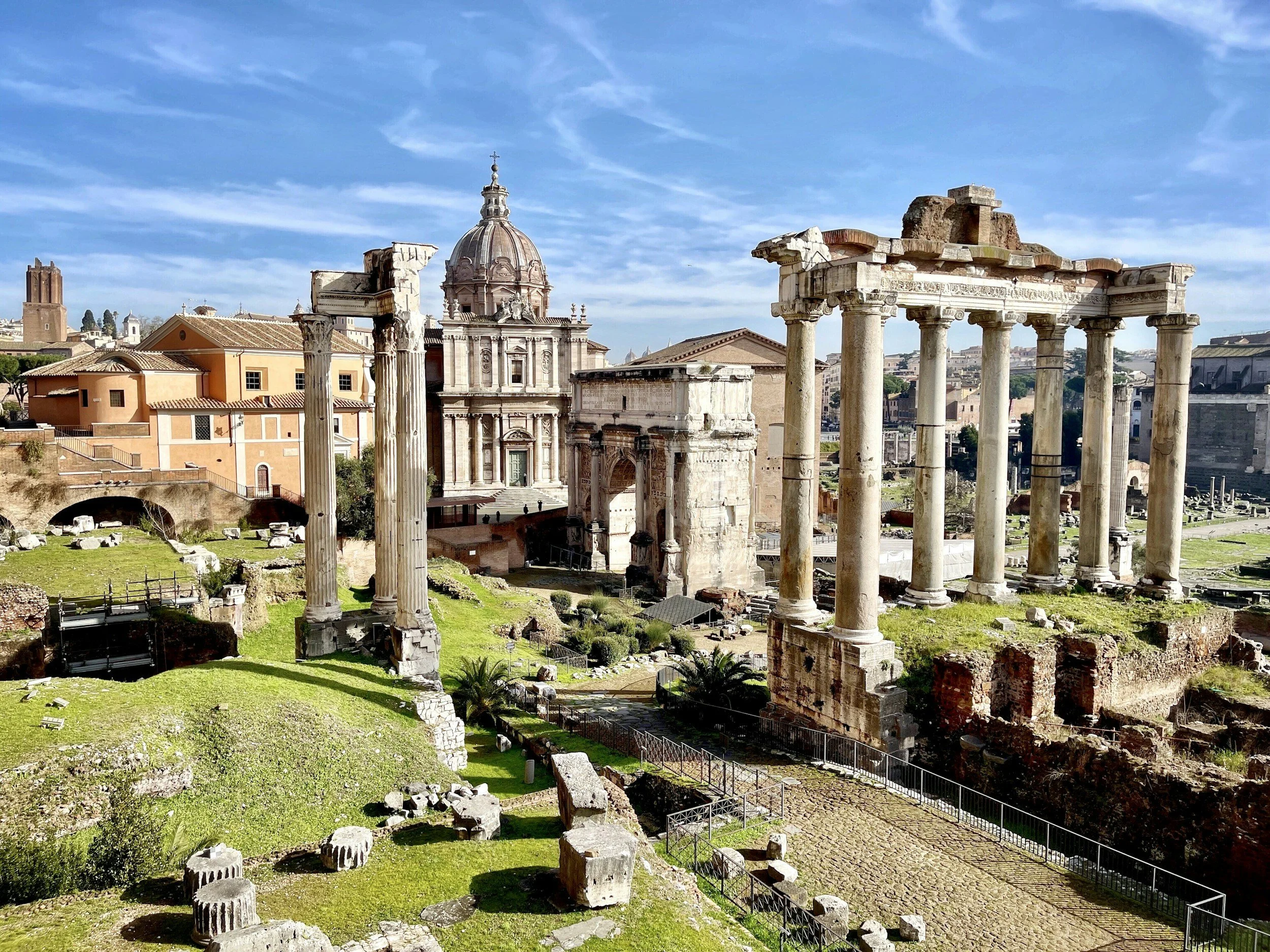
(ANALYSIS) Five hundred years ago, a Russian monk told his ruler that history had run out of empires: “Two Romes have fallen, the third stands and a fourth shall not be.” On Oct. 19, in a closed-door lecture at Nashville’s Grand Lodge of Tennessee, the billionaire Peter Thiel referenced that prophecy yet named a successor. America is the New Rome.
The Christian tradition Thiel invokes begins with a “restraining force.” Early church leaders read Daniel’s vision of the fourth great kingdom as Rome, the last empire of history (Daniel 2:40–43). Tertullian said Christians pray for the emperors because Rome’s endurance restrains evil and delays the end of the age. Paul had written of a mysterious “restrainer” — the katechon of 2 Thessalonians 2:6–7 — who holds back the “man of lawlessness” from doing evil (2 Thess. 2:3).
Rome fell in 476. The seat of empire had already moved east, to Constantinople, the New Rome. When Constantinople fell — first from within, in Moscow’s judgment, by accepting union with the Latin church at Florence in 1439, then to the Ottomans in 1453 — Moscow claimed the succession, having thrown off Mongol control a generation earlier, in 1480.
Around 1510, Philotheus of Pskov warned Grand Prince Vasily III: if the Third Rome’s restraining mandate fails, it too will fall, with no successor. The Antichrist follows, according to the Russian religious tradition I studied in graduate school.
For Thiel, a heterodox evangelical, the Antichrist is not a single person but a global, technological, authoritarian system. The alternative to Antichrist is Armageddon — the catastrophic collapse of civilization through global warfare and destruction. “I don’t want Antichrist, I don’t want Armageddon. I would like to find some narrow path between these two,” said Thiel, in interviews with Tyler Cowen and at the Hoover Institution, in 2024.
The “narrow path,” Thiel believes, is the katechon — the “restraining force” that holds back both totalitarianism (Antichrist) and collapse (Armageddon). As attendee Nathan Worcester reports, a New Rome requires three elements: “It must be a military superpower (citing Daniel 2:40, the kingdom ‘as strong as iron’); it must be a financial superpower that monitors and controls payments (citing Revelation 13:17); and it must be an ideological or religious superpower that wins hearts and minds (citing Matthew 24:24, ‘signs and wonders to deceive, if possible, even the elect’).”
Private equity and technology in trusted hands also play a part, according to Thiel. In Nashville he eliminated the other contenders one by one.
Russia is out: Bolshevism broke its spiritual continuity; it lacks the armies and economic resources.
China is out: formidable technology, but no global force projection, capital controls that bar a world currency, no ideological draw.
The European Union is weak and the Vatican reaches for regulation of AI and technology rather than power. All fail Thiel’s tests of capacity. Only America stands.
In most of his lectures, Thiel admits that the restraining force could flip and become the Antichrist — the New Rome could easily become a totalitarian one-world government. The Antichrist “might even present himself as the katechon, or hijack the katechon.”
In an essay in First Things, Thiel cites Vladimir Solovyov’s “Short Tale of the Antichrist,” which shows how a world leader becomes the Antichrist by promising “peace and safety” to the masses (1 Thess. 5:3). The churches are absorbed into empire. Only a confessing remnant of true faith refuses and resists. Solovyov’s point lands close to home: the empire that claims to restrain evil is the first candidate to become evil.
Thiel concedes the flip, but offers no test for it. His three elements measure capacity, not character. A restrainer stays legitimate only while it remains subordinate to a higher authority, preserves an exit for dissenters, and holds power that can be appealed, limited, and reclaimed. Solovyov adds the sign: The order that demands recognition and punishes confession has already changed sides. “When the Son of Man comes, will he find faith on earth?” (Luke 18:8).
Here’s my problem with Thiel. He’s not a theologian but an apocalyptic preacher, and one of the most influential technocrats alive. He warns against the bureaucratic state and authoritarian systems to avoid civilizational collapse, while also profiting from the technologies, political networks, and surveillance tools that could enable them. A self-described libertarian, he moves fluidly in the nexus of technocracy, theology, right-wing politics, and Christian nationalism.
This raises the unsettling question: Is Thiel exposing the Antichrist — or announcing it?
The challenge for people of faith, conscience, and goodwill is not to succumb to paralyzing fear or forecast doomsday, but to practice spiritual discernment and cultivate community. The spiritual advice I once heard in church may still be the best guide today: read the signs, take heart, stay vigilant, speak truth, do good work, persevere and love your neighbor.
The apocalypse may not arrive suddenly in the form of beasts and battles. More likely, it will come gradually and look like an ongoing negotiation between collapse and control. Our task is to see things clearly, name the powers and resist both extremes.