
[Essay]
A Gothic Telling of Peter Thiel’s Rivalry With the Antichrist
Peter Thiel seems determined to associate himself with the Antichrist. For years now, the venture capitalist has been making headlines with his private, off-the-record lecture series on the subject and with bizarro podcast appearances — such as when he struggled to answer Ross Douthat’s question on whether he thinks the human race should endure. (“There’s so many questions implicit in this.”) But with influential Silicon Valley denizens seemingly in competition with one another to put forward the most unrelatable and sometimes unhinged ideology while also pushing a technology that could complicate humanity’s future, Thiel’s fixation on the Antichrist might, in 2026, solicit little more than a shrug.
This is in part because, unlike this new wave of tech moguls and weirdos preaching New Age “isms,” such as rationalism or effective accelerationism, Thiel’s ideology is a comparatively known quantity. He wrote in 2009 that he doesn’t “believe that freedom and democracy are compatible.” He was the only major tech leader to endorse Donald Trump in 2016. He bankrolled Hulk Hogan’s lawsuit that put Gawker out of business. The company he founded, Palantir, has contracts with cities, states and the federal government to power surveillance by the police and ICE. For fans of liberal democracy, he’s become the first true tech villain of the internet age. That a man so many people take, figuratively, to be the antichrist would be obsessed with the literal antichrist is too cute by half, and perhaps just another Silicon Valley ego trip.
At least, that’s how I had been thinking about it until I got an email offering to take me “Inside Peter Thiel’s Nashville Antichrist Lectures.” And maybe the Halloween spirit got the better of me, because I clicked.
The link came from Pirate Wires, a right-wing tech site founded by Mike Solana, the chief marketing officer of Founders Fund — a venture capital firm founded by Peter Thiel. Being familiar with the site, I wasn’t expecting an objective account. But who cares? I was being taken inside, and that had its perks. As my insider correspondent explained, although the event was off-the-record, he was allowed to bring a notebook (after the first day) and permitted to write about its contents.
To the extent that I can summarize four days of billionaire mumbo jumbo that took my inside-access correspondent some 10,000 words to convey, the crux of Thiel’s concept of the Antichrist comes from 1 Thessalonians 5:3 where the apostle Paul says, “For when they shall say, Peace and safety; then sudden destruction cometh upon them, as travail upon a woman with child; and they shall not escape.” This verse has often been cited as a prophecy of the end times; the Antichrist brokers a false state of security with humanity before breaking it and leading them to damnation. In Thiel’s telling, the phrase “Peace and safety” is a stand-in for the global regulatory state exemplified by institutions like the United Nations or the FDA. For Thiel, the age of modernity, and thus progress, ended sometime between the development of the nuclear bomb and the moon landing. Post moon landing, we’ve been in a state of stagnation where concerns over safety have trumped our innate desire to innovate and solve problems like the pesky issue of our own mortality. AI won’t move the needle enough: Thiel wants us to become fully transhuman and go to Mars.
Borrowing heavily from Carl Schmitt, Thiel identifies the Antichrist as an attempt to unify nations into one global world order. He believes that current apocalyptic fears about climate change, nuclear war, or AI-driven doomsday are manifestations of the Antichrist intended to make us afraid of our own technology and lure us into a unified nanny state under a false sense of security. We will follow the Antichrist according to Girard’s memetic theory, which explains humans fundamentally seek to imitate other humans. Copying others, says Girard, can lead to memetic rivalry or violence in which case communities restore unity by directing the violence at a scapegoat (the crucifixion of Jesus being the ultimate example). In Thiel’s reading of Girard, scapegoats are necessary, and thus a single world order without nation states competing and scapegoating each other would lead to the ultimate unleashing of violence — e.g. armageddon.
Thiel contrasts the Antichrist with the katechon, another biblical term referring to the power that stops the Antichrist from accomplishing his mission. For example, Schmitt saw Hitler as the katechon to the Antichrist that was the Soviet Union. (He admitted later he was wrong.)
Thiel won’t definitively put a name to the Antichrist (or on the katechon), but he does offer some requirements needed to fill the role. He/she should be young (ideally 33), popular, likely a politician, and will talk obsessively about the coming apocalypse. He has repeatedly offered up climate activist Greta Thunberg and AI doomer Eliezer Yudkowsky as potential candidates. Donald Trump isn’t the Antichrist, according to Thiel, but his presidency could be the katechon.
Apparently modeled on another four-part lecture series on the Antichrist given by theologian and philosopher John Henry Newman in 1835, Thiel’s lectures, as depicted by my inside-access correspondent, do evoke the lyceum of the antebellum era. Set at a Free Masons lodge in downtown Nashville, my correspondent described the scene as attended mostly by men in suits packing tin canisters of Zyn. I could see Thiel at the podium, resembling any number of mid 19th century charlatans explaining to a willing audience how they had fused religion and science with some new theory or invention. I happen to have a particular fondness for this era because it was these charlatans that inspired one of my favorites writers: Edgar Allan Poe.
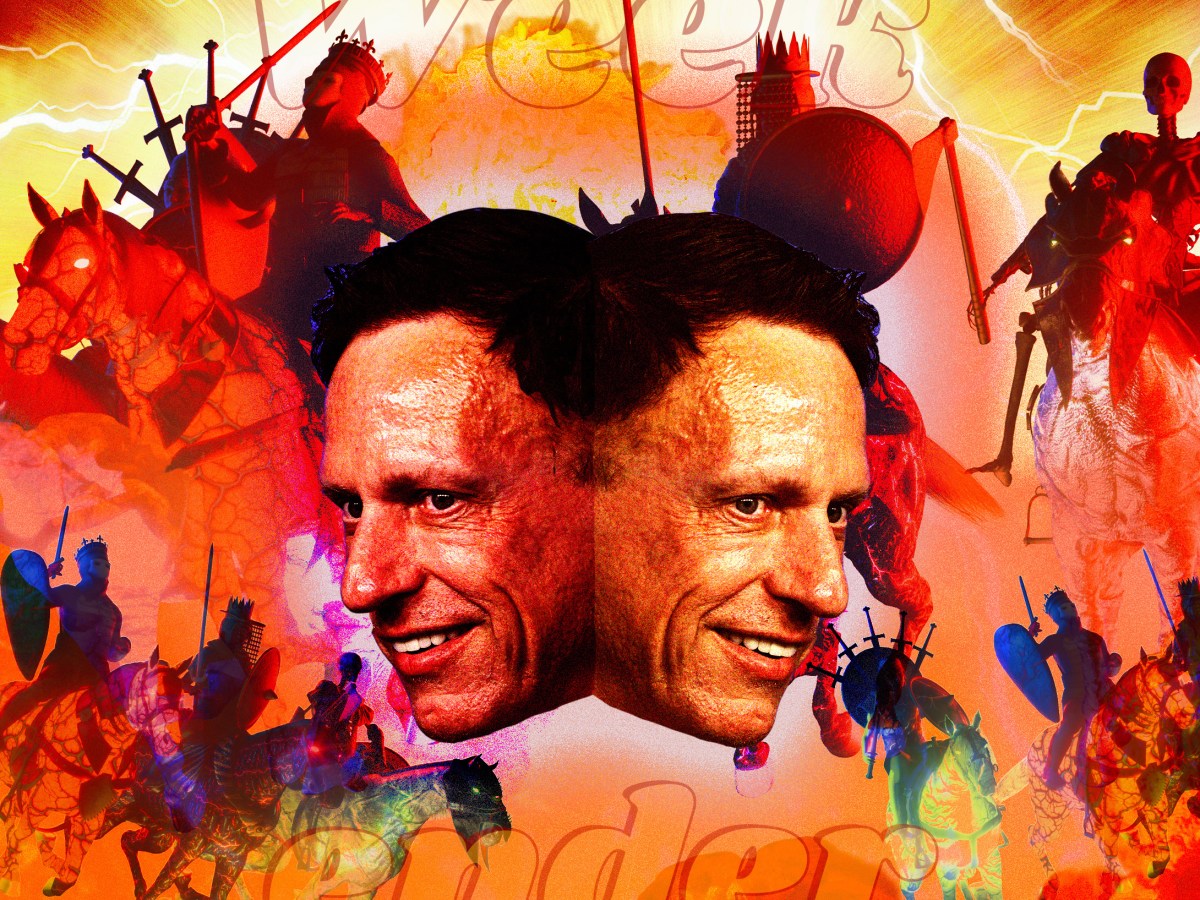
I thought of Poe as I read Theil’s interpretation of the Antichrist. Specifically, Poe’s story William Wilson. It’s about a privileged man who in his youth unknowingly encounters his consciousness transformed into a physical entity identical to him in appearance. This doppelgänger follows and antagonizes him through boarding school, elite universities and into adulthood. Ultimately, there is a confrontation between the two rivals and William stabs his antagonist. In classic Poe fashion, when William views himself in a mirror, he sees that he has stuck the knife in himself.
It was written a hundred years before Girard introduced his idea of the mimetic double, where rivals become so fixated on copying each other that the relationship inevitably ends in violence. I wonder if Peter Thiel has ever read it.
Ultimately, what persuaded me there might be something worth considering in Thiel’s lectures comes near the end of my correspondent’s account where he notes: “At one point, Thiel joked that perhaps he is not introspective enough to realize that he himself is in fact the Antichrist, but that in any case he fails to meet the (self-identified) criteria.” It took William Wilson looking in the mirror to see the truth.