
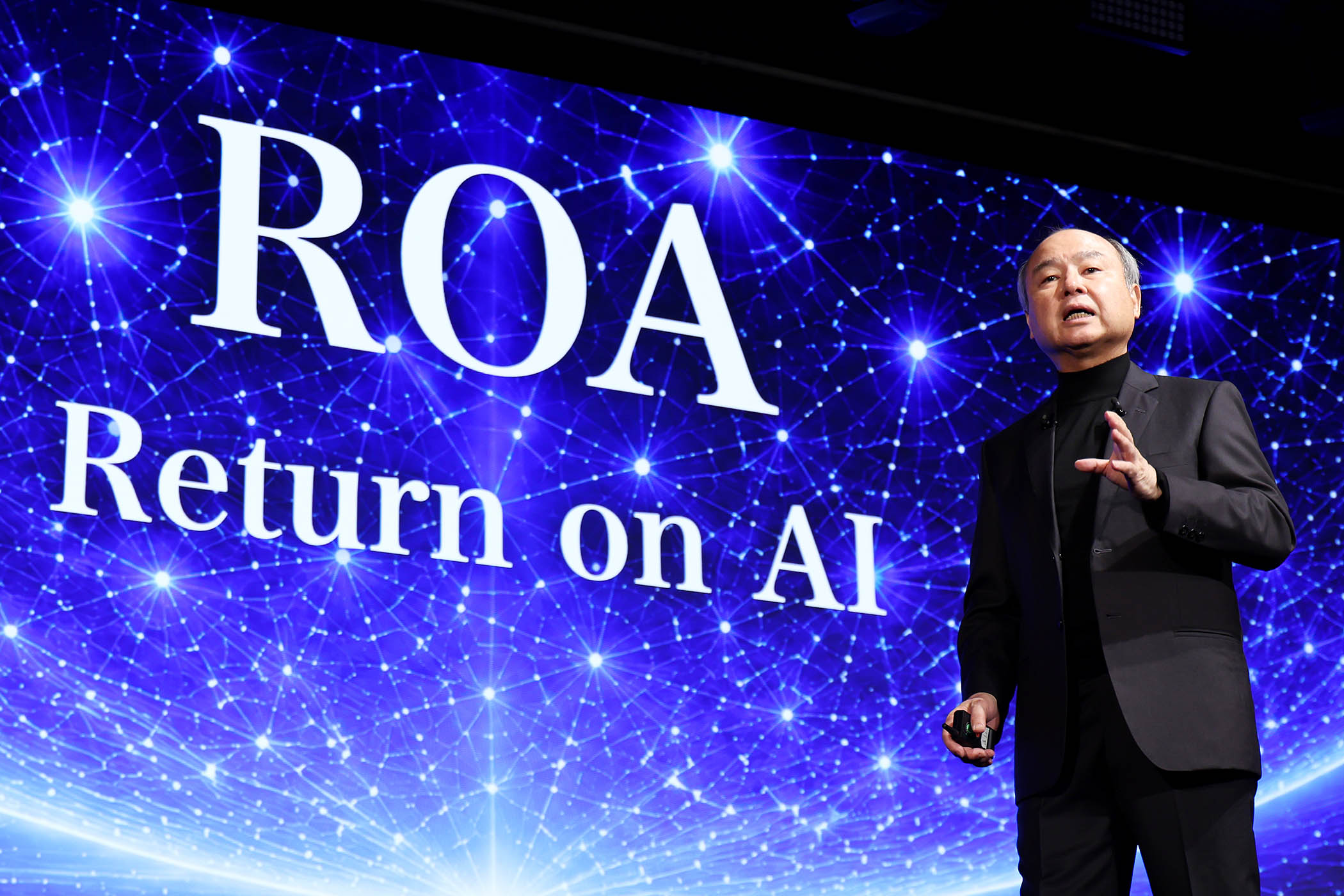
When Japan’s wealthiest investor, Masayoshi Son, let it be known he was planning to raise $100bn to plough into AI companies, investors were left wondering whether to laugh or head for the exit.
Ten years ago, largely thanks to deep-pocketed Gulf states, Son raised $98.6bn through his media-tech giant SoftBank. The Vision Fund invested in dozens of startups, fuelling the biggest boom Silicon Valley has ever seen. Then came the Covid pandemic, a sharp market correction, and yet another near-death experience for SoftBank and its mercurial founder.
Son’s latest high-wire act involves a $65bn bet on OpenAI, the ChatGPT developer, which is planning an IPO with a trillion-dollar valuation some time in 2027. The timetable is critical not just for Wall Street investors desperate to crystallise paper profits but also for SoftBank, which has borrowed heavily to finance its 13% stake.
Yet the growing public debate about AI safety, as well as rising competition from Chinese open source models and concern about soaring AI valuations, has introduced fresh uncertainty into the IPO process and therefore SoftBank’s future and the reputation of one of the world’s most consequential tech investors.
Last week there was a rout in chip-related shares, compounded by worries that revenues from the AI boom will not be sufficient to support the vast debt piles financing data centres. The IMF declared an AI crash to be one of three “salient risks” to the world economy, alongside government borrowing and a large-scale cyberattack. Adding to market jitters, Hock Tan, CEO of Broadcom, one of the leading chipmakers, said the AI boom was attracting ignorant speculators.
“A lot of investors have no clue what they are investing in,” Tan said at an event in Singapore. These punters “set very extreme expectations only to find out that it’s almost like they are in a casino”.
When it comes to high-rollers, Son is the ultimate whale. Born in a Korean family in Japan, the man known as Masa to friends and rivals suffered harsh discrimination as a child and almost died from Hepatitis B as a young man. He is a Forrest Gump character, close to or at the heart of the biggest technology stories of the past 50 years, the gambler who doubles down when everyone else cashes out.
Son bankrolled Alibaba, China’s internet colossus, before the world had heard about it; plotted with Steve Jobs to turn the iPhone into a wonder product; and, in the chaotic aftermath of the Brexit referendum in 2016, snapped up the UK’s most valuable chip designer Arm for $32bn in cash – in hindsight a paltry sum.
‘Some people ask whether we are in a bubble. They are out of their minds. This is just the beginning’‘Some people ask whether we are in a bubble. They are out of their minds. This is just the beginning’
Masayoshi Son
But he has also suffered humiliating setbacks: WeWork, founded by the charismatic Adam Neumann, caused losses to SoftBank of about $20bn; Greensill, the supply-chain finance business, crashed in 2021, damaging Son’s reputation (and that of former prime minister David Cameron); not to mention Katerra, a San Francisco construction “disruptor” linked to Greensill, Wag, a dog-walking app, and Zume Pizza.
Artificial intelligence changes everything, Son insists. The combination of more powerful chips, more intelligent agents and more sophisticated large language models will prove irresistible. By 2040, artificial “super intelligence” will account for about 20% of global GDP, he says.
“Some people ask whether we are in a bubble,” he told an investor conference in Kyoto last June. “They are out of their minds. This is just the beginning.”
Son has been preaching the virtues of AI for a quarter of a century. Well before it became fashionable, he spoke of “singularity” – the moment when robots surpass human intelligence. Some may find that terrifying. Not Son. The advances in medicine, science and daily life will be transformational, he says, though super-intelligence could be “super-dangerous” in the wrong hands.
SoftBank’s AI strategy rests on four pillars: chips (Arm, Bristol-based Graphcore and Ampere); large language models (OpenAI); infrastructure via data centres and energy (the much-hyped $500bn Stargate venture involving Oracle and OpenAI); and “physical AI” represented by robotics, led by the acquisition of ABB’s business in Switzerland.
That said, there’s no disguising how much is riding on OpenAI and its founder, Sam Altman, still only 41.
Son was late to OpenAI, missing out to Microsoft, which became the lead investor. During his Vision Fund phase, between 2016-21, Son splurged money on “tech-enabled” companies using data and algorithms rather than “Deep AI” model builders such as OpenAI, Anthropic and Google’s DeepMind. The man looking to hit a home run was responsible for one of the biggest swings and misses in the history of investing.
When ChatGPT was unveiled to the world in November 2022, SoftBank was in defensive mode. Son was out of the public eye (some say he was unwell). SoftBank, led in his absence by its CFO Yoshimitsu Goto, was desperate to reduce borrowing and restore confidence among investors.
Nominally doing penance, Son was in fact plotting a comeback. According to a close business ally, Jony Ive, designer of Apple’s fabled iPhone, he secured a second introduction to Altman. (Son had first met Altman in 2017 when the wunderkind was at startup accelerator Y Combinator.) This paved the way for SoftBank’s first OpenAI play: a $500m investment in October 2024 at a valuation of $157bn.
According to present valuations, OpenAI is worth about $850bn, making SoftBank’s 13% stake worth some $100bn. The latest slug of equity has been funded by one of the largest junk bond offerings in history ($11bn), paying steep yields of up to 9.75%. Furthermore, there is a $25bn margin loan on SoftBank’s Arm stake and a $10bn margin loan “linked” to OpenAI shares but not serving as collateral, according to SoftBank.
A house of cards? Not quite. But Son’s appetite for leverage – borrowing giant sums on the back of existing assets – remains insatiable. Son is not so much a tightrope walker as a plate spinner, with each plate a stake pledged as collateral for the next. The trick works as long as Masa keeps moving – and the underlying business is sound.
Arm, in which SoftBank retains a 90% stake, has proven an indispensable asset under its rock-steady CEO Rene Haas. Floated in New York in 2023, the chipmaker is today worth about $260bn – almost 10 times the 2016 purchase price. Then again, if Arm’s valuation drops, the loan against it does not.
People close to SoftBank play down the financial risk. The outstanding $25.9bn on a one-year bridge loan to fund the OpenAI stake was repaid last month, well ahead of schedule. Meanwhile, SoftBank’s loan to value – how much it owes against what its assets are worth – is only 13%, well below its self-imposed limit. (Credit ratings agencies put the figure higher because they count margin loans backed by investee shares.)
Looked at from a different point of view, the remaining dependence is structural. SoftBank borrows to fund OpenAI, whose rising paper value underpins those same loans, so the risk of contagion is real. The deus ex machina is Nvidia, the advanced chipmaker and the world’s most valuable company at $5.2tn, though it saw a cool $169bn wiped off in last week’s chip sell-off.
Nvidia buys stakes in customers, guarantees their debts, lends its credit rating and rounds up financing for the energy-hungry data centres powering the AI revolution. Its role as a backstop to OpenAI (and, by implication, SoftBank) has been critical.
Back in 2019, Son sold a 4.9% stake in Nvidia, a decision he describes as one of the worst of his career. Instead of sitting on a second Alibaba, he now finds himself hunting for cash to fund his AI ambitions. Hence his latest scheme to raise $100bn, largely from Gulf investors – and his rush to float companies such as SB Energy, which has yet to put a data centre into operation.
SB Energy’s prize asset is a data centre in Pike County, Ohio, the site of a Cold War-era uranium enrichment facility. Billed as the world’s largest data centre, the plant will be leased to OpenAI and is backed by Nvidia. SB Energy is projecting a revenue backlog of $439bn that it will receive over roughly 20 years, starting in 2028.
It feels like pie in the sky, but people close to SoftBank say power company valuations – in contrast to those of tech companies – are often based on future revenues. The same sources play down the significance of SoftBank’s latest $100bn fundraising target.
One said: “Masa says ‘100’ about everything. Like, let’s invite 100 journalists or let’s raise $100bn. He’s just thinking big.”
The idea that Son is overly dependent on Gulf money is also given short shrift in Tokyo. Hardly surprising, since Saudi Arabia, whose Crown Prince Mohammed bin Salman handed over $45bn for Vision Fund 1, is under daily assault from Iran-backed Houthi rebels and its own budget is stretched.
In the meantime, the United Arab Emirates, which delivered $15bn for modest returns, has its own distractions as a result of the Manchester City spending scandal. And neither country, incidentally, invested in Vision Fund 2.0.
The case against Son is that he is a momentum investor, a creature of enthusiasm easily swayed by charismatic founders such as WeWork’s Neumann and indeed Sam Altman. The case for Son is that he is a techno-optimist who has been dead right on direction, if not timing.
Son has always thought in terms of growth potential, viewing short-term profit and loss as a distraction. But financial markets are moving in the opposite direction. Investors want to know whether capital-hungry AI companies are real businesses with revenue and returns. Trillions of dollars are at stake.
Something, or somebody, has gotta give.
Lionel Barber is author of Gambling Man: The Wild Ride of Japan’s Masayoshi Son (Allen Lane)
Photograph by Kiyoshi Ota/Bloomberg via Getty Images