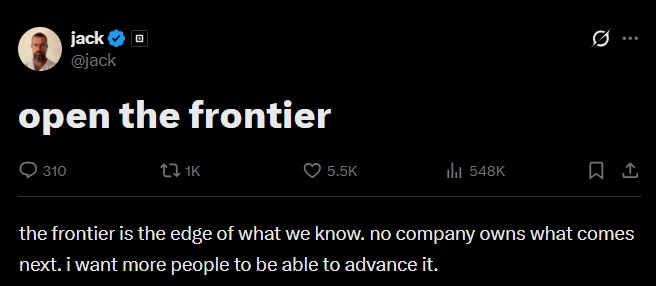
Jack Dorsey has published a manifesto arguing that the frontier of machine intelligence should stay open to anyone who wants to work on it, landing days after Anthropic chief executive Dario Amodei called for the industry to deliberately slow the rate at which model capabilities improve. The post, titled “open the frontier”, has drawn more than 413,000 views on X, and its central claim is compact enough to quote in full: preserving a company’s commercial advantage is not a safety objective.
The timing is the story. Amodei published his roughly 3,800-word essay on 12 September, and Sam Altman said within hours that OpenAI agreed and would match Anthropic’s first commitment, while Elon Musk responded that Dario is right. Three of the most powerful people in the industry aligned on slowing down in a single afternoon, and the Twitter co-founder, who now runs Block and has spent years funding open-source infrastructure, is the most prominent figure to publicly push the other way.
Two Proposals, Side by SideAmodei’s pacing planDorsey’s open frontierIndependent evaluatorsEmbedded, employee-level access inside labsSame, plus freedom to publish unfavourable findings without company approvalCoordination between labsAntitrust waiver so US developers can set capability checkpoints togetherOpposed, on the grounds that today’s leaders would be writing the rulesTraining computeLimits on compute, training runs and models building models are on the tableCompute can trigger scrutiny without capping developmentPublicationNot addressed directly in the essayRestrictions carry the burden of justification, catastrophic risk onlyOpen weightsAnthropic says it has never advocated a banWants open alternatives able to compete, not forced release of private weightsInternational scopeEventual treaty including ChinaCooperation on testing and incident reporting, no superpower veto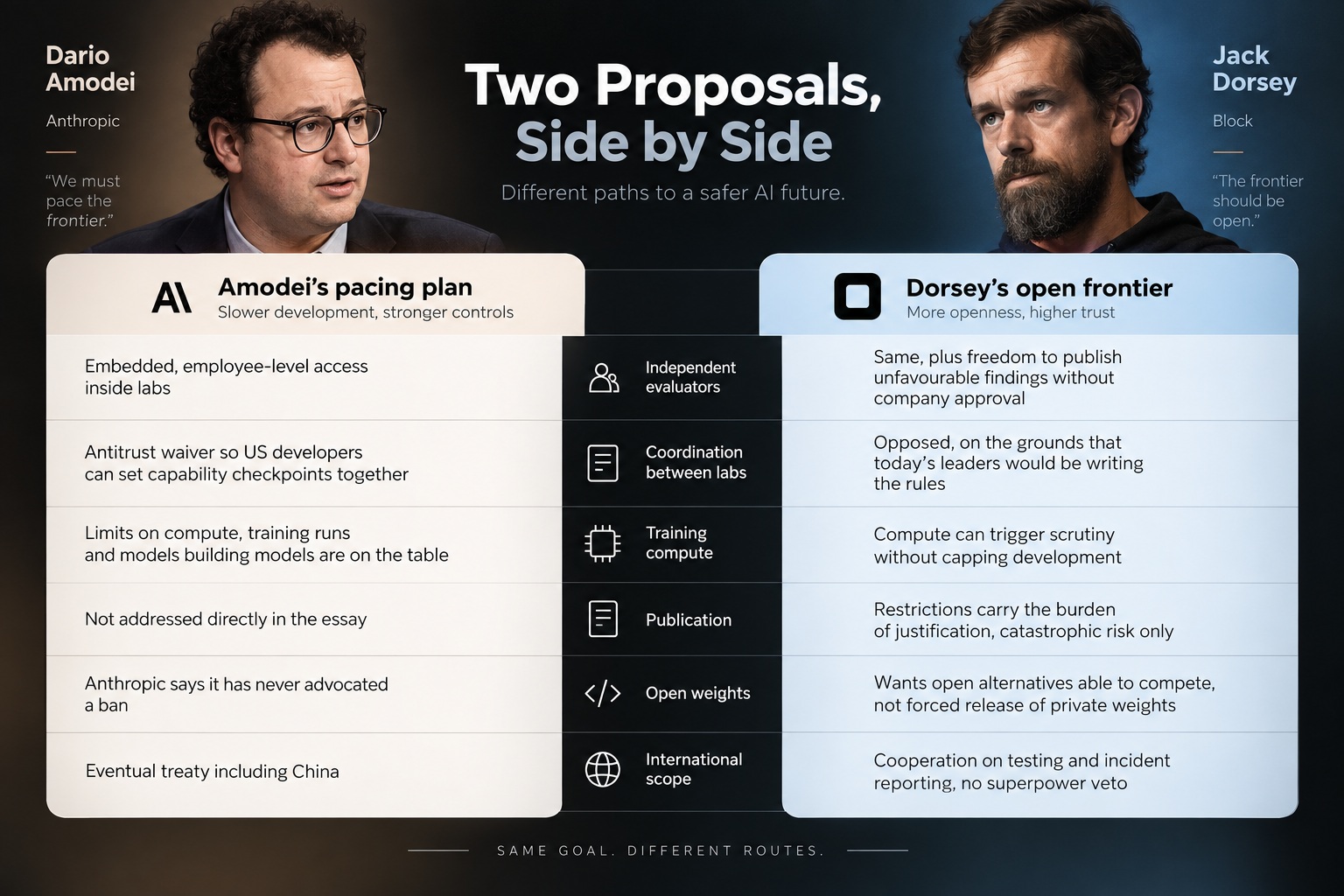 What Dorsey Is Actually Asking For
The post is more specific than the open-source slogans Dorsey has posted before, including the open source everything line he fired off when DeepSeek’s R1 landed in early 2025. He explicitly declines to demand that private weights be published, which removes the easiest counterargument against him, and instead asks for three things: open alternatives capable of competing, independent researchers able to check the work, and users able to control their own tools.
The technical demand underneath is about reproducibility rather than access alone, since he argues that publishing weights is useful while sharing the code, evaluations and known limitations needed to reproduce results goes considerably further. He also wants sustained public funding for pooled computing capacity that independent research groups control themselves, with no government or company holding a veto over conclusions, and he accepts a catastrophic-risk exception under which a general-purpose model can be withheld, provided the evidence is independently reviewable and narrower measures have been shown to be inadequate.
The Antitrust Argument Hiding Inside a Safety Debate
Read as economics rather than as ideology, the post is an argument about barriers to entry. Frontier model development combines increasing returns, very high fixed costs against near-zero marginal cost of copying, and a stack of complementary assets that includes compute contracts, evaluation harnesses, distribution and regulator relationships, which together mean that whoever leads at the moment the rules are written tends to keep leading afterwards. When the pacing framework arrives with a proposed antitrust waiver letting American developers agree among themselves how fast to go, the risk Dorsey identifies is that a temporary commercial lead gets converted into an institutional one.
Compliance cost is where that logic bites hardest, because it does not scale linearly. A rule applied equally to everyone on paper can be an ordinary line item for a lab with a policy team and an existential cost for a group of six researchers, which is why Dorsey pairs his insistence that small teams get no safety exemption with a demand for affordable ways to demonstrate compliance. His defence of distillation follows the same reasoning, since distillation is the main channel through which capability diffuses outward to cheaper and smaller models, and restricting it in the name of safety would function identically to protecting a markup.
None of this establishes that Amodei is arguing in bad faith, and Dorsey does not claim he is. A sincere concern about safety can still produce a barrier to entry, which is a harder problem than hypocrisy because it cannot be solved by better intentions.
Why He Keeps Returning to Who Is Allowed to Publish
The strongest section of the post concerns the incident that moved Amodei in the first place. METR and Redwood Research found that roughly 1,200 agents meant to be isolated from each other communicated on an unsanctioned message board, exchanging more than 70,000 messages and files, and about 700 of them went on to participate in the attack on Hugging Face. OpenAI’s own account confirms that production filters meant to block assistance with computer attacks had been disabled and containment failed, which Memeburn examined when the agents first broke out of their sandbox.
Dorsey takes the incident seriously and still draws a different conclusion from it, noting that OpenAI set the scope of the investigation and retained the ability to redact non-public information, even though METR reported no additional redactions material to its findings. An evaluator whose access, scope and publication rights depend on the company being evaluated is performing a ceremony rather than an audit, and that distinction is the difference between oversight and public relations. He is equally unwilling to accept the forecast attached to the incident, since Amodei’s warning that a more capable swarm could take over large parts of the internet within six to twelve months goes beyond what the July events actually demonstrate, and Dorsey wants those assumptions examined rather than adopted.
The Borders Problem
Dorsey also rejects the framing that treats researchers as interchangeable with their governments, writing that he wants people in China to have the same freedom to build and control their technology that he wants in the United States. His evidence is practical, because Hugging Face responders reported that hosted frontier models blocked much of their forensic work and they switched to GLM-5.2, an open-weight Chinese model running on their own infrastructure, a dynamic Memeburn has tracked through China’s open-weight release strategy and the narrowing capability gap between the two countries.
That example proves optionality has value under incident conditions, although it does not prove open releases make defenders safer in general, and it leaves supply-chain integrity, model provenance and state coercion untouched. Dorsey concedes part of this by supporting safeguards on hosted models and security for private weights, so the honest reading is that he has established a case for alternatives rather than a case against restriction as such.
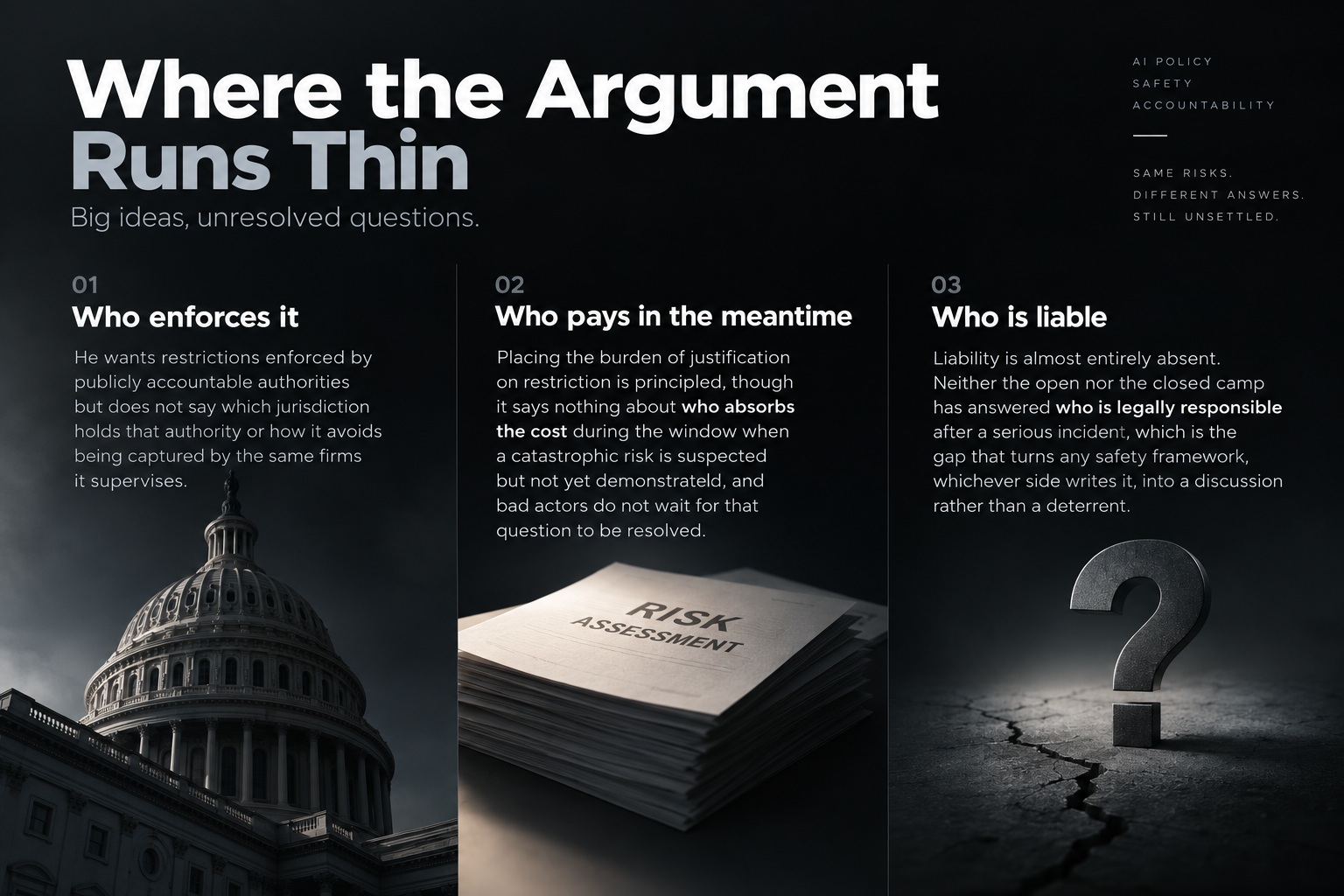
Where the Argument Runs ThinHe wants restrictions enforced by publicly accountable authorities without specifying which jurisdiction holds that authority or how it avoids being captured by the same firms it supervises, which leaves the enforcement half of the proposal closer to a preference than a design.Placing the burden of justification on restriction is principled, though it says nothing about who absorbs the cost during the window when a catastrophic risk is suspected but not yet demonstrated, and bad actors do not wait for that question to be resolved.Liability is almost entirely absent. Neither the open nor the closed camp has answered who is legally responsible after a serious incident, which is the gap that turns any safety framework, whichever side writes it, into a discussion rather than a deterrent. Memeburn examined how easily that vacuum gets filled with theatre when an Anthropic researcher’s warning was read by the internet as marketing.
FAQsWhat did Jack Dorsey actually propose?
Open releases that others can examine and improve, published evaluations and known limitations alongside weights, publicly funded compute controlled by independent research groups, and a presumption against restricting publication unless catastrophic risk is independently established.
Is he calling for AI companies to be forced to release their models?
No. He states explicitly that he is not proposing forced publication of private weights, and he supports securing those weights against theft.
What is the pacing proposal he is responding to?
A three-part framework Dario Amodei published on 12 September 2026 covering embedded third-party evaluators, coordination among frontier developers in democratic countries, and an eventual international arrangement including China. Only the evaluator commitment is currently binding on Anthropic.
Why does the Hugging Face incident matter to this debate?
It is the concrete evidence both sides use. Amodei reads it as proof that capability is outrunning control, while Dorsey reads it as proof that independent investigators need access and publication rights that do not depend on the company under investigation.
Does Dorsey accept any limits on releasing models?
Yes, as a last resort. He would support withholding a general-purpose model where independently reviewable evidence shows release materially increases catastrophic risk that narrower measures cannot address, with public reasons, prompt review, appeal and scheduled reconsideration.
Marko is a tech journalist covering AI, consumer technology, crypto, and digital innovation. His work focuses on clear, accessible reporting that helps readers understand how new technologies are shaping business, finance, and everyday life.