
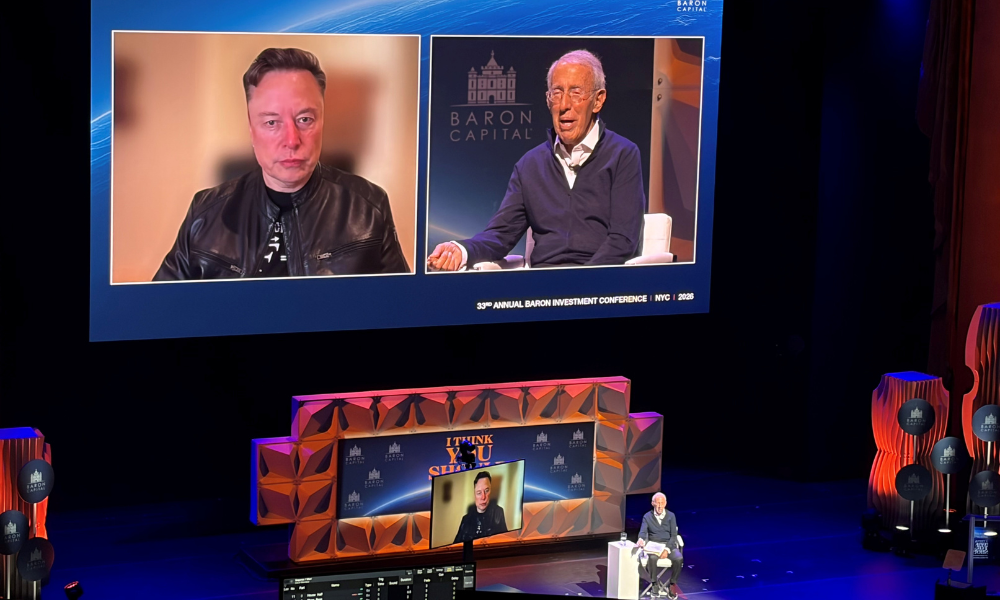
SpaceX CEO Elon Musk appeared via videolink during the Baron Investment Conference in New York
“The pitchfork level for data centers is pretty high,” quipped the SpaceX CEO.
Data centers may be critical to the AI revolution, but they have become a highly contentious issue as opponents slam their environmental impact and energy consumption.
For SpaceX CEO Elon Musk, there’s an obvious solution to the data center dilemma, which is building them in space.
“The pitchfork level for data centers is pretty high,” quipped Musk at the start of an hour-long discussion with Baron Capital CEO Ron Baron, in New York City Friday. Musk appeared via videolink for the “fireside chat” during the Baron Investment Conference at the Metropolitan Opera House in Manhattan.
Baron later asked Musk about data centers in space, and the SpaceX chief said that initial signs around the technology are positive. “So there’s a satellite with an NVIDIA GPU up there that we launched, and there’s a satellite we recently launched with a Google TPU,” he said. “And these are operating to the best of my knowledge – they’re working fine in space.”
The Google Tensor Processing Units are part of Project Suncatcher, a research effort around scalable machine learning infrastructure in space.
SpaceX is working on its own Starmind project to capture solar energy in space and to deliver compute power for AI back on Earth via a satellite constellation. “We expect to start launching the first Starmind computers, which we’ve co-designed with NVIDIA, probably – I’m just guessing here – but in the 3rd quarter of next year,” said Musk. “And we’ll start off slow, but then it will ramp to significant volume probably in ’28, and then very, very large volume in ’29.”
“In order to get to the terawatt per year scale or even, let’s say, maybe the 200 gigawatt per year scale, you really need to go into space because there just isn’t enough power on the ground to realistically get to those levels per year,” he added.
Musk explained that it’s always sunny in space and the solar panels can always face the sun directly. “You don’t have atmospheric attenuation of solar power, so you get 30% more solar power in space,” he said. “You can get away with a very tiny battery pack because you don’t need to last through the night.”
The SpaceX chief also highlighted the role that the Starship mega-rocket will play in the push to build data centers in space. “The cost of intelligence in space is dramatically less than the ground once you have a low cost per ascent to orbit,” he said. “So Starship, because it will be the first fully reusable rocket, will lower the cost of access to space, by a factor of 100, or maybe more.”
A major milestone is looming for SpaceX and Starship. The space exploration company is targeting Nov. 13 for its Starship 15 mission, which will mark its first attempt to catch the ship via the launch tower, according to the Teslarati website.
This has been an eventful week for Musk, with the announcement that Tesla will be winding down production of its Cybertruck at Gigafactory Texas around the middle of 2027 to make room for increased Cybercab production. The SpaceX and Tesla CEO was not asked about the Cybertruck decision or the midterm election result during his discussion with Baron on Friday.