
SAN FRANCISCO – Investigations into whether Nvidia’s CEO was the target of a “foreign intelligence effort” are raising questions about the future of the chipmaker, which became one of the world’s most valuable companies by providing technology that powered the artificial intelligence boom.
Jensen Huang has been synonymous with Nvidia since he co-founded it more than 30 years ago. The company now faces potential damage to its reputation and stock price, uncertainty over a possible successor and new scrutiny from shareholders and elected officials.
President Donald Trump said Monday that the FBI is investigating Huang’s affair with an alleged Chinese government agent. But Trump said he spoke with the executive and believes Huang “had absolutely no idea that the person in question was a spy.”
With a valuation of more than $4 trillion, the company has outsized importance as a Wall Street behemoth and provider of chips relied upon by AI developers. Law enforcement and members of Congress, as well as Nvidia’s board and shareholders, are all asking questions about the affair. The company’s shares dropped more than 4% Monday and continued sinking Tuesday morning.
Nvidia’s identity has been tied to Huang himself
Huang has said he has more than 60 direct reports in a corporate structure that keeps him at the center of decision-making. As various investigations ramp up, the succession plan to replace Huang is unclear.
“The Nvidia board is between a rock and a hard spot. They have almost no good options. Jensen is Nvidia,” said David Yoffie, a professor at Harvard Business School. “And if he has done something wrong and he needs to be removed and they have no successors, that’s a terrible outcome.”
Replacing Huang would be challenging in part because his public profile is so closely associated with Nvidia.
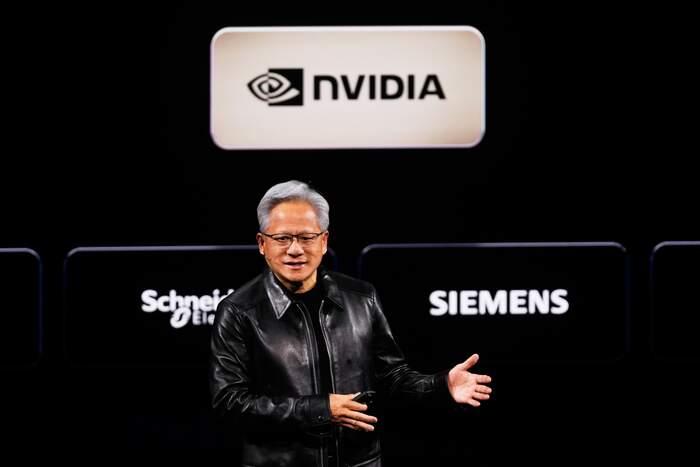
Jeffrey Sonnenfeld, a professor of leadership at the Yale School of Management, compared Huang’s relationship with Nvidia to Steve Jobs’ role at Apple. Down to Huang’s signature leather jacket, like Jobs’ turtleneck, Nvidia is “symbolically and substantively, inextricably intertwined around his personal aura.”
Other tech executives, such as Oracle’s Larry Ellison and Microsoft’s Bill Gates, have also been deeply intertwined with the success of their companies, making it hard to separate them. But in those cases, the companies “can still be successful long after the original founders have taken on a lesser role,” said Dan Morgan, vice president and senior portfolio manager at investment firm Synovus Trust.
If Huang resigns or is removed by the board, speculation on possible replacements has turned to figures including Nvidia co-founder Chris Malachowsky, who is a senior technology executive at the company, and Chief Financial Officer Colette Kress.
Nvidia employs more than 40,000 people worldwide, and there are “lots of other great leaders” within the company, said Bob O’Donnell, president, founder and chief analyst at TECHnalysis Research.
“I think it’s important that the company starts to let some of these other folks come out as spokespeople so people feel trust, they feel good about Nvidia and their future, even without Jensen,” O’Donnell said, although he said he does not think Huang will leave his post.
In a statement announcing its own investigation, the company’s board also expressed confidence in Huang and said it had no reason to believe national security or company secrets were compromised.
Huang had the ‘Midas touch,’ but his reputation is at risk
During his 33-year tenure at the helm of Nvidia, Huang built a reputation as a trusted business leader and an established voice within the technology world. He cultivated close relationships with other tech executives, as well as with Trump, helping to persuade him to take a lighter touch on regulating AI.
“Everybody wanted to have that Midas touch of his when it comes to technology,” O’Donnell said.
But the scandal is a growing liability for Huang and Nvidia at a delicate time for the AI industry after the midterm elections in the U.S. ushered in a wave of Democrats promising tougher regulation. Top Democrats Sen. Mark Warner and Rep. Hakeem Jeffries said Monday they are interested in investigating further.
A shareholder on Monday sued Nvidia and Huang, accusing them of deceiving investors in their responses to media reports about Huang’s affair with the purported Chinese spy. The complaint filed in federal court in California says the company misled investors about Huang’s relationship with Alice Huang, who news reports said is suspected of working for Chinese intelligence, and the national security implications.
The New York Times identified her as a business executive and Chinese citizen.
Sonnenfeld said he places the odds that Huang stays on as CEO at roughly 50-50, but those odds are “slipping by the moment.”
“He has lost the confidence and trust of his key constituents, his board, his employees,” said Sonnenfeld, who is also founder and president of the Chief Executive Leadership Institute. “And every employee knows that if anybody else had done this, they would have been fired long ago.”
Some experts are more confident in the company’s stability going forward. Morgan, of Synovus Trust, said that if Huang is required to step down to a lesser role at Nvidia following the company’s investigation, he is “still confident that the company will continue to maintain its lead in the GPU AI chip market.”
But at the same time, the affair “sounds more like a made-for-TV melodrama than a real story,” he said.
___
Huamani reported from Los Angeles. Associated Press Technology Writer Barbara Ortutay in Oakland, California, contributed to this report.
Copyright 2026 The Associated Press. All rights reserved. This material may not be published, broadcast, rewritten or redistributed without permission.