
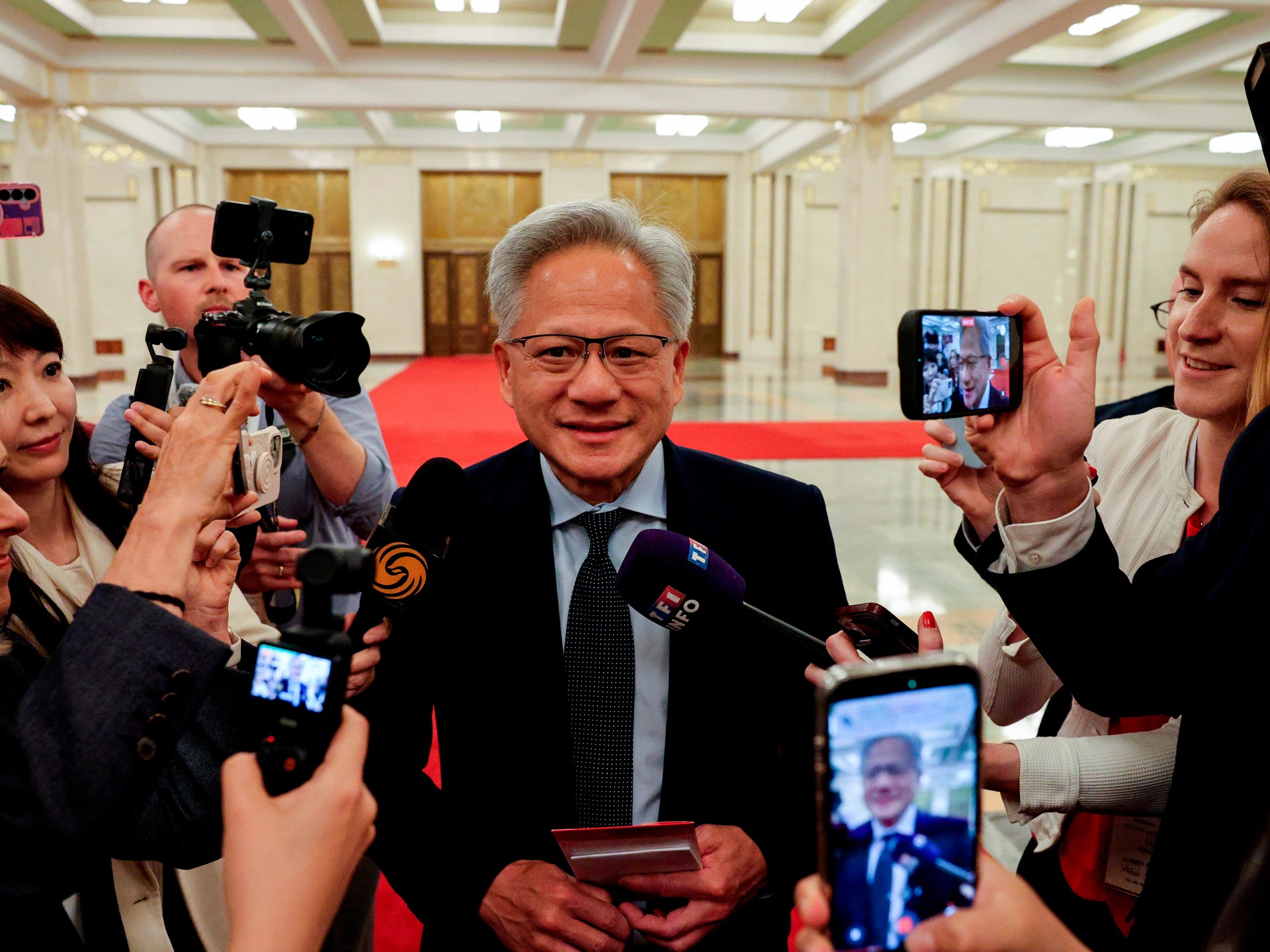
Nvidia chief executive Jensen Huang has resigned following revelations that he had two extramarital affairs.
Nvidia’s chief financial officer, Colette Kress, has taken over as interim CEO while the company looks for a permanent replacement.
Recommended Stories list of 2 itemsend of list
The company controls an estimated 90 percent of the market for advanced artificial intelligence (AI) chips and is one of the world’s most valuable companies.
Here is what we know:
Why did Nvidia CEO Jensen Huang resign?
Huang stepped down on Thursday following several days of intense scrutiny over his personal relationships and potential national security issues.
On Sunday, Huang admitted to being unfaithful to his wife and apologised to his family and to Nvidia employees.
Huang moved to the United States from Taiwan as a child. His wife, Lori, has been with him since before he cofounded Nvidia in 1993.
Nvidia’s board initially backed Huang, saying on Sunday that it had confidence in his leadership. It also launched an independent investigation into reports that he had been targeted by Chinese intelligence.
But on Wednesday, the Reuters news agency reported the board was meeting to consider whether to remove him following further revelations of a relationship with Kimberly Powell, a senior Nvidia executive who reported directly to him.
The company announced his resignation on Thursday. Huang also resigned from the board, ending his 33-year tenure as chief executive.
Nvidia did not give a reason for his departure.
“Jensen’s contributions to Nvidia are profound,” the board said in a statement, thanking him for his “immeasurable contributions to the company and the industry”.
What are the allegations involving Jensen Huang?
The allegations were related to reported extramarital affairs.
The first involved Alice Huang, a former executive at Singapore-based tech company Megaspeed, who is alleged to have worked for Chinese intelligence.
The allegations have raised questions about national security, particularly given Huang’s support for allowing Nvidia to sell advanced AI chips to China.
Separately, The New York Times reported on Wednesday that Huang had an affair with Powell, Nvidia’s vice president of healthcare, who reported directly to him.
The second reported relationship raised concerns about a potential conflict of interest involving a senior executive.
Why are there national security concerns?
The controversy comes amid a debate in Washington over exporting advanced US AI chips to China.
Huang, 63, spent years campaigning against the restrictions on Nvidia chip sales to China.
In December 2025, President Donald Trump approved the export of Nvidia’s H200 chips to China, despite concerns that the technology could bolster Beijing’s AI capabilities.
The chips are about six times more powerful than the H20 models previously available to Chinese buyers.
Exports are subject to US inspections, limits on shipments, restrictions on military use and a 25 percent tariff.
According to Al Jazeera’s Osama Bin Javaid, Chinese companies reportedly ordered more than two million H200 chips, potentially worth $54bn.
“Worth remembering it’s orders, not completed sales,” he said.
Critics are concerned the technology could help China close the AI gap with the US.
The allegations raised questions about whether his personal relationships could have exposed sensitive information.
“There is no established evidence he knowingly assisted Beijing or that company secrets were compromised,” Bin Javaid noted.
Nvidia’s board has also said it has no reason to believe national security was compromised.
Who is Colette Kress, Nvidia’s new interim CEO?
Kress has served as Nvidia’s chief financial officer since September 2013 and oversaw the chipmaker’s finances during a period of growth.
During her time at Nvidia, the company’s annual revenue rose from $4.13bn in fiscal 2014 to $215.9bn in fiscal 2026.
Before joining Nvidia, Kress held senior finance roles at Texas Instruments, Microsoft and Cisco.
She holds a bachelor’s degree in finance from the University of Arizona and an MBA from Southern Methodist University.
Kress is also among the US’s wealthiest self-made women, according to Forbes.
In a statement following her appointment, Kress said she was committed to building on the foundation Huang had created over the past 33 years.
 This undated handout photo from Nvidia obtained on November 12, 2026, shows Nvidia Chief Financial Officer Colette Kress, who has been named interim CEO following the resignation of Jensen Huang [Handout/Nvidia via AFP]Will Colette Kress become Nvidia’s permanent CEO?
It is not yet clear.
Nvidia’s board has appointed Kress as interim CEO while it searches for a permanent replacement and considers both internal and external candidates.
Trump has suggested former Apple chief executive Tim Cook as Huang’s successor.
In a post on Truth Social, Trump praised Huang’s work at Nvidia and said Cook was the person to replace him.
“A Legend replaces a Legend,” Trump wrote.
Cook stepped down as Apple’s chief executive in September and now serves as the company’s executive chairman.
Speaking to Al Jazeera, technology and cybersecurity analyst Ritesh Kotak said choosing Nvidia’s next CEO would be a decision for the company’s board.
“At the end of the day, it comes down to the board,” he said.
Kotak pointed to the differences between Apple, which primarily sells consumer technology, and Nvidia, whose chips power much of the AI industry.
There has been no indication that Cook is interested in the position.
What have been the reactions?
Trump has defended Huang amid the allegations.
Reporting from the White House, Al Jazeera’s Alan Fisher said Trump had offered a “very forceful defence” of the Nvidia cofounder, who accompanied him on a trip to China earlier this year.
Trump said he recently learned of the suspected spying scandal, although reports suggest he had been informed of the allegations before the trip.
Fisher said the president was likely to face further questions about “what he knew and when he knew it”.
Meanwhile, Huang’s departure has raised concerns about Nvidia’s future.
“He’s the captain that was steering the ship back since the early ’90s,” Kotak told Al Jazeera.
“These are big shoes that need to be filled,” he added.
Kotak said the resignation could create uncertainty among Nvidia’s employees and customers.
“If you’re Nvidia, if you’re the employees, if you’re a customer, I think you’re worried right now,” he said.
Clement Delangue, chief executive of Hugging Face, which Nvidia has agreed to acquire, reaffirmed his commitment to open-source AI following Huang’s resignation.
Meanwhile, Lloyd Blankfein, former chief executive of Goldman Sachs, reflected on Huang’s departure in a post on X.
“Sad about Jensen. Shakespearean,” he wrote, quoting former French President Charles de Gaulle: “The graveyards are filled with indispensable men.”
Huang’s departure has also raised questions about the wider AI industry. Nvidia is not only a major chip supplier but also an investor in companies that build and rent out AI computing infrastructure.
The company is also preparing to invest approximately $10bn in AI developer Anthropic as part of its planned stock market listing, expected next week.
What’s next for Nvidia?
Nvidia is in a difficult moment as it looks for a permanent CEO and is under increasing political scrutiny in Washington.
The hunt is now on for a permanent successor, and the board are open to both insider and outsider candidates, Nvidia said.
According to Reuters, several names are being discussed by industry watchers, including:
Kress, Nvidia CFO, analysts and investors have cited her experience, authority and deep relationships with Wall Street as assets that could help steer the company through the transition.
Nvidia executive Ian Buck, vice president of hyperscale and high-performance computing. He joined in 2004 and helped develop technology that transformed the company from a video game chipmaker into a leading force in AI hardware.
Rene Haas, Arm CEO, spent seven formative years at Nvidia, rising to vice president and general manager.
Harvey Jones, Nvidia’s first-ever board chair, was appointed to the position following Huang’s resignation. Jones has served on Nvidia’s board since 1993, before the chipmaker went public. He also sits on the company’s audit and nominating and corporate governance committees.
Lisa Su, who leads AMD, is one of Nvidia’s main competitors. If appointed, the announcement could represent a major disruption for AMD.
Sanjay Mehrotra, Micron SEO, has more than four decades of experience in the semiconductor industry and has worked closely with Nvidia, which uses Micron products.
And Cook, who succeeded in leading Apple after cofounder Steve Jobs died in 2011, appeared as a potential candidate following Trump’s comments.
The leadership shake-up has also had an effect on the markets. Nvidia shares were down nearly 12 percent at one point on Thursday before recovering some of that ground.
The major US stock indexes also closed lower.
“Investors seem to be moving past the scandal and putting their money elsewhere, shifting to other tech stocks,” Al Jazeera’s Kristen Saloomey reported from New York.
Meanwhile, US lawmakers are looking into the potential national security implications of Huang’s reported relationships.