
AI Companies Race to Secure Long-Term Memory Supplies
Discuss Equity Investments, Corporate Bonds and Other Cooperation Options
“Contracts Favorable to Producers Expected”
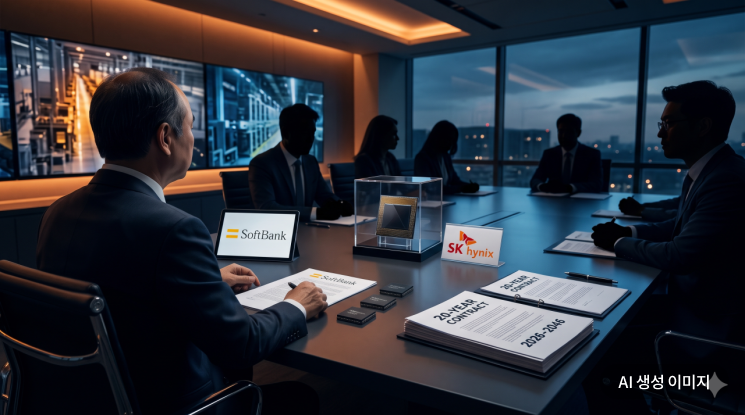
Analysts say AI companies are considering a range of ways to secure memory, including equity investments, joint ventures and purchase agreements lasting up to 20 years. The reason is that memory shortages could hamper efforts to improve AI performance as competition intensifies. As buyers compete more fiercely to secure supply, analysts expect this to lead to contracts and financing arrangements that favor memory makers.
On Nov. 23, Kim Sunwoo, a researcher at Meritz Securities, said, “Not only SoftBank but also various memory buyers are considering a range of investment and cooperation options, including equity investments, special-purpose corporate bonds and joint ventures, as part of their medium- to long-term memory procurement plans.”

From Buying Chips to Participating in Production… Equity Investments and Joint Ventures Under Consideration
According to The Information and a Reuters report citing it, SoftBank Chairman Masayoshi Son reportedly sounded out U.S. financial institutions about the possibility of raising around $1 trillion to acquire SK hynix. SoftBank said it is no longer actively considering the deal, while SK hynix said it had no knowledge of the report.
Researcher Kim believes SoftBank has proposed several options to SK hynix since last year to secure a stable supply and participate in its high-bandwidth memory (HBM) business. “It is looking beyond simple long-term supply contracts and seeking to secure supply over an extended period and commercialize the business by participating in production,” he said.
SoftBank owns semiconductor design company Arm and is also developing its own AI computing chips. Even if it develops semiconductors for computing, it would be difficult to expand the business without sufficient memory to use alongside them. Researcher Kim also believes SoftBank is considering ways to link its investments in AI services such as OpenAI and Perplexity with the memory business.
Expectations for “recursive self-improvement (RSI)” are seen as one factor behind these moves. The concept is that AI becomes smarter by repeatedly analyzing and modifying its own performance. Researcher Kim said that “a severe shortage of memory semiconductors could become a medium- to long-term bottleneck” in this process, adding that various ways to stabilize memory procurement are under consideration.
Cooperation to participate in production would also have to address issues involving control and technology leaks. Researcher Kim believes SK Group has little intention of selling SK hynix, one of its key assets. He said the company would be “extremely sensitive to any infringement on its decision-making authority during factory operations and to the risk of technology leaks” in the case of equity investments or joint ventures.
Who Will Pay to Expand Factories? Producers Take a Cautious Approach
Buyers’ demands are also reflected in the contract terms. According to Meritz Securities, multiple big tech companies, including U.S. cloud companies, have begun proposing purchase commitments lasting more than 10 years and up to 20 years, beyond the typical three- to five-year long-term supply agreements (LTAs). The aim is to secure now the memory they will need in the future.

Employees are leaving work at SK hynix headquarters in Icheon, Gyeonggi Province. Photo by Kang Jinhyeong.
Memory makers cannot decide to expand capacity based solely on a promise of long-term purchases. Expanding production facilities also increases fixed costs, including depreciation expenses. If demand later weakens or prices fall, the company that expanded its factories will bear the burden. This is why producers that have experienced past semiconductor downturns find it difficult to invest based only on the contract term.
Researcher Kim expects how to finance capacity expansion and protect management control, alongside purchase agreements, to become increasingly important. The analysis suggests that financing through corporate bonds and similar means could reduce business risks for memory makers more than an approach in which buyers acquire stakes and participate in decision-making.
Hot Picks Today

“Two Spend 500,000 Won in a Flash, Yet Wait Two Hours?” … ‘Dreamland’ Shunned by Kids and Foreign Tourists
Despite the recent decline in memory stock prices, Meritz Securities maintained a positive outlook for industry conditions and earnings to improve in 2027-2028. “New business structures that favor memory makers will emerge beyond simple purchase contracts,” Researcher Kim added. “Changes in the ecosystem that benefit memory makers will drive a strong recovery in their share prices.”
This content was produced with the assistance of AI translation services.
© The Asia Business Daily. All rights reserved. Unauthorized AI training and use prohibited.