
00:09 Speaker A
Brian, thank you so much for uh giving us the time.
00:11 Brian
Yeah.
00:11 Speaker A
I want to start with a Coinbase question. Uh, what’s Coinbase today? and what what was it before five years ago and what is going to be in the future five years time?
00:23 Brian
Yeah, well, our mission at Coinbase is to increase economic freedom in the world. That hasn’t changed. and we started off with crypto as a way to decentralize the financial system, give people, you know, sound money with Bitcoin and property rights and free trade and permissionless access. I think that’s just getting started actually. It’s it’s very much a big journey. But now we’re seeing AI play a big role as well. and in the same way that crypto decentralized the financial system, we want to see AI decentralized to preserve freedom in the world. We think it’s a bad future if just a couple of frontier labs have, you know, all powerful, all knowing overlords. And I think many of the people running those those labs feel the same way. And so the the antidote to that is to have a bunch of open weight models that are all collaborating together. I think open weight models on narrow tasks can outperform the frontier. and just like a team of people can outperform a single smart individual, we’re going to see teams of agents come together and so to do that, they’re going to need financial infrastructure and prices and markets as a way to collaborate uh in this new agentic economy. So that that’s what Coinbase is building next. We’re building um the financial accounts for for AI, we’re building the payment rails and the market places where uh builders can come together and collaborate and build teams of agents.
01:31 Speaker A
Can you quan quantify how big that market will be?
01:34 Brian
Yeah, well by 2030, there’s some estimates that about three to 5 trillion dollars of payments, you know, will be happening in the agentic economy. I think if you go out to 10 years from now, you know, what percent of all transactions will be done by agents instead of humans. I I think it’s well over like 99.9% will be. Yeah, because there’s just going to be more agents than than humans. They’re they might be doing smaller transactions, real-time transactions.
01:57 Speaker A
You don’t think humans will have any input on this?
01:59 Brian
Oh, they will for sure. I mean, the human economy is going to be at least as what as big as this today, probably even bigger. I just think there’ll be way more agents.
02:07 Speaker A
I see. So, if you look at that kind of future, what’s the security risk? I mean, we’ve seen a lot of AI-driven hacks and, you know, and and and web 2, web 3 as well. How do you, how do you prepare for that?
02:22 Brian
Yeah, so I think uh trust really matters in these moments and I think that um there’s a flight to quality right now because whenever we see an incident happen in the industry, you know, we try to go and collaborate with other companies in the space to mitigate the issue, but it also, you know, to be honest, it it benefits Coinbase in these moments. We’re the largest custodian of crypto, the most trusted brand. And we’ve done a number of things over time like, you know, we’ve developed our infrastructure in a way that a single developer getting malware on their laptop can’t be used to compromise uh our systems. More than 99% of the funds are stored entirely offline, disconnected from the internet. And then what I think all firms should be doing right now is really using AI on defense. That’s how you combat AI from the attackers is to use AI as a defender. And for instance, you know, we’re using AI to to review and scan every line of code before it goes into production. Um, so these are good best practices.
03:15 Speaker A
And is that the kind of uh advice you’d give any founder who’s looking into that this kind of a market?
03:20 Brian
Yeah, I think every company is trying to figure out how to be an AI native company and part of that is using AI on defense for cyber security.
03:26 Speaker A
Mhm. Gotcha. Um, I want to talk a little bit more about uh crypto here. Um, you said crypto could be the infrastructure for this big economy that’s coming, right? Um, we’ve seen Open AI start their wallet and not with crypto. What’s your take on that? Like, you know, they’re still doing web two kind of wallet and obviously probably paying fees and all that. If somebody asks you like, hey, Open AI is doing it. Why do we need crypto then?
04:02 Brian
Well I think uh, you know, backward compatibility is important. So most of the merchants out there in the world are still accepting credit cards. Uh, we we don’t mind that. We have a coinbase card and you know, we’re going to make that available to agents as well. So the initial use cases people have been building with these agents are kind of like personal assistants. so it’s like, hey, can you buy me a plane ticket? Can you buy me a pair of shoes? That kind of stuff is still going to run on credit cards for a while.
04:26 Speaker A
I see.
04:27 Brian
But what I’m sort of talking about I think is the next evolution of that where agents are going to be paying other agents and many of these are small transactions amount real time, they’re exist all over the world. That’s going to require new rails and so there’s a there’s like a there’s a website we put together called agentic.market and you can see these real-time agentic payments happening. Most of it’s happening right now on base with USDC stable coins. Uh and so that’s going to be a big thing in the future.
04:57 Speaker A
would you if somebody tells you like, give me exact example of how that would save me money or save me time? Can you do you have any numbers or any examples?
05:08 Brian
Yeah, I’ll give you an example. So, um a lot of people are using AI to make ads for their business like to put on social media. If you go to a def a default frontier agent today and you say, make me an ad, um it won’t do a very good job by itself. And the reason is that it needs to collaborate with a number of other vendors. So you might need to uh work with 11 labs to get a really professional voice over done, right? You might need to get work with a a video specialist to get um like certain rendering done that doesn’t look kind of low budget, right? And so we’re seeing more examples like that where the agent that you’re talking to can’t do it all itself. It needs to connect to 1, two, 10, 20 other vendors to start to really get more meaningful work done. And you can imagine that as you give it higher level tasks like, let’s say you you say, hey, I have this new idea for a product, um help me launch it into the world. It might need to connect to dozens of vendors to get that done just like uh you would if as a human starting your own company.
06:21 Speaker A
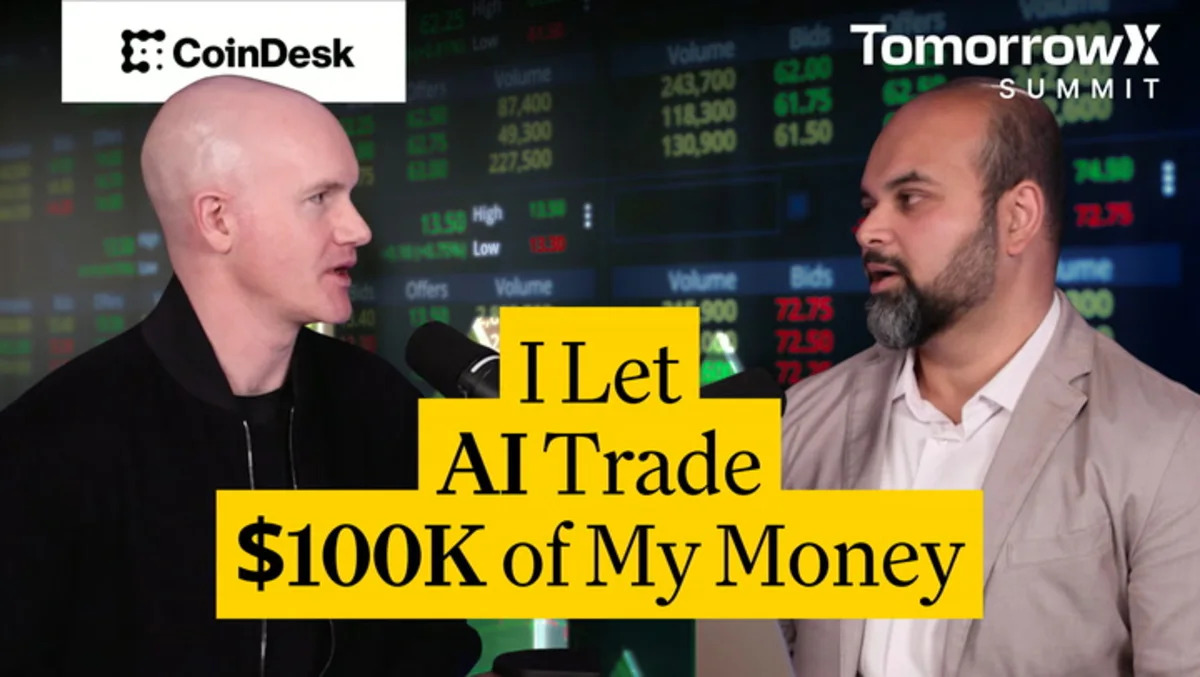
Mhm. Makes sense. So one more question about AI agents and we were talking about this about backstage is that would you personally give an an AI agent $100,000 to trade?
06:33 Brian
Yeah, I mean, I already have been giving it money like that to trade. So uh that’s what’s great about, you know, Coinbase is what we’re really good at is taking frontier technology like crypto and AI, making it trusted and easy to use. So in the case of AI, I don’t think people should just connect an account an AI agent willy-nilly, but they should we’re doing it in a way at coinbase that creates safety and security. So you can segregate a a some set of funds. Um you can give it limits and controls and permissions.
07:04 Speaker A
I see. Is that the key that giving the limits and controls?
07:07 Brian
Yeah, and and then it can ask you permission before it does anything, right? Now, if you want to eventually you trust it enough and you say, okay, trade on autopilot. I’ve only put $500 here, so you I I’m going to allow you to experiment or do it with paper trading to first, you know, before you go with real money. These are the kind of things people are starting to experiment with.
07:27 Speaker A
How’s your uh your agent doing with your 100,000?
07:31 Brian
Well, I have three or four of them running with different portfolios. Some of them are up, some of them are down, to be honest.
07:39 Speaker A
Okay. Fair.
07:39 Brian
Um and we’re and we’re developing actually some cool features where anybody can craft their own trading strategy and they can publish it and if it’s doing well, other people can copy trade it. So I think I think that’ll be a big feature.
07:54 Speaker A
Gotcha. Speaking of trading, um we know what’s happening in crypto markets and traditional markets as well. What’s your thought on the recent brutal sell off that we’re seeing and I know you you had some predictions in 2030, Bitcoin will be certain numbers. Are you still sticking by it and where when can we start seeing some relief?
08:21 Brian
Yeah. Yeah, I’m sticking by it. I think that we saw something similar in advance of the SpaceX IPO where there was a Bitcoin sell off. People rotated into SpaceX, but then after a few months, you know, it came back and people rotated back in. The Anthropic IPO, I think is happening later this week. So I I think that’s primarily what’s happening. I also, you know, I really believe in these four-year cycles for Bitcoin and if you if you believe in that hypothesis, I think we’ve probably seen the bottom of this cycle, things will start to trend up next year. Uh, so overall, I’m pretty bullish. I, you know, I think what did I say? By 2030, it might be 400,000. Yeah, something like that. I I think that’s pretty reasonable.
09:10 Speaker A
Okay. And uh what uh would make you say that?
09:12 Brian
Oh I I should say one more thing too. I think this the bottom of this cycle was still 4x the bottom of the prior cycle. that’s true. So you know, you have to look at I think if you look at it over these four year cycles, things are going to trend positively.
09:25 Speaker A
And to get to that 400,000 or even a million, what would be your uh uh uh what what what are the signs that you need to see?
09:37 Brian
Well, um accumulation, you know, the price. I think you’d start to see potentially more regulatory clarity like, you know, the the regulators in this environment with the CFTC and the SCC have started to put out rule making, which I think is very positive. That’s a good sign. Um so yeah, and then I think just continue to adoption whether it’s a stable coins, like tokenized equities are growing really fast. We’re seeing uh perpetual futures take off a lot, prediction markets. So these are all positive trends. Um like 25% of our trading fee revenue is coming from prediction markets and derivatives now. Right? So it’s it’s crypto’s really started to diversify to power all parts of the financial system. We’re seeing like finan financing on chain really really grow nicely over the last year. Um, so tokenization of stocks, I think is now just crossed uh four or five billion on on base. So there’s actually pretty bright signs. Like if people they over fixate on the price of Bitcoin and you know, we we love Bitcoin but there’s actually all aspects of the financial system are being updated now by crypto.
10:47 Speaker A
Gotcha. That’s all the time we have Brian. Thank you so much for coming and joining us. Thank you.
10:51 Brian
Thank you. Yeah, thanks for having me.
10:52 Speaker A
Thanks.