
How much good could you do with $113 billion?
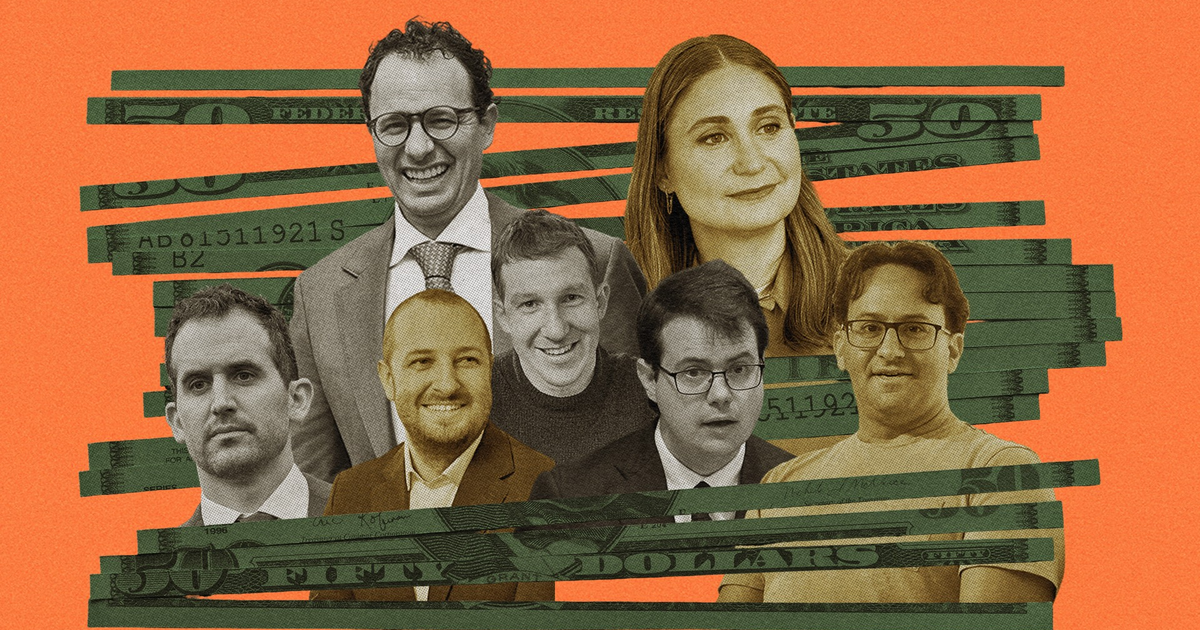
The seven Anthropic cofounders have all pledged (opens in new tab) to give away 80% of their personal equity to philanthropic causes, which adds up to about $113 billion based on the $83 IPO share price. If they follow through, that would make them some of the biggest philanthropists (opens in new tab) in U.S. history. Together, they’d be giving away more than either Warren Buffett ($68.3 billion) or Bill and Melinda French Gates ($52.6 billion).
But, as with everything in the world of charity, it rests on the will of the givers, who all have their own interests, causes, and philosophies. We only have a handful of clues about where that money could go and the lives it could change. Will the Anthropic founders keep the money local, in the city where they’re based and where many grew up? Will large sums get channeled to AI safety nonprofits, which have become their own cottage industry? How are the deciding any of this?
For San Francisco, the big question is how Anthropic’s charitable ventures might shape the city or lift up those in need. Many of the founders have ties to effective altruism, a utilitarian-influenced philosophy around giving that believes in steering money to wherever each dollar does the most good.
“It has the potential to be a game-changer for nonprofits,” said Priya Shanker, executive director of the Stanford Center on Philanthropy and Civil Society. “Nonprofits are pretty stretched for resources, so it could be a potential boon.”
Tech tycoons have long given away slices of their fortunes. Usually, though, the giving comes years or even decades after their companies go public. Anthropic’s founders, some of whom have been involved in philanthropy for years, have taken a different route by declaring their intentions upfront.
However, there is no timeline attached to the Anthropic pledge. And the financial filing that mentions it says the commitments are voluntary and “do not constitute legally binding obligations.” So, when, how, and in what form the cofounders will donate remains unknown. That has made many in the philanthropy scene skeptical, because the history of giving is full of unfulfilled promises.
For example, Mark Zuckerberg and Priscilla Chan in 2015 announced a tuition-free school offering healthcare for children in East Palo Alto, only to pull its funding a decade later, leaving dozens of families feeling stranded. In 2010, some of the country’s richest people signed the Giving Pledge, promising to give away at least half of their wealth. Last year, the Institute for Policy Studies (opens in new tab) found that of the 32 original U.S. signers who are still billionaires, only one couple has given away half, and many have grown even richer.
Anthropic is “definitely unique, and their approach is pretty singular,” said Bella DeVaan, a program director at the institute. “But we have a lot of examples of extremely wealthy individuals promising to give money away to charity, and collectively we don’t have an ability to hold them to their word.”
Effective altruism doesn’t always mean giving locally
The paradox around the impact of AI — that it could open a bright future for humanity or lead us to extinction — is part of Anthropic’s DNA, and so is its relationship to giving. CEO Dario Amodei has long been drawn to effective altruism.
Amodei has said he doesn’t consider himself an effective altruist but is “sympathetic to a number of the ideas,” as he told Hard Fork (opens in new tab) in 2023. In a 2010 post on GiveWell’s blog, (opens in new tab) reported in a recent profile in The New York Times (opens in new tab), he pondered whether it was better to donate $10,000 to a group funding adult tuberculosis treatment or to one vaccinating children in Africa, weighing factors like the adults having formed deeper connections with other people. He ultimately went for child vaccinations.
There are other “Ants” — the name Anthropic employees use for themselves — who have ties to EA. Daniela Amodei, Dario’s sister and cofounder, is married to Holden Karnofsky, who works at Anthropic and holds millions in equity. But before joining the company, Karnofsky cofounded GiveWell, a charity-efficiency evaluator associated with EA. He later cofounded Open Philanthropy (now called Coefficient Giving), which — funded mainly by Facebook cofounder Dustin Moskovitz and his wife, Cari Tuna — is one of the largest EA donors to causes that include animal welfare, pandemic preparedness, and, more recently, AI safety.
Some EA philanthropists have drawn attention for funding unusual causes. Coefficient Giving (opens in new tab) has given more than $4 million to fish, shrimp, and other aquatic animal welfare in Europe, Asia, and Latin America, including research to make the slaughter of farmed fish less painful. The EA reasoning is that a little money can spare a huge number of animals from suffering, a blogger wrote in an effective altruism forum (opens in new tab).
“If you give even a hundred dollars, you’ll affect more shrimp than there are people in Montana,” the blogger wrote.
“There are areas that are much more needy than the Bay Area,” said Enrico Moretti, an economist at UC Berkeley. “I’m thinking about African countries where people are starving or they don’t have basic health or education. Probably the dollar spent there is more effective than the dollar spent on the low-income populations in the Bay Area.”
Still, Moretti expects a significant share of the Anthropic founders’ largesse to stay local. In a study (opens in new tab) with two colleagues, he found that a publicly traded company boosts donations to nonprofits in the same city as the headquarters by an estimated $3 million to $10 million a year. And even if the public fund or the founders direct some charity outside the Bay Area, he expects Anthropic employees to donate more locally.
The Silicon Valley Community Foundation, which manages charitable funds for many of the region’s tech donors, has found (opens in new tab) that even though most of the giving it receives goes outside the Bay Area, an important chunk stays here. Of the $2.1 billion it distributed in grants in 2025, about $700 million went to local causes, while the rest went elsewhere in the country and abroad. But it has seen an increasing interest in donating locally, including among AI techies. What stands out to Nicole Taylor, president and CEO of the Silicon Valley Community Foundation, is the “sense of urgency” among AI-involved donors. “They really want to make a difference immediately, and they also want to leverage what other people have done,” she said.
In conversations with those donors, she has heard interest in education, science, healthcare, and, recently, housing. “People know that they’re displacing housing,” she said. In San Francisco, rents and home prices have been rising in recent months, and IPOs tend to push those costs even higher. It will likely worsen if OpenAI, the creator of ChatGPT, goes public next year. The donors Taylor has talked to, she said, “really want to do something about that.”
Anthropic has started donating in the city
Even though most of the charity has yet to come, the company has taken steps. Ahead of its IPO, Anthropic made one big move to share its wealth locally by committing $50 million (opens in new tab) through a donor-advised fund at the San Francisco Foundation for nonprofits across the Bay Area. Early recipients include the SF-Marin Food Bank and Glide.
Anthropic matches its employees’ donations to donor-advised funds and nonprofits with company stock. Employees are paid partly in shares, and those hired in the early days get better giving deals. For those who joined before mid-2024, Anthropic donates three shares for every one they give, on up to half their stock. Later hires get a one-to-one match on up to a quarter of the stock they received.
Since 2025, the program has recorded roughly $2.1 billion in expenses, according to its filings, and if employees follow through on their pledges, the company could end up donating roughly $40 billion more.
“We view our donation matching program as a meaningful expression of the company purpose and a reflection of the values that define our culture,” the filing states.
The company has also set aside 5% of its stock, worth about $70 billion at the IPO price, to what it calls the “Anthropic Public Benefit Fund,” which is dedicated to “the responsible development and maintenance of advanced AI for the long-term benefit of humanity.”
Benjamin Soskis, a senior research associate at the Urban Institute’s Center on Nonprofits and Philanthropy, sees another novelty there. Philanthropy, he argues, has for years carried a tension: Many fortunes were made in industries that caused harm, and some of that money was later spent trying to redress it.
John D. Rockefeller made his fortune with oil in the late 19th century; many years after his death, the foundation he left behind invests (opens in new tab) millions to halt climate change. Anthropic, Soskis said, is exposing the “ambivalences that were buried under the surface of a lot of philanthropy for the last century.”
For now, though, much about Anthopic’s philanthropy is still a promise on paper. And giving away money is harder than it sounds. Even when people want to donate, barriers (opens in new tab) stand in the way: a financial system that favors accumulation, the time it takes to understand the social problems donors want to solve, and even psychological hurdles, such as a fear of failure or of wasting money.
“It’s hard to predict what will stay and what will go,” Taylor said. “My hope is they do stay, and they do remember that this is where they got their start.”