
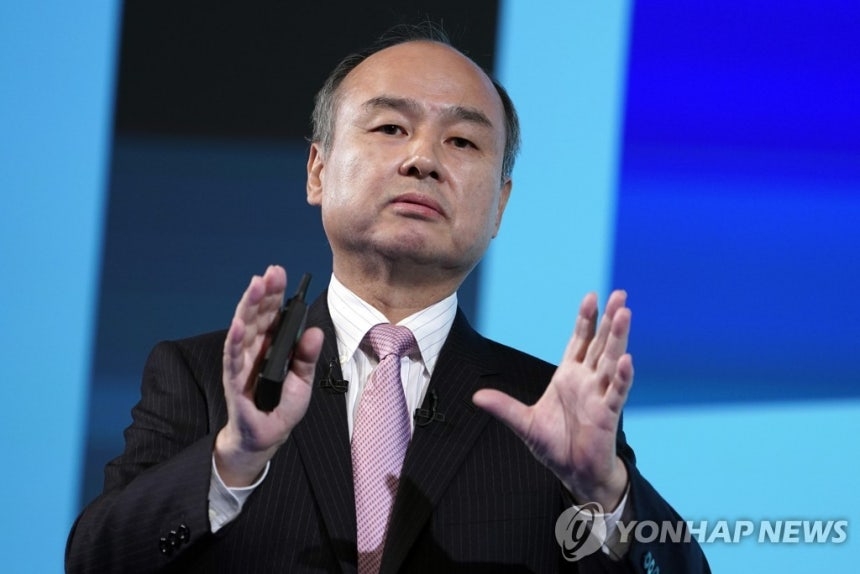
 Masayoshi Son, chairman of SoftBank Group. EPA/Yonhap
SoftBank Group Chairman Masayoshi Son sounded out U.S. financial institutions about raising money to acquire SK hynix (000660), the world’s second-largest memory chipmaker, according to people familiar with the matter. The deal could have reached $1 trillion, or about 1,400 trillion won, but appears to have been dropped at an early stage because it was unlikely to be feasible.
The Information reported on the 21st, citing multiple people familiar with the matter, that Son recently approached major investment banks to discuss how to finance a purchase of SK hynix. SoftBank, however, says it is no longer pursuing the deal. A SoftBank spokesperson said the company reviews a range of opportunities but that this one is no longer under active consideration. There was also no confirmation that Wall Street banks had discussed providing financing.
The prevailing view in the market is that the idea was never realistic. SK hynix has a market value of about $577.7 billion, or 777 trillion won, down sharply from a peak reached about a month earlier. The $1 trillion figure floated as a purchase price reflects that peak market value plus a 40% control premium.
Still, some read the episode as a sign of how far Son’s ambitions in artificial intelligence extend. SoftBank is the largest shareholder in Arm, a chip design intellectual property company, and in SB Energy, which operates data center and power businesses. It also owns Ampere Computing, a server chip designer, and DigitalBridge, a data center investment firm. On top of that, it has taken large stakes in Intel and OpenAI.
The one piece of the AI supply chain SoftBank has yet to secure is memory. SK hynix is one of three suppliers of high-bandwidth memory for AI accelerators, along with Samsung Electronics (005930) and Micron Technology of the United States. AI accelerators are chips built solely for AI work, pairing logic chips with HBM to handle large-scale computation, and Nvidia effectively monopolizes the market. The HBM boom has pushed profit margins at the three memory makers toward 80%, and their shares more than doubled in the first half of this year. Those stocks have since entered a correction.
Son has relied on borrowing for each of his large investments. He financed the OpenAI stake by pledging Arm shares as collateral. Earlier, he borrowed against his Alibaba holding and ultimately sold the stake to help cover costs including the $32 billion purchase of Arm. In 2017, he pulled together money from the sovereign wealth funds of Saudi Arabia and the United Arab Emirates to launch the $100 billion Vision Fund, which invested in Uber, ByteDance and WeWork.
An industry official said the SK hynix approach, feasible or not, showed that Son has a plan to take control of the entire AI value chain.