
Silicon Valley billionaire Peter Thiel entered the heart of the Trump administration to create a stage for realizing his beliefs and secure funding to grow Palantir Technologies Installed anti-regulation figures at oversight agencies Helped build a system for deporting immigrants
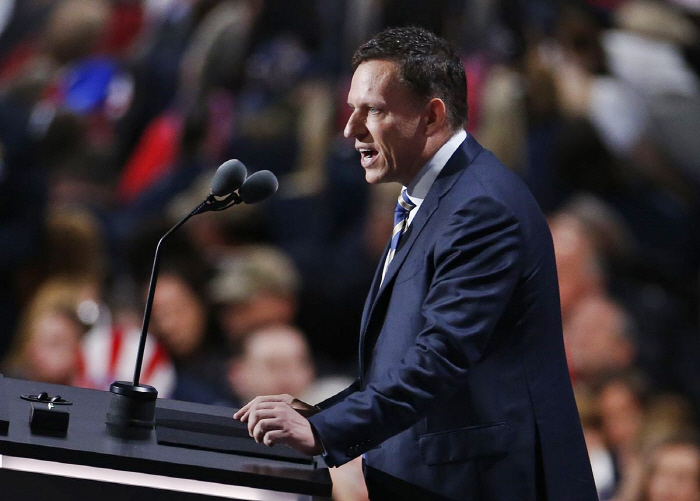
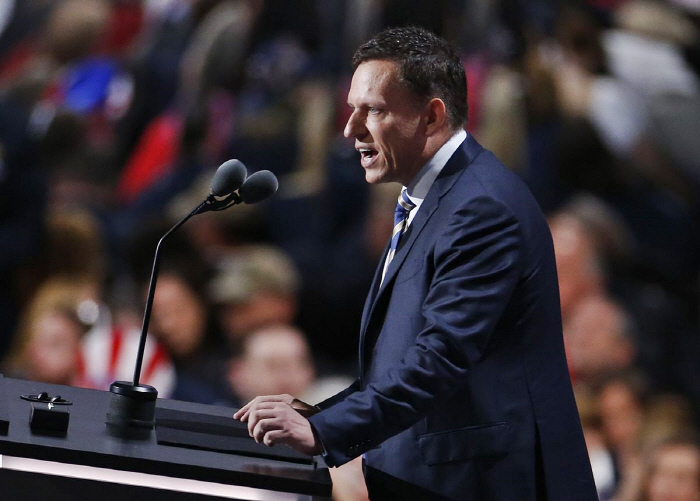 사진 확대 Peter Thiel speaks at a Republican rally. [Reuters/Yonhap]
The world of Peter Thiel, the PayPal Holdings, Inc. and Palantir Technologies co-founder and Silicon Valley billionaire, was built on the ruins of the established order and conventional wisdom. The capitalist virtue of “competition” becomes the lot of losers, while “monopoly,” the evil he is most wary of, symbolizes victory. University education is useless, while young people starting businesses is immensely beneficial to individuals and society. The state, which protects citizens’ freedom, instead becomes an agent of oppression, blocking entrepreneurs’ freedom to operate and technological progress.
Yet his actions often contradict his claims. He criticized Google, the undisputed leader in the search market, for its “monopoly”—the ideal of entrepreneurs—and expanded his business and influence through connections he built at his alma mater, Stanford University. While criticizing the state, he grew Palantir Technologies by supplying information systems software to the government and military, and, in return for declaring his support and making donations, joined the administration of U.S. President Donald Trump, entering the very heart of power.
Why did Silicon Valley’s “rebel,” who rejected the established order, go on to enter the realm of political power? “The King of Palantir Technologies,” a book by Max Chafkin, a senior reporter at Bloomberg Businessweek, traces the life of Peter Thiel, so full of contradictions, and examines how Silicon Valley’s technology capital expands into political influence.
According to the author, the foundation of Thiel’s thinking is “libertarianism”—the belief that individual and entrepreneurial freedom must be protected from interference by the state and democratic majorities. That is because politics stands in the way of technological progress needed for disruptive innovation and advancement. “Political correctness,” which sparks ethical debate, is also something he believes must be overcome. This is where Thiel’s thinking becomes dangerous: it leads to “techno-authoritarianism,” the idea that risks and harms to society need not be considered in the pursuit of technological progress. In his view, entrepreneurs who build businesses by circumventing regulations, exploiting loopholes in the system, or ignoring norms altogether deserve praise. His longstanding principle says it all: “It is better to look evil than incompetent.”
Palantir Technologies’ growth, as recounted in the book, is clear evidence. After the September 11, 2001, terrorist attacks, demand grew among law enforcement and intelligence agencies to collect and analyze terrorism-related information in response to threats. Palantir Technologies supplied “Gotham,” data and intelligence analysis software used to identify terrorists. Concerns about civil rights and privacy violations did not concern Thiel.
His actions on the transition team during the first Trump administration followed the same course. He was responsible for selecting the heads of regulatory agencies, including the Federal Trade Commission (FTC), the Food and Drug Administration (FDA), and the National Institutes of Health (NIH). Most of the people he backed were extreme opponents of regulation—so much so that roughly nine out of ten failed to receive President Trump’s approval. Even so, his conviction that one must take risks to achieve “disruptive innovation” had come close to being realized politically.
Palantir Technologies benefited by aligning itself with the Trump administration’s policies. As part of the immigrant deportation policy, Palantir Technologies was secretly involved in building databases and information analysis systems for U.S. Immigration and Customs Enforcement (ICE), and provided software to identify people for deportation and support investigations. Thiel thought little of the ethical concerns and conflict-of-interest controversies raised in connection with this work. For him, political power was a “stage” on which to put his beliefs into practice, increase his influence, and grow his company.
The author argues that Thiel’s actions have helped shape Silicon Valley’s ethos across the political spectrum. He points to the criminal tendencies of the cryptocurrency industry, the monopoly ambitions of Google and Apple Inc., and Amazon’s anti-labor practices. He also warns that Silicon Valley as a whole treats these actions as a price worth paying for social progress. A “Thiel universe” seeking to realize a techno-authoritarian worldview that uses technology capital and political power to undermine democracy and ethics is now wielding considerable influence.
The author says, “They [Silicon Valley elites] are celebrities representing the most privileged class, and the oligarchs of our society. And Thiel is their founder.”
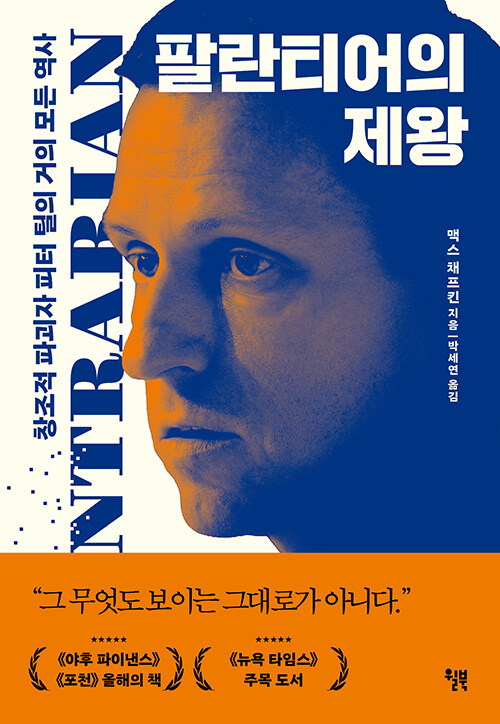 사진 확대
Written by Max Chafkin, translated by Park Se-yeon, published by Willbook
This article has been translated by GripLabs Mingo AI.