
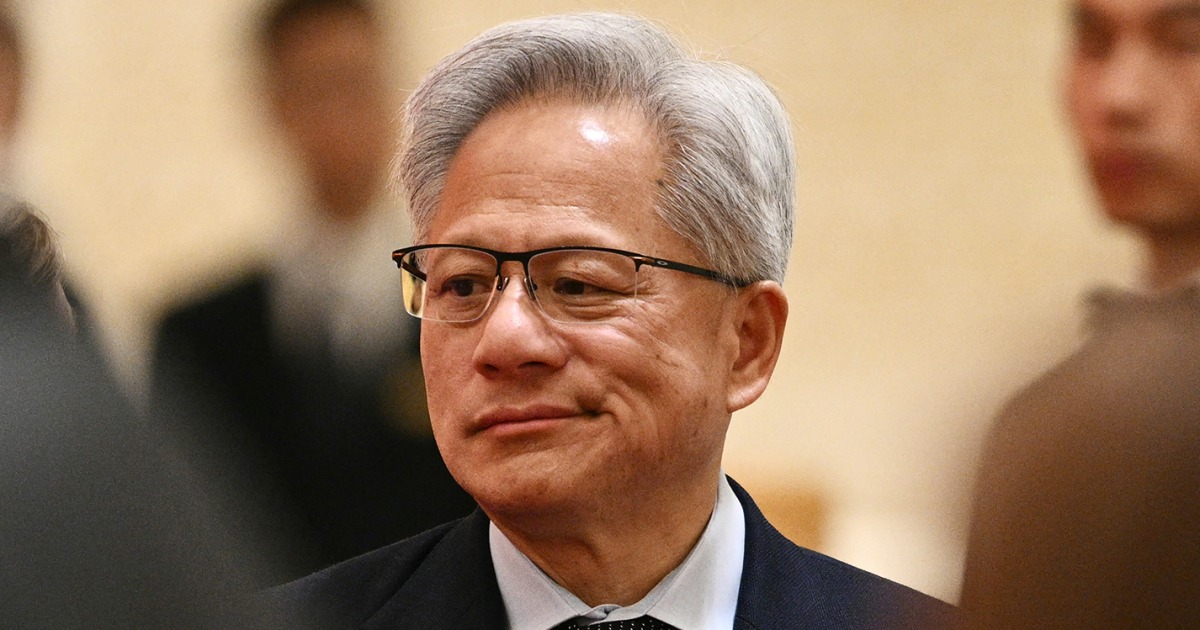
The stock market was thrilled with the announcement that Jensen Huang was returning as CEO of Nvidia, but lawmakers on both sides of the aisle reacted with shock — and said they still expect him to answer questions next week on Capitol Hill.
“You gotta be kidding me,” Sen. John Cornyn, R-Texas, told MS NOW when he learned of Huang’s reinstatement 11 days after he resigned in the wake of revelations of alleged extramarital affairs, including one with a woman U.S. intelligence believes to be a Chinese spy.
In its announcement, the board said it reached the decision after receiving “input from senior levels of the United States government” that his “reinstatement poses no national security risk.”
“No national security risk? Based on what?” Cornyn asked in a post on X.
President Donald Trump told CNBC he’d spoken to the board “directly and indirectly.”
“One of the things the board wanted to know, is there a national security problem?” Trump said. “And after a lot of research, we — you know, we’ve been looking at this for more than a couple of days, right? This has been a story for a few weeks. We said no, it’s not a problem.”
Lawmakers made clear they still need answers.
The Senate Banking Committee, chaired by Sen. Tim Scott, R-S.C., announced that Huang was scheduled to testify publicly Dec. 3.
“The national security concerns and adherence to export controls will be central to the committee’s oversight and the congressional hearing. Our markets demand transparency. Americans deserve the truth. Our committee will deliver answers,” Scott said in a statement.
A spokesperson for the House Intelligence Committee told NBC News that Huang’s reinstatement as Nvidia CEO “changes nothing” for the three House committees that are set to conduct a closed-door transcribed interview with Huang on Dec. 1.
“There are serious questions on national security implications that still need answers. Seems like the only thing that is consistent these days on this issue is our three Committee’s commitment to oversight,” the spokesperson said in a statement.
The speedy reinstatement and assurances of the lack of a security risk came after the Justice and Commerce departments last week shared details about their investigation into Megaspeed, the Singapore-based company tied to Alice Huang, the suspected spy with whom Huang was allegedly involved.
Megaspeed reportedly acquired billions of dollars’ worth of Nvidia chips and is also being investigated over concerns that it — and its subsidiaries — smuggled chips to China.
Sen. Kevin Cramer, R-N.D., said in an X post that “the legal and reputational risk of hiring a CEO who may very well be convicted in the United States or other nations of violating espionage and export control laws is now born by the board of Nvidia, but the national security risk is passed along to the United States military and its citizens. The risk of extortion by a Chinese asset who’s been banned by Singapore is risk enough to not rehire Huang.”
Sen. John Kennedy, R-La., told NBC News in a phone interview “It’s not my job as a public official to tell a private company who to pick for their CEO. That’s up to the board of directors.”
But, he added, “What I want to know is whether Nvidia violated the export controls of our country with respect to advanced chips. And I want to know if the Department of Commerce did. That will be the purpose of the Banking Committee hearing.”
Sen. Jeanne Shaheen of New Hampshire, the top Democrat on the Senate Foreign Relations Committee, said in a statement that the administration appears to have known about the Chinese espionage efforts targeting the Nvidia CEO for the past year and his reinstatement “without any apparent accounting or response to the risks to our national security, demands an explanation.”
Senate Minority Leader Chuck Schumer, D-N.Y., said the administration’s “rush to reinstate Jensen Huang underscores the need for Congress to act.”
“Trump is putting his own financial interests and the needs of his billionaire buddies before our national security, emphasizing that he’s learned nothing from his resounding election defeat,” Schumer said in a statement. He added that “Democrats will wield their full power to investigate any wrongdoing by the Trump Administration, Jensen Huang, other NVIDIA executives, and anyone selling out our national security for financial gain.”
House Minority Leader Hakeem Jeffries, D-N.Y., called the board’s decision “indefensible, irresponsible and incomprehensible.”
“Congress will not be deterred from conducting a swift, thorough and wide-ranging investigation into business malfeasance by NVIDIA and corrupt abuse of power by Howard Lutnick and the Department of Commerce,” Jeffries said.
Lutnick agreed earlier this month to testify before Congress about the Huang scandal amid lawmakers’ scrutiny of China’s access to advanced AI chips.
Democrats pointed Trump’s financial ties to Nvidia, with Rep. Robert Garcia of California, the ranking member on the Oversight Committee, noting the president has a sizeable amount of Nvidia stock. “No president who has invested in a private company should be involved in their board decisions,” Garcia said.
Rep. Raja Krishnamoorthi, D-Ill., cited Nvidia’s donation to Trump’s White House ballroom project as a reason to give the board’s decision extra scrutiny.
“Trump’s assurances cannot be taken at face value, especially after Nvidia’s $25 million donation to his ballroom. Huang must testify at a full public congressional hearing, with every member of the relevant committees allowed to question him,” he posted on X.
Sen. Pete Ricketts, R-Neb., questioned the Nvidia board’s decision in a post on social media.
“Jensen Huang had multiple affairs including with subordinates and an alleged Chinese spy,” Ricketts wrote. “His own board described his behavior as lacking ‘candor.’ I’ve served on a public company board. His behavior does not support reinstatement.”
“Nvidia’s decision today doesn’t excuse Jensen Huang from testifying before Congress,” he continued. “It also doesn’t absolve Nvidia of answering for national security concerns and unaccounted-for chips. I look forward to Mr. Huang coming to the Senate in December.”
Sen. Chris Van Hollen, D-Md., called the president’s actions “Exhibit A about the political corruption and rot at the heart of the Trump administration’s big tech and AI policy.” He told reporters it was a “good sign” that Republican senators and lawmakers have spoken out because they “realize this is a threat to national security.”