
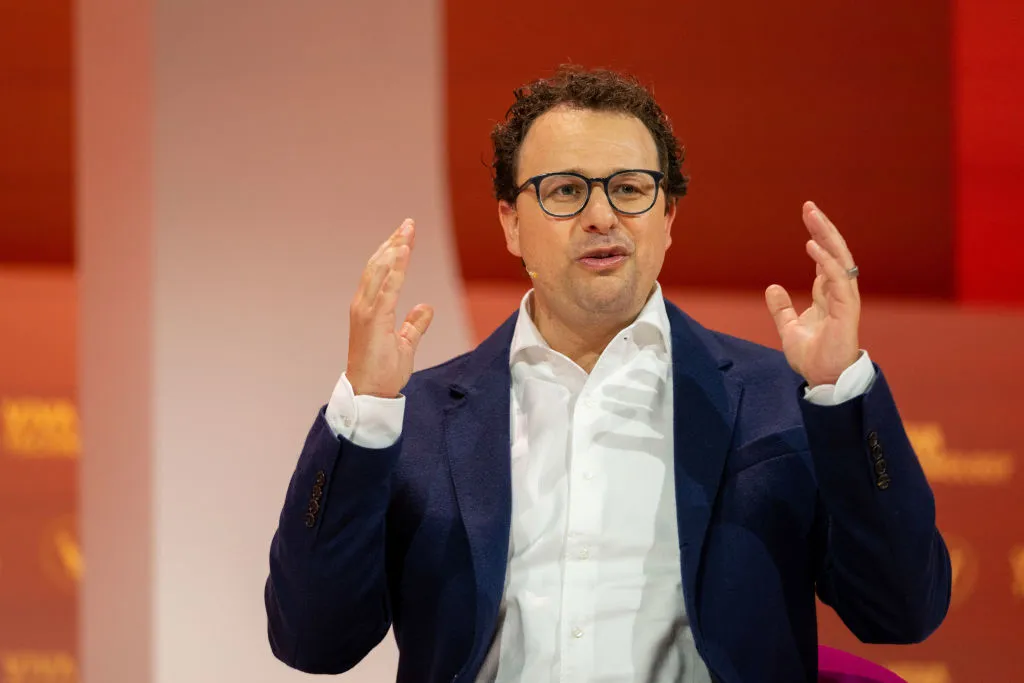
Dario Amodei, CEO of Anthropic, has rejected claims suggesting that his company advocates for abandoning human free will in favor of artificial intelligence systems, describing these accusations as illogical.
In a lengthy post on the X platform, Amodei emphasized that achieving efficiency or enhancing security should not come at the expense of humanity’s right to self-determination, stressing his rejection of delegating governance and societal management tasks to artificial intelligence systems.
Growing Debate Over Human Control of Artificial Intelligence
Amodei’s remarks come amid mounting concerns regarding the future of human control over artificial intelligence, particularly with the accelerating capabilities of advanced models.
Earlier in November, OpenAI CEO Sam Altman underscored the importance of ensuring that humans retain the ability to determine their own future.
Additionally, Meta Chief AI Officer Alexandr Wang warned against handing over societal management to intelligent systems, noting the difficulty of maintaining human control if these systems become capable of developing themselves without restrictions.
In contrast, Amodei affirmed that he has repeatedly called for subjecting artificial intelligence to democratic oversight and employing technology to strengthen democratic institutions, while ensuring humans retain ultimate decision-making power.
The Difference Between Task Automation and Surrendering Human Control
The Anthropic CEO explained that there is a fundamental difference between abandoning human free will and using artificial intelligence to automate specific tasks.
He pointed to a number of applications that intelligent systems can increasingly carry out, including driving cars, designing cancer treatments, and developing software comprehensively.
However, concerns become more complex when these systems reach the stage of Recursive Self-Improvement (RSI), which is the ability to repeatedly enhance their capabilities without human intervention.
Amodei acknowledged that imposing restrictions on this process may be necessary in light of the potential risks associated with losing human control.
Anthropic Accelerates Model Development Using Artificial Intelligence
Despite these warnings, Anthropic is expanding the use of artificial intelligence in its internal research and development operations.
In June 2026, the company announced that the Claude model wrote over 80% of the code integrated into its codebase.
Furthermore, an independent evaluation published in November by METR, an organization specializing in artificial intelligence safety research, indicated that Anthropic’s models are improving at a rate roughly double their historical pace, driven primarily by the use of artificial intelligence in research.
The company disclosed in its initial public offering documents that it relies on each generation of Claude models to accelerate the development of the next generation, as part of a process it calls “Closing the Loop”.
Nevertheless, Amodei emphasized that Claude developing successive generations of advanced models entirely independently, without effective human oversight or a sufficient understanding of development processes, is not expected to be safe.
Challenges of Human Oversight in Artificial Intelligence Models
The acceleration in developing artificial intelligence models poses challenges for engineers and safety experts, especially as reviewing the behavior of advanced systems and fully understanding their operational mechanisms becomes increasingly difficult.
Increasing reliance on artificial intelligence models to evaluate other models could complicate oversight processes, particularly with the potential emergence of deceptive behaviors in some systems once they realize they are being evaluated.
These developments are not limited to Anthropic; OpenAI announced this week that it has solved one of the most prominent open problems in computer science concerning the precise lower bound for matrix multiplication speed, a fundamental mathematical operation in deep learning and physical simulation applications.
Competition Among AI Companies Raises Safety Questions
Amodei criticized the commercial and political rhetoric of some competing companies, arguing that calls to maintain human control do not necessarily translate into a fundamental difference in model development strategies.
He explained that various artificial intelligence companies continue to release models capable of further task automation while simultaneously asserting their awareness of potential risks and their commitment to providing safeguards.
As competition intensifies, the primary challenge for technology companies remains how to leverage artificial intelligence to accelerate innovation without letting its capabilities exceed the boundaries of effective human oversight.
Read the article in