
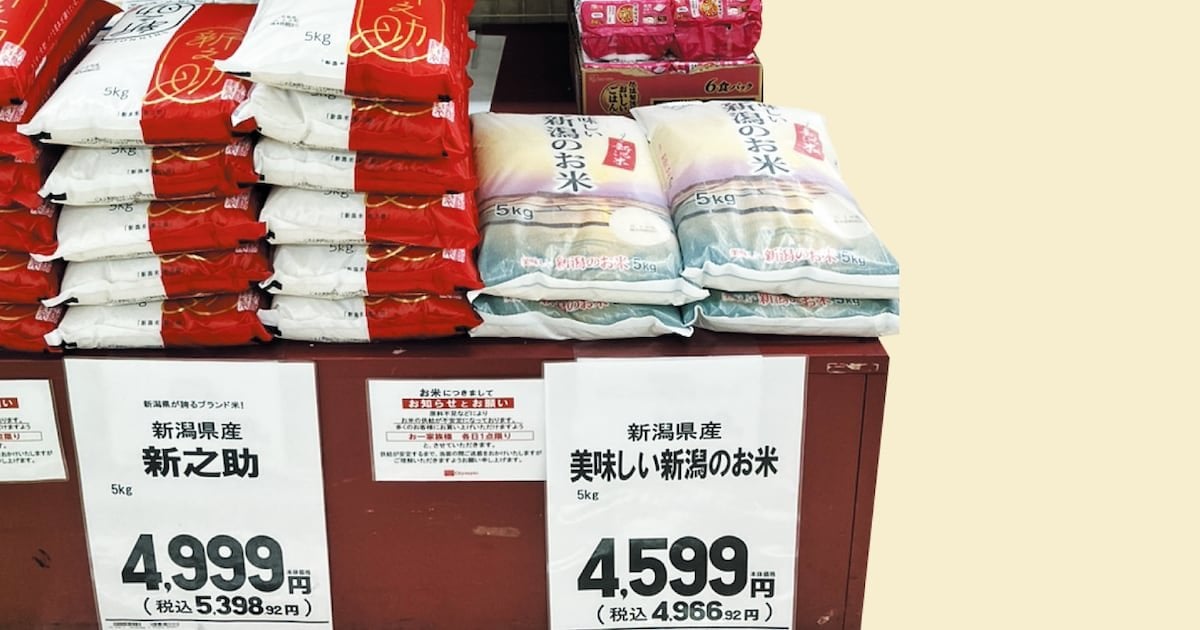
On the 27th, at the rice section of the Olympic Asakadai supermarket in Asaka City, Saitama Prefecture, Japan, a sign reading “Limited to one per family” was posted. It added, “Please understand that this is to avoid inconvenience until rice supply stabilizes.” Unlike last October when similar signs were displayed, rice prices have since risen even higher. On this day, the cheapest rice was priced at 4,966 yen (about 47,000 KRW, per 5kg), 44% higher than the previous price of 3,454 yen. On the same day, at National Azabu, a supermarket in a luxury residential area of Tokyo, the cheapest rice was 5,900 yen per 5kg, with the most expensive at 6,480 yen—roughly three times the typical price range of 2,000 yen in previous years.
Japan’s so-called “Reiwa rice crisis” has now dragged on for 10 months. After a massive earthquake advisory issued last August triggered nationwide panic buying and drove up rice prices, those prices have continued to soar even after the advisory was lifted. Japan’s rice consumption this year is projected at around 7 million tons. On the supply side, last year’s harvest reached 6.79 million tons, and rice imports have increased by several hundred thousand tons compared to previous years. Since March, the government has released up to 310,000 tons of stockpiled rice into the market. Nevertheless, the average price of rice hit a new record this month at 4,285 yen per 5kg.
Despite supply exceeding demand, prices remain high. Allegations are emerging that the political “Nōrin-zoku” (agriculture and forestry faction) within Japan’s ruling Liberal Democratic Party (LDP), together with the National Federation of Agricultural Cooperative Associations (JA Zen-Noh), which controls agricultural product distribution, are partly responsible for sustaining the price surge. The triangular relationship—JA Zen-Noh, which benefits from higher prices; the Ministry of Agriculture, Forestry and Fisheries, which releases stockpiled rice to JA Zen-Noh; and the LDP’s Nōrin-zoku politicians, who rely on JA Zen-Noh members’ votes—is being cited as a key factor behind the crisis. According to the Sankei Shimbun, quoting a former agriculture ministry official, “JA Zen-Noh, which wins more than 90% of government rice auctions, is intentionally delaying shipments to create supply bottlenecks.”
JA Zen-Noh reportedly acquired 296,000 tons of the 310,000-ton government stockpile but has passed on only about 104,000 tons to wholesalers. Less than 20,000 tons have reached supermarket shelves. JA Zen-Noh cites slow milling processes and difficulties securing transport vehicles. However, Sankei dismissed this as “an excuse bordering on absurdity,” pointing out that JA Zen-Noh is the entity most familiar with rice distribution and could delegate milling to retailers.
JA Zen-Noh, which has about 10 million cooperative members, regularly backs LDP Nōrin-zoku politicians during elections. Among the estimated 70 to 90 members of the faction, a prominent figure is Hiroshi Moriyama, LDP Secretary-General and effectively second in command to Prime Minister Shigeru Ishiba. During the rice crisis, Moriyama drew criticism for comments such as “It’s not necessarily good for rice to be cheap” and “Let’s not forget that rice depends on producers (farmers).”
Another Nōrin-zoku politician, former Agriculture Minister Taku Eto, was dismissed on June 20 after gaffes such as saying “I’ve never had to buy rice because my supporters give me plenty.” It is rumored that Eto rejected Ishiba’s proposal to switch government rice sales to direct contracts with wholesalers. After JA Zen-Noh dominated auctions by bidding high prices, Ishiba reportedly suggested using direct sales to bypass the bidding system and sell rice cheaply to wholesalers, but Eto opposed this, arguing that “government intervention in market prices is inappropriate.”
Facing a crucial upper house election in July, Ishiba has now launched a “war on rice prices” to boost his approval ratings—even if it costs some support among farmers. With his popularity languishing in the 30% range, a poor election showing could threaten the survival of his cabinet. Ishiba pledged to “bring rice prices back to the 3,000-yen range as quickly as possible” and appointed former Environment Minister Shinjiro Koizumi as Eto’s replacement. In his inaugural speech, Koizumi said he had received “instructions from Prime Minister Ishiba to review the sale of stockpiled rice through direct contracts” and would “completely reassess the rice release policy.” He added that “what matters most now is not pandering to specific organizations or interest groups,” a veiled criticism of JA Zen-Noh. Koizumi previously clashed with JA Zen-Noh during his tenure as head of the LDP’s agriculture committee from 2015 to 2017, when he pursued agricultural reform.
Koizumi has now halted competitive bidding and is transferring 300,000 tons of stockpiled rice to wholesalers and large retailers at half the auction price via direct contracts. Companies applying for such contracts reportedly include major online retailer Rakuten, convenience store chain FamilyMart, and supermarket giants Aeon and Ito-Yokado. On the 29th, the government began delivering rice to some contractors, with the goal of reaching consumers soon.
Among consumers, there is now hope that the newly released rice will be available in early July—both online and in stores—at slightly above 2,000 yen per 5kg. Iris Ohyama, a consumer goods company that acquired 10,000 tons of stockpiled rice via direct contract, told the Yomiuri Shimbun on the 29th: “Once we verify the quality, we will provide affordable rice to consumers as soon as possible.” If “2,000-yen rice” becomes firmly established in the market, Ishiba may be able to achieve his “3,000-yen rice” target ahead of the election, potentially giving his approval ratings a timely boost.
Posted by Freewhale98