
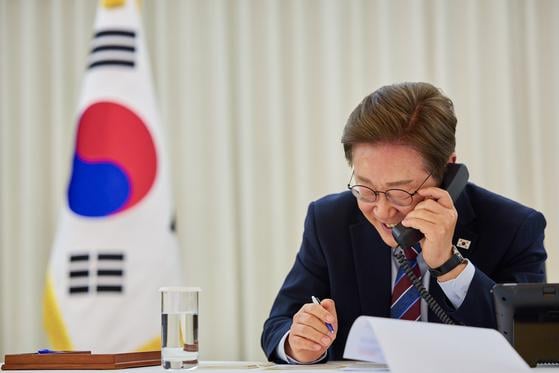
President Lee Jae-myung is considering whether to attend the upcoming NATO summit in the Netherlands on June 24–25, as sentiment within the presidential office has shifted from caution to active consideration, a senior official said Wednesday (June 12).
“There has been a change in mood regarding NATO attendance,” a key presidential aide told the JoongAng Ilbo. “The initial mood was negative, but that is no longer the case.”
Another presidential official added, “It would be good to attend. Nothing has been finalized, but there is a real possibility that the president will go.”
A close Democratic Party (DPK) source also said, “The decision is now leaning toward attendance, but the final call rests with the president.”
Previously, many political observers expected that if President Lee attended the G7 summit (June 15–17), back-to-back participation in the NATO summit would be unlikely. The early election left the new government with little time to prepare for multilateral diplomacy, as cabinet appointments and presidential office staffing remain incomplete.
President Lee himself hinted at possible non-attendance during a May 25 press conference, saying: “Domestic circumstances are turbulent and complicated. I’m still considering whether it is necessary to attend both.”
Cautious Diplomacy Shifts Toward Engagement
One leading voice of caution has been former Foreign Minister Chung, a prominent figure among South Korea’s “self-reliance” (자주) foreign policy advocates. In an interview, Chung said he advised the president: “NATO has become a platform for supporting Ukraine and carries an anti-Russia tone. Under the Yoon Suk-yeol administration, South Korea leaned strongly toward the U.S., but attending NATO repeatedly risks playing into Japan’s push for an ‘Asian NATO.’”
In contrast, he supported attending the G7 summit, noting that “Canada respects Korea’s democracy and seeks cooperation in submarine construction and shipbuilding.”
However, the mood began to change following President Lee’s June 6 phone call with former U.S. President Donald Trump. This was followed by phone conversations with Japanese Prime Minister Fumio Kishida (June 9), Chinese President Xi Jinping (June 10), and Czech President Petr Pavel (June 11).
As Lee’s diplomatic engagement accelerated, officials began to see no compelling reason to avoid multilateral diplomacy forums that could advance pragmatic national interest–centered foreign policy.
Signaling Stability to Allies
Officials also believe it is important to avoid generating unnecessary doubts among the U.S. and other liberal democracies regarding the new administration’s stance toward China and the U.S.
After six months of frozen summit diplomacy following the December 3 martial law crisis, participating in both the G7 and NATO summits would symbolize South Korea’s return to active global engagement.
NATO’s consistent invitation of South Korea, Japan, Australia, and New Zealand (the Indo-Pacific Four) since Russia’s 2022 invasion of Ukraine has also influenced the internal shift in thinking.
National Security Advisor’s Role
Attention is also on National Security Advisor Wi Sung-rak, a key figure behind Lee’s “pragmatic diplomacy” strategy. Wi, known as a pro-alliance figure during the Roh Moo-hyun administration, advised Lee closely during the election.
His influence is seen in Lee’s inaugural pledge to “strengthen trilateral cooperation based on the strong South Korea–U.S. alliance,” and in the sequencing of Lee’s first presidential phone calls—U.S. → Japan → China—mirroring the protocol of previous conservative administrations.
Remaining Concerns
Nonetheless, some voices within the ruling bloc remain cautious.
With the cabinet still incomplete—South Korea currently lacks a confirmed prime minister—there are concerns about leaving the country for an extended period so soon after taking office.
Self-reliance advocates also warn that NATO participation could be perceived as joining efforts to contain China and Russia.
A senior pro-Lee DPK lawmaker noted: “The president listens to opposing views, but ultimately, what matters most will be what serves the Korean people—not ideology.”
Posted by Freewhale98