
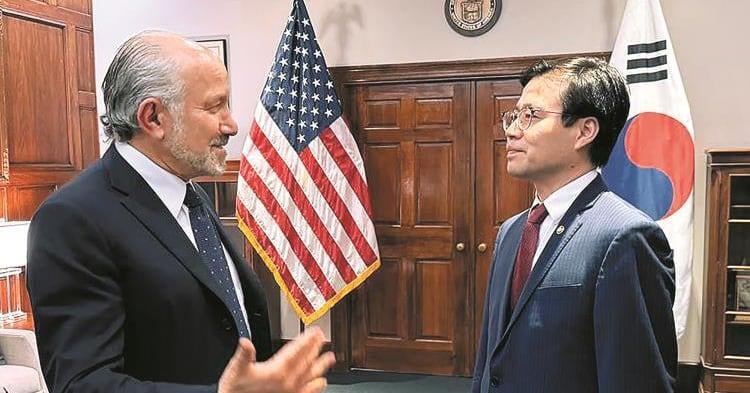
It was learned on the 15th that the U.S. has requested the South Korean government to establish a massive investment fund to help rebuild its domestic manufacturing sector. The idea is for the Korean government to lead the creation of a “Manufacturing Cooperation Enhancement Fund” that Korean companies could use when building or expanding factories in the U.S. or investing in local companies. This demand is fundamentally different from the previous U.S. requests related to trade barrier reductions — such as further opening South Korea’s agricultural market (including beef and rice) or allowing Google to export high-resolution map data.
According to this newspaper’s reporting on the 15th, the U.S. government raised this fund creation proposal during Korea-U.S. tariff negotiations held earlier this month in Washington, D.C. It is reported that the U.S. cited Japan’s proposal to create a “U.S.-Japan Investment Fund” during its own tariff negotiations with Japan. The Japanese fund was reportedly set at about $400 billion (approximately 550 trillion KRW). Given that Korea and Japan run similar trade surpluses with the U.S., the U.S. is said to have requested Korea to establish a fund of the same scale.
As President Donald Trump pushes negotiations with a final ultimatum sent to Japan, Korea, and others on July 7, threatening “25% reciprocal tariffs from August 1”, this new demand appears to be a way for Trump to secure a tangible domestic achievement.
With just over two weeks left before the reciprocal tariffs take effect, the Korean government now faces the challenge of figuring out how to raise the astronomical fund, a figure exceeding 80% of this year’s national budget. It’s believed that internal government frustrations over U.S. Commerce Secretary Howard Lutnick’s hardline proposals, which have stalled negotiation progress, stem from these very demands.
1. Trump’s Push: Build U.S. Manufacturing with Korean Money
The U.S. first raised the fund proposal during two rounds of high-level trade talks held in Washington, D.C. on July 7 and 10. Korea’s chief trade negotiator, Yeo Han-koo, who met twice with Secretary Lutnick, said after the talks, “We had in-depth discussions on ways to strengthen Korea-U.S. manufacturing cooperation.”
A government official explained, “Our government came prepared with various non-tariff barrier reduction ideas, like opening agricultural markets, to minimize reciprocal and auto tariffs, but Secretary Lutnick focused on the fund creation proposal.”
At a press briefing on the 14th, Yeo commented, “Korean companies’ investments in the U.S. , in shipbuilding, semiconductors, batteries, and their purchases of U.S.-made advanced equipment align with the kind of bilateral manufacturing cooperation the U.S. wants.”
He added, “While investments and purchases are matters for private companies to decide, the government’s role is to build a ‘platform’ behind the scenes to facilitate and support them.” This was interpreted as an indirect acknowledgment of the U.S. fund demand. He further remarked, “Rather than a negotiation merely focused on reducing tariffs by a few percentage points, we could pursue a ‘positive-sum’ negotiation that both aids U.S. manufacturing recovery and provides our companies with new growth engines through U.S. expansion.”
2. Origin in U.S.-Japan Talks
The U.S.-Japan investment fund idea reportedly came from Japan itself during its tariff negotiations. In May, the Financial Times reported that SoftBank chairman Masayoshi Son, a Trump ally, suggested the fund to U.S. Treasury Secretary Scott Besant.
Originally proposed at $300 billion, the fund’s size was reportedly increased to $400 billion during negotiations. For Trump, the fund served as both a major investment win and a way to achieve his manufacturing policy goals, while Japan could secure tariff reductions on automotive goods and other favorable terms.
The problem lies in the scale the U.S. expects from Korea. Given Korea’s trade surplus with the U.S. is similar to Japan’s, Washington is reportedly expecting Korea to establish a fund on par with Japan’s. But considering the economic size differences and the disparity in direct U.S. investment between the two countries, the requested amount is extremely burdensome for Korea. At the same time, offering a significantly smaller figure could make it difficult to persuade the U.S. Korean officials were said to have discussed appropriate fund sizing, financing methods, and target investment sectors on the 15th.
3. Could This Be a ‘Win-Win’ Strategy?
Some analysts suggest that if the fund supports Korean companies’ investments and expansion into the U.S. — and in return secures the maximum possible tariff cuts — it may not be a bad deal for Korea. With domestic demand hitting its limits and facing fierce low-cost competition from China globally, investing in U.S. expansion could be necessary not just for tariff relief but for future growth.
One expert, speaking on condition of anonymity, said, “Korean companies are already shifting away from exporting goods made domestically and toward ‘market-entry-type investments’ — producing and selling directly overseas.” They added, “Since companies only invest in projects they expect to profit from, creating a fund to support that is not just a government expense or loss.”
However, concerns remain that such moves could accelerate the hollowing out of Korea’s domestic industries.
The government reportedly plans to resume “2+2 trade negotiations” with U.S. Treasury Secretary Scott Besant and Commerce Secretary Howard Lutnick as soon as Korea’s finance and industry ministers are sworn in following this week’s confirmation hearings.
However, with the U.S. pressing hard for agricultural market openings and now adding the massive fund demand on top, negotiations are expected to be highly challenging. Some predict that, in the worst case, talks could miss the August 1 deadline.
Yeo Han-koo emphasized on the 14th, “We will not sacrifice substantive outcomes just because of time pressure.”
Posted by Freewhale98