
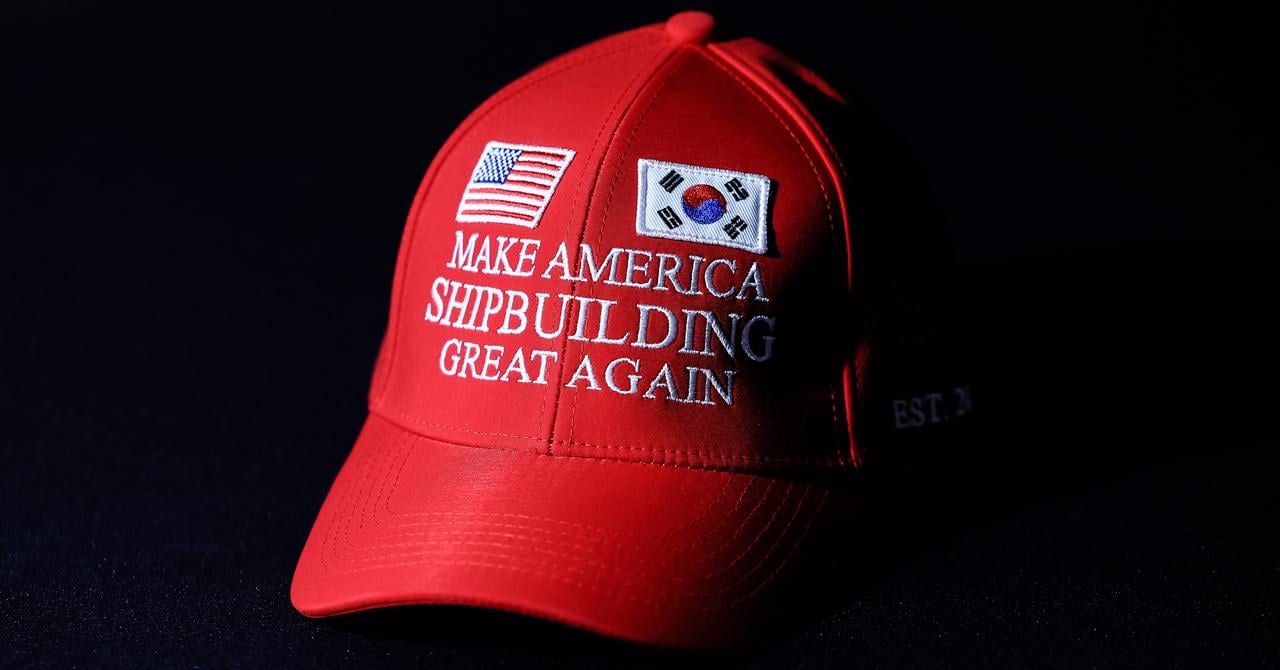
China has issued a warning through its state media over Korea’s proposal to the United States for cooperation in shipbuilding under the “MASGA (Make American Shipbuilding Great Again)” initiative. Beijing argues that if Korean-built vessels are used in U.S. military operations, Seoul could be exposed to military risks. It pointed to the Asia-Pacific as the likely theater and hinted at the possibility of clashes with Chinese forces.
On the 18th, the Chinese state-run English-language daily Global Times (GT) ran a commentary titled “U.S. Attempt to Strengthen Shipbuilding May Not Benefit Korea and Japan.” The piece stated:
“The U.S. wants to use the expertise and capabilities of its allies, Korea and Japan, the world’s second- and third-largest shipbuilding nations, to strengthen its own shipbuilding capacity. Such an approach does not serve the national interests of Korea and Japan.”
GT paid special attention to the fact that U.S. Senators Andy Kim (D-NJ) and Tammy Duckworth (D-IL) met with President Lee Jae-myung during their visit to Seoul that day, and would also visit Korean shipyards. GT speculated:
“The two senators and U.S. officials are likely to discuss establishing joint ventures for the construction and repair of U.S. Navy non-combat vessels, as well as attracting Korean investment in U.S. shipyards. It seems the U.S., focused on reviving its shipbuilding industry, wants to integrate Korea and Japan into its defense industrial base.”
GT argued that this U.S. initiative could be dangerous for Korea and Japan:
“Considering the complex geopolitical environment of the Asia-Pacific, Washington’s strategy aims to draw Seoul and Tokyo into its defense system for its own strategic and military interests.”
It further suggested the possibility of military confrontation with China:
“If vessels bearing Korean or Japanese logos are used in U.S. military operations against third countries, Seoul and Tokyo could face difficulties. They must be cautious of such scenarios.”
Although GT referred to a “third country,” it defined the target of U.S. strategic ambitions as the Asia-Pacific. This implies that if U.S. forces used ships built by Korea or Japan for operations against China, Beijing could respond militarily.
The commentary also claimed the MASGA project might not bring economic benefits:
“For Korea and Japan, increasing investment of talent, technology, and capital to boost U.S. shipbuilding may not necessarily be profitable. It could shift production bases abroad and weaken domestic competitiveness.”
This was not GT’s first warning. On July 30, it published another editorial titled “Korea’s Shipbuilding Package Proposal Raises Concerns Over Growing U.S. Dependence.” That piece described Korean investment in U.S. shipbuilding as “a high-risk gamble” — trading technology and capital for tariff reductions amid rapidly shifting global supply and trade networks.
It also pointed out that U.S. shipbuilding is plagued by supply-chain gaps and labor shortages, adding uncertainty. While Korea sees collaboration with U.S. shipbuilders as a chance to expand its global market share, GT warned that it could instead lead to subordination to U.S. interests.
The China Daily, another state-run English outlet, echoed this line the same day. In its editorial, it argued that Korea’s participation in U.S. supply-chain restructuring aimed at decoupling from China could harm the long-term economic partnership between Seoul and Beijing. It urged the Lee Jae-myung administration to pursue “strategic autonomy” and strengthen cooperation with China instead.
Posted by Freewhale98