
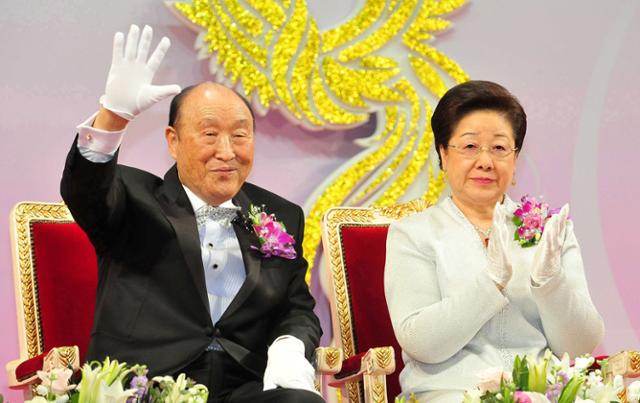
"Legal action against religious leader Han Hak-ja is very concerning."
This statement defending Han Hak-ja, the leader of the Family Federation for World Peace and Unification (Unification Church), did not come from Korean political or religious circles. It was posted on social media on the 4th (local time) by Mike Pompeo, who served as CIA Director and Secretary of State during Donald Trump's first administration and was considered a "power player." Pompeo warned that "the increasing violations of religious freedom represent an abandonment of the democratic principles that South Korea should support."
This statement was interpreted as Pompeo's "supporting fire" to defend the Unification Church. The entity that has put the Unification Church on the defensive is the special prosecutor team investigating allegations involving First Lady Kim Keon-hee. Allegations continue to emerge daily that the Unification Church made improper solicitations to the Yoon Suk-yeol administration through First Lady Kim and People Power Party lawmaker Kwon Seong-dong as intermediaries. The special prosecutor has conducted multiple raids on Unification Church facilities and is now targeting President Han directly. They have even characterized the Unification Church-related allegations as "state manipulation." Given this situation, Pompeo's statement likely stems from an "SOS" sent by the Unification Church. He has connections, having appeared in video lectures for the Universal Peace Federation (UPF), a Unification Church-affiliated organization, in 2021 and 2022.
The notable point is that the Unification Church reached out to high-ranking American politicians for a "public opinion war" and actually received a "response." What enabled the Unification Church, which is classified as a heretical sect by major Korean Christian denominations, to wield such influence? This analysis examines why the Unification Church sought to join hands with political circles, how it grew to the point of exercising "influence" in American politics, and whether it can escape the crisis it faces from the special prosecutor's investigation.
Founded in 1954… Full-Scale US Missionary Work in the 1970s
The Unification Church is a new religious movement founded by Korean Sun Myung Moon in 1954. It began overseas missionary work in Japan in 1958 and the United States in 1959, rising to become an international religious organization. It rapidly expanded its membership through active missionary activities in the United States, particularly in the 1970s. After founder Sun Myung Moon's death in 2012, his wife Han Hak-ja defeated her children in a succession struggle and has been serving as the second president. While precise statistics are unavailable, according to a 2015 media report, the Unification Church claims to have 300,000 members in Korea and 3 million overseas (including 600,000 in Japan and 100,000 in the US).
The Unification Church's "honeymoon relationship" with political circles dates back to the Park Chung-hee administration. In the 1960s and 70s, the Unification Church emphasized anti-communist ideology and organized the "International Federation for Victory over Communism" with support from the military government. The two parties, pursuing "political foundation strengthening" and "membership expansion," became symbiotic. This relationship was starkly revealed in the 1977 US Congressional investigation known as the "Fraser Report." Tak Ji-won, director of Modern Religion, explained: "While politicians may find connections with heretical religions burdensome, the funds and votes they can obtain through their organizational power are significant. From the heretical religion's perspective, they receive protection while also securing influence by relying on politicians, so they have no choice but to actively seek relationships with political circles."
Supporting Nixon, Reagan, and Bush… Establishing Media Companies in the US
The Unification Church then expanded "outward" using its doctrine. The church's doctrine states that "humanity's ultimate goal is to form one great family centered on God and build the Kingdom of Heaven on Earth." In other words, the earthly mission is to build a "Cosmic Peace and Unification Nation," which could be called a world single state or world government. Unlike other heretical religions that focused on domestic evangelization, the Unification Church aimed for "worldwide missionary work" from its founding.
This is when it began building relationships with American political circles. In 1973, the Unification Church publicly declared support for US President Richard Nixon, who was in crisis due to the Watergate scandal. In the 1980s and early 1990s, it also built relationships with US Presidents Ronald Reagan and George Bush, growing mainly with Republican Party support. Additionally, in 1982, it launched the conservative daily newspaper "Washington Times," entering the US media business. The Washington Times is known today as a major conduit between the Unification Church and American right-wing political figures. Choi Jong-geun, chairman of the Unification Church Anti-Corruption Monitoring Committee, who has continuously exposed internal corruption within the Unification Church, claimed: "The Washington Times provided hundreds of billions of won in political donations to the Republican Party from funds received from the Unification Church, maintaining relationships with American conservative elders."
Missionary activities on a global scale require significant funding. Where did the Unification Church's financial power come from? First was business. The Unification Church created the "Unification Group" for corporate activities and developed various businesses. As a result of expanding business through subsidiaries in education, media, construction, and other fields, its current asset scale is reported to approach several trillion won.
Second was donations. Japanese members' contributions were particularly the core funding source for the Unification Church. Japanese members are known to constitute a high proportion of worldwide membership, and Japan's Asahi Shimbun reported that "the Unification Church's average annual donation income in Japan from 2015-2022 was 40.9 billion yen (approximately 386.4 billion won)." This was somewhat revealed in the 2022 assassination of former Japanese Prime Minister Shinzo Abe. The perpetrator stated his motive as: "My mother's large donations to the Unification Church destroyed our family, making me angry. I targeted Abe, who had close ties with the Unification Church."
Using its massive financial power as a weapon, the Unification Church continued political lobbying. Money generated power, and power generated money again. It spared no expense in recruiting famous figures. For example, Trump reportedly received $2.5 million (approximately 3.5 billion won) from the Unification Church for "three video lectures" in 2021 and 2022. Each video was about 10 minutes long. On average, Trump's lecture fee paid by the Unification Church was "over 100 million won per minute."
However, the Unification Church's "prestige" has shown signs of wavering in recent years. The decisive trigger was the Japanese government's "order to revoke the Unification Church's corporate status and dissolve" after Abe's assassination in 2022. Some analyze that the Unification Church approached First Lady Kim Keon-hee and the People Power Party around this time to compensate for the blow from Japan. If true, it ultimately became the "worst move." The Unification Church allegations caught in the special prosecutor's investigation net include: mass enrollment in the People Power Party, providing 100 million won to People Power Party lawmaker Kwon Seong-dong and making solicitations, and delivering luxury gifts to First Lady Kim through Geonjin Temple and making solicitations.
Currently, the Unification Church appears to be staking everything on a public opinion war. The idea is to create a "religious persecution" frame through famous figures' voices. Pompeo's case is not alone. Former US House Speaker Newt Gingrich also contributed an article to the Washington Times on the 27th of last month stating: "The comprehensive political and religious persecution by Lee Jae-myung's government in South Korea is suffocating." Also, although later claiming it was a "misunderstanding," Trump's mention of concerns about "raids on large Korean churches" during the Korea-US summit on the 25th of last month cannot be ignored. While the dominant interpretation is that he was referring to the Marine death incident special prosecutor team's raid on Yoido Full Gospel Church, some suggest he "might have been pointing to the Unification Church raids."
However, experts predicted that the Unification Church's attempts at "opinion reversal" would not work. Chairman Choi Jong-geun noted: "The special prosecutor is investigating problems arising from corruption among high-ranking officials within the Unification Church, not persecuting religion." He continued: "Even though top internal officials are confessing everything to investigative agencies, the Unification Church continues trying to use the 'religious persecution' frame. They mistakenly think this is how they survive."
Jin Yong-sik, president of the Korea Christian Heresy Counseling Center Association, offered similar analysis. Jin stated: "The Unification Church's strategy of buying and fronting influential politicians with money is an attempt to survive by pressuring opposition forces. It's nothing more than a last-ditch struggle." He emphasized: "While the Unification Church tries to shift the issue to religious persecution, they must realize that the special prosecutor's investigation is 'social sanctions' for their anti-social acts long committed under the name of 'religion' and reflect."
There are also many voices calling for completely severing the ties between politics and religion. Director Tak Ji-won argued: "As this Unification Church incident has surfaced, political and religious circles will probably be careful for a while. However, since there's a high possibility of (symbiotic relationships) repeating before long, thorough punishment is necessary." This means it should serve as an opportunity to reflect again on the constitutional "principle of separation of church and state."
Posted by Freewhale98