
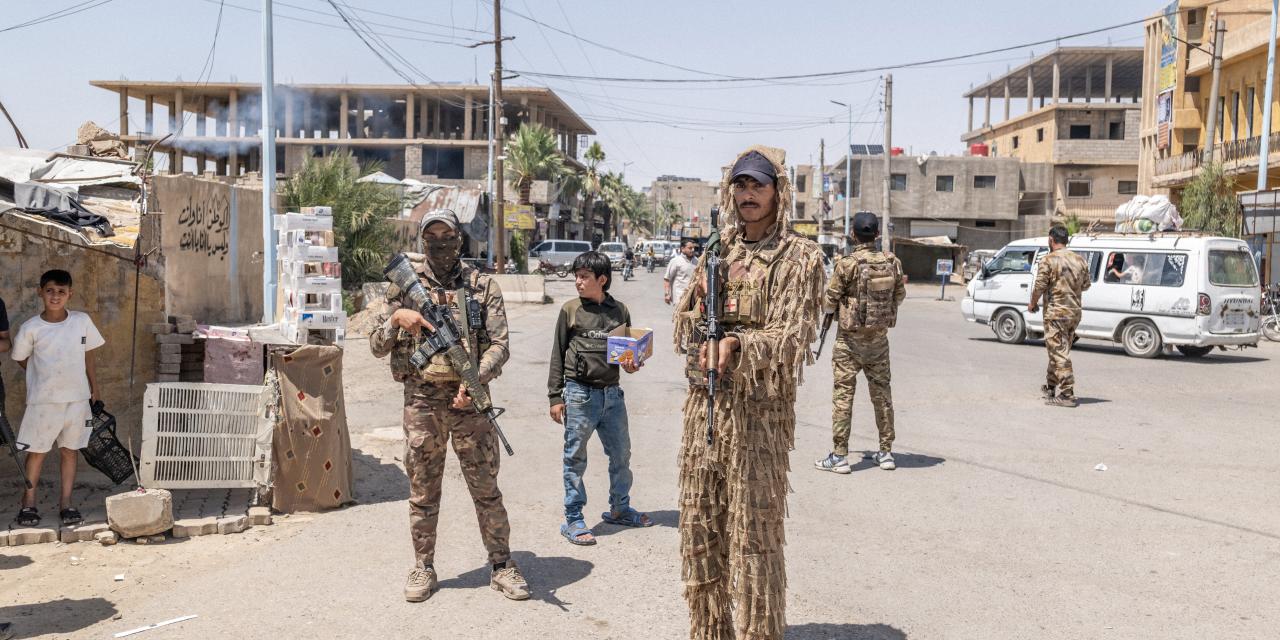
Six years later, that rare, decisive victory over militancy is being eroded. Islamic State, now a decentralized mobile insurgency, is exploiting a reduced American presence and the collapse of Bashar al-Assad’s regime in Syria to enlist new recruits and widen its reach, said U.S. and Kurdish military commanders.
The group is freshly equipped after raiding arms depots late last year after rebels took Damascus and the regime’s army and its Iranian allies fled. It isn’t able to hold territory, but it is contributing to a sense of lawlessness that’s adding to the stress on the new state.
Islamic State militants staged 117 attacks in northeast Syria through the end of August, far outpacing the 73 attacks in all of 2024, according to SDF figures. They have also plotted attacks in the capital, 270 miles away from their bases of operation in the east, Syria’s government said.
Many of its assaults in the northeast were in Deir Ezzour province, a desert region the size of Maryland that is home to most of the country’s estimated 3,000 Islamic State fighters. A weeklong trip through the province’s towns showed how the militant group is adapting its tactics to again make its influence felt—by killing representatives of the area’s Kurdish rulers, renewing its demands for payments, and sowing fear.
“The withdrawal of American forces is inspiring Daesh,” said Goran Tel Tamir, a top regional SDF commander, using the Arabic acronym for Islamic State. “We see them launching more attacks on us. We are getting more complaints from people. This is putting us in a difficult position.”
While Islamic State is digging in, the U.S. has ramped down. Since April, the U.S. has pulled out around 500 of the 2,000 American troops in Syria and shut down multiple bases or handed them over to the SDF, which controls a swath of Syria’s northeast. In the coming months, the troop count could drop below 1,000, the Pentagon said. Much of the drawdown has occurred in eastern Syria, particularly Deir Ezzour.
Pentagon spokesman Sean Parnell said the reductions reflect U.S. success in degrading the group.
While the SDF controls much of Syria’s northeast, its troops are stretched thin. In addition to patrolling the territory, they are responsible for guarding camps and prisons housing nearly 50,000 former Islamic State fighters, along with their wives and children. The SDF has asked foreign countries to take back their citizens there, but most haven’t.
Posted by John3262005