
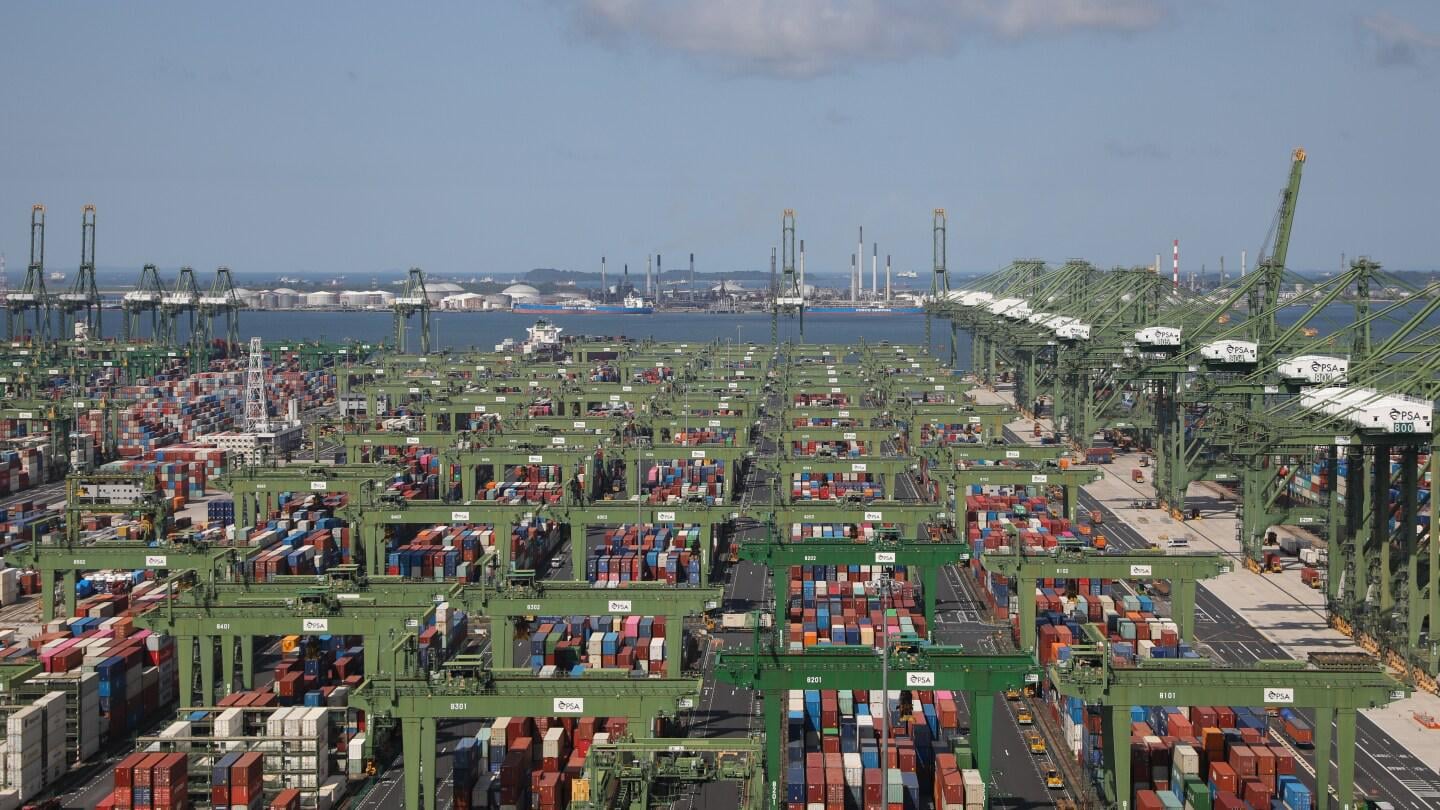
SINGAPORE, Singapore (AP) — Carbon tax concessions granted to global oil giants may undermine incentives to shift to cleaner energy, environmentalists fear.
So conservation groups in Singapore are seeking more transparency over what discounts the city-state of 6 million giving polluters for taxes on their climate-changing emissions. Singapore is the only Southeast Asian country to have imposed a carbon tax so far. Most of the European Union, California, South Korea and Japan also do so.
Indonesia, Malaysia and Thailand are preparing to implement similar taxes next year and Vietnam and Brunei are considering the idea. The groups are pressing the Singaporean government to disclose more information about “allowances” Singapore’s National Climate Change Secretariat (NCCS) has awarded to certain companies.
The government says the tax breaks are “not a free pass” for corporations to continue emitting. But it has balked at providing details or even full data about the impact of the carbon tax.
Singapore accounts for only 0.1% of global carbon emissions, but its emissions per person were 27th highest out of 142 countries, said Vinod Thomas, a senior fellow at the ISEAS-Yusof Ishak Institute, a Singapore-based think tank.
“Singapore is being watched and is being seen as a leader,” Thomas said, adding that “it matters to a great extent what others will do. If one country alone reduces emissions, that’s great. But the atmosphere only cares about the total, so it is critical the rest of Southeast Asia also plays its part.”
Singapore’s carbon tax evolves
Implemented in 2019, the carbon tax was set to increase every few years to allow emissions-intensive, trade-exposed companies time to invest in cleaner technologies.
But the island nation has granted closed-door concessions to certain businesses.
The NCCS says the deals are private because corporations raised valid concerns about how information on allowances could be used to compromise their business strategies and operations. Only facilities with credible plans for ending their net carbon emissions have been granted partial concessions, it said.
The policy partly is meant to prevent carbon leakage, a term for when companies move to countries with less stringent climate regulations.
While the tax covers around 70% of Singapore’s emissions, the NCCS has not disclosed the exact amount of emissions reductions brought on by the carbon tax. It says it is “difficult to isolate the exact amount of emissions reductions” and that more information will be provided “in due course.”
Local climate groups issued a joint letter in September demanding more information about the scale and scope of the tax breaks, contending that “transparency is not incompatible with competitiveness.”
“We can’t even come to a conclusion about whether the carbon tax is effective because we don’t have the data,” said Rachel Cheang, co-founder of Energy CoLab, a youth-led local climate group. “Any conversation with the government is just not on equal ground.”
The city-state’s carbon tax started at 5 Singapore dollars ($3.7) per ton of emissions. It has risen gradually, to 25 Singapore dollars ($19) per metric ton last year, and will be 45 Singapore dollars ($34.70) in 2026. By the end of this decade, it’s expected to be 50-80 Singapore dollars (about $40-$60) per metric ton.
The push for greater transparency
The carbon tax burden falls most heavily on global energy companies — like ExxonMobil, which operates Singapore’s largest refining facility on Jurong Island; Shell, which runs the country’s oldest refinery on Pulau Bukom and Chevron, which has a 50% interest in the Singapore Refining Co.
ExxonMobil and Chevron did not respond to requests for comment. Shell said “We won’t be commenting.”
There is no publicly available data on the amount of carbon released by high-emitting companies in Singapore. Such information “would help the public hold them accountable for their emissions,” said Ho Xiang Tian, co-founder of the local environmental group LepakInSG.
Ordinary Singaporeans have a stake in this since the tax may be passed on in the form of higher utility rates.
LepakInSG calculates a set carbon tax of 50 Singapore dollars would increase the household utility bill for a 4-room, government-subsidized apartment by 8 Singapore dollars ($6.20) a month.
That’s probably tolerable for most families and may encourage people to conserve electricity, said Ho, but “We have also called for the government to ensure protection for the more vulnerable groups, to ensure it will not disproportionately impact them.”
US stance may slow carbon tax momentum
The push for a more transparent policy coincides with the derailing this month by U.S. President Donald Trump of a months-long international effort to set up the first global tax on shipping emissions.
Trump vehemently opposes charging such fees.
Progress toward expanding carbon taxes will face obstacles as long as the U.S. — the world’s second largest emitter after China — stays committed to fossil fuels, said Shi-Ling Hsu, a professor at Florida State University’s College of Law and author of “The Case for a Carbon Tax: Getting Past Our Hang-ups to Effective Climate Policy.”
“There’s going to be a big block on global carbon taxes as long as Trump is in office,” Hsu said.
For Cheang and others in Singapore, that adds to the urgency of providing more transparency over how its carbon tax works.
“We have a huge responsibility, in that sense, to uphold a certain amount of integrity in the way that we are designing and implementing our policies,” she said.
Posted by Shameful_Bezkauna
1 Comment
Please for the love of fuck stop praising Singapore for its “developmental authoritarianism”. The authoritarian structure was *not* what made Singapore a developed nation, but *good policymaking and highly advantageous geography* – the only thing authoritarianism achieved in Singapore was slowly strangling the country to death and enslaving its people to oligarchs.
Dictatorships of all fashions are no less bound to corrupt, entrenched interest groups than democracies. The difference between the two systems is that the “entrenched interest groups” in a dictatorship tend to be either monied interests, state/bureaucratic interests, or armed security forces, while the “entrenched interest groups” in a democracy tend to be large, organized political associations with common goals, such as labour unions, farmers’ associations, or small business owners.
Benevolent dictatorship is a myth *created by and for dictators* to justify their own pillaging, any “perfect” politicoeconomic system can be implemented in a democracy just as well as it could be implemented in a dictatorship, because by the definition of it being *perfect* it would have to fulfill the economic needs and wants of the populace – *every* ideology inevitably melts away with enough bread and circuses. **Every** dictator ever has claimed to be benevolent, and yet there has not been a single benevolent dictator since Cincinnatus (whose “benevolence” was probably propaganda by the patrician elites to be honest – he was an aristocrat who violently opposed the idea that the common citizens should have rights).