
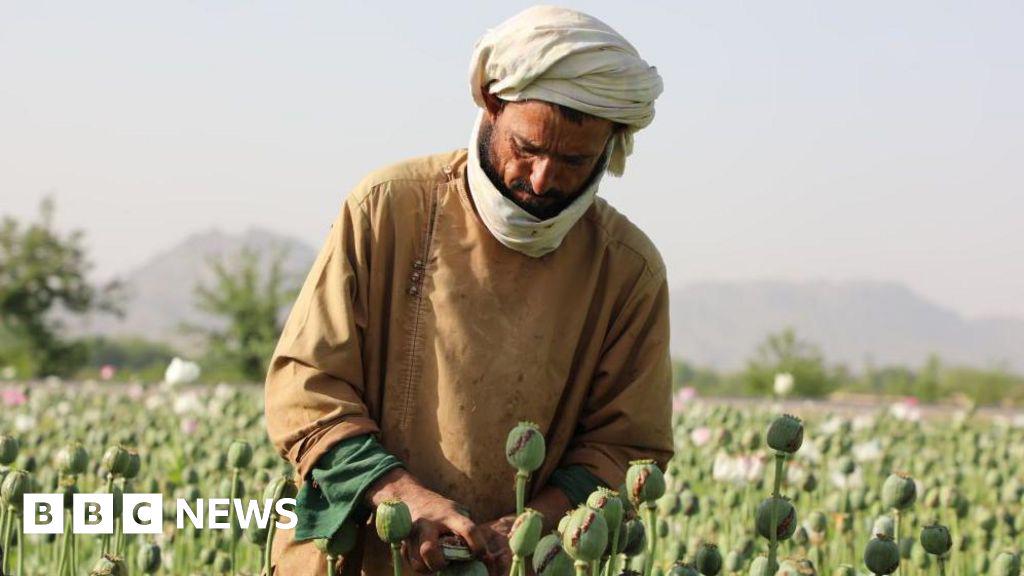
Opium farming in Afghanistan has dropped significantly following a ban imposed by the Taliban government in 2022, the United Nations said.
The total area of land for growing opium poppy shrank 20% since last year, while the amount of opium has fallen by 32% over the same period, the UN's Office on Drugs and Crime said in a survey.
Afghanistan used to produce more than 80% of the world's opium, with heroin made from Afghan opium making up 95% of the market in Europe.
But after retaking power the Taliban banned the practice in April 2022, saying opium was harmful and went against their religious beliefs. The UN said most farmers continued to observe the ban despite "severe economic challenges".
The total area under opium poppy cultivation this year was estimated at 10,200 hectares, mostly in the north-east of the country, with Badakhshan province accounting for the largest share. Before the 2022 ban, more than 200,000 hectares were under poppy cultivation in Afghanistan.
The Taliban's efforts to destroy opium fields occasionally sparked violent resistance from the farmers, particularly in the north-east, the UNODC said, noting that casualties were reported during clashes in several districts of Badakhshan. But the vast majority of Afghan farmers adhere to the ban issued by the Taliban's supreme leader.
Poppy fields are no longer openly visible in Helmand, but they do still exist. While opium is in decline, trafficking in synthetic drugs such as methamphetamine have risen since the ban, the UNODC said.
Posted by John3262005
5 Comments
It’s Herover bros
Combined with the incredibly hostile regulatory environment for Syrian Captagon, the illicit drug market is on a real downturn in the Middle East.
The Taliban being the most powerful governing entity in modern Afghan history will never stop being fascinating to me
Their whole strength is that they unite around Islam (and Pashtunwali), with tribal identity subordinate.
Which enables them to do shit like this. They basically took away the livelihoods of a ton of farmers, of entire towns, with this stunt. Opium is super easy to grow and transport and sell. It is not easily replaced by, yknow, non-drug crops. And people mostly just complied. Like there isn’t gonna be a giant schism or revolt over this.
To be clear, that doesn’t mean the leadership can do whatever they want, all the time. They have to throw the tribes a bone sometimes. They have to leave the villages alone sometimes.
But they have much more leeway to implement policy than the King, or the Communists, or the Northern Alliance, or the Islamic Republic ever did.
Under Benazir Bhutto, Pakistan and Afghanistan were the greatest distributors of opium across the globe. I think Afghanistan was like exporting 90% of the world’s supply during its heyday.
Great PR stunt by the Taliban, but for the most part, this has actually had a negative impact on rural Afghanistan. There simply isn’t a replacement cash crop for opium given the country’s geography and human capital. There’s a reason why the United States and the Republic basically gave up on enforcing anti-opium laws.