
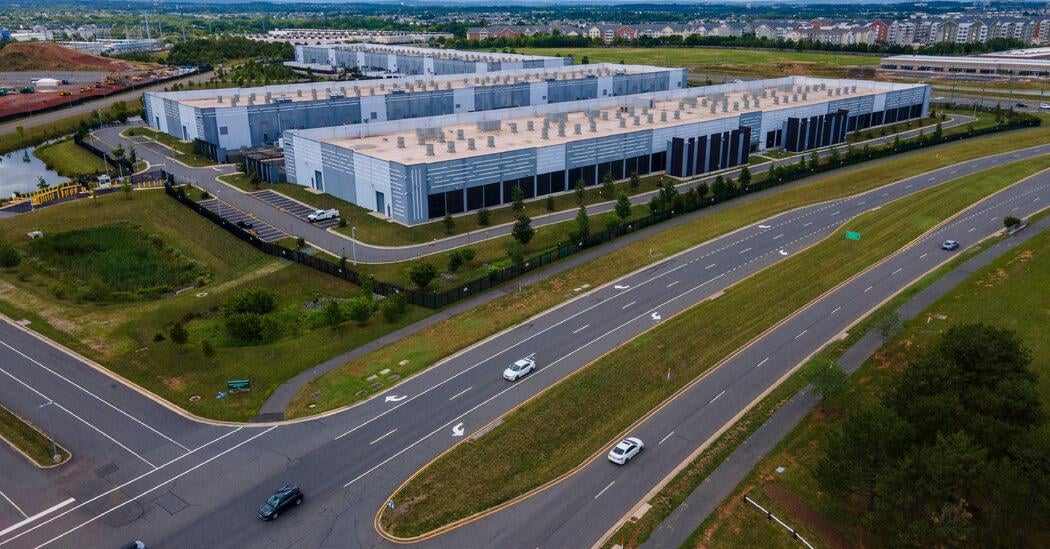
Debt has entered the A.I. boom | To fund heavy spending on infrastructure for artificial intelligence, companies have leveraged a growing list of complex debt-financing options
Posted by ONETRILLIONAMERICANS
Debt has entered the A.I. boom | To fund heavy spending on infrastructure for artificial intelligence, companies have leveraged a growing list of complex debt-financing options
Posted by ONETRILLIONAMERICANS
7 Comments
berniesanders.jpg “I am once again asking for ping FINANCE”
> Like many companies trying to keep up in the A.I. boom, QTS Data Centers, a digital infrastructure company that’s wholly owned by the investment giant Blackstone, has been dropping billions of dollars to expand its network of cutting-edge computing facilities. It has also, like a growing number of fellow tech companies, found a way to unlock additional (and much-needed) cash: exotic financial instruments.
> According to an investor offering sheet obtained by DealBook, Blackstone is on the cusp of closing a $3.46 billion commercial-mortgage-backed securities (C.M.B.S.) offering to refinance debt held by QTS, the biggest player in the artificial intelligence infrastructure market. It would be the largest deal of its type this year in a fast-accelerating market. (Blackstone declined to comment.)
> The bonds would be backed by 10 data centers in six markets (including Atlanta, Dallas and Norfolk, Va.) that together consume enough energy to power Burlington, Vt., for half a decade.
> Blackstone’s offering is part of the latest push in the A.I. infrastructure financing blitz. According to McKinsey, $7 trillion in data center investment will be required by 2030 to keep up with projected demand. Google, Meta, Microsoft and Amazon have together spent $112 billion on capital expenditures in the past three months alone.
> The sheer scale of spending is spooking investors: Meta’s stock tumbled 11 percent after the company revealed its aggressive capital expenditure plans last week, and tech stocks have sold off this week on overvaluation fears.
> Now, the tech giants are turning to financing maneuvers that may add to the risk. To obtain the capital they need, hyperscalers have leveraged a growing list of complex debt-financing options, including corporate debt, securitization markets, private financing and off-balance-sheet vehicles. That shift is fueling speculation that A.I. investments are turning into a game of musical chairs whose financial instruments are reminiscent of the 2008 financial crisis.
> Big tech companies are looking for new sources of financing. While Meta, Microsoft, Amazon and Google previously relied on their own cash flow to invest in data centers, more recently they’ve turned to loans. To diversify their debt, they’re repackaging much of it as asset-backed securities (A.B.S.). About $13.3 billion in A.B.S. backed by data centers has been issued across 27 transactions this year, a 55 percent increase over 2024.
> If investors want to buy data center A.B.S., they have two options, according to Sarah McDonald, a senior vice president in the capital solutions group at Goldman Sachs: They can invest in a data center that has one tenant, like a hyperscaler, or in a co-location data center, which has thousands of smaller tenants. The former is an investment-grade tenant with a long-term lease, but the risk is highly concentrated; the latter is most likely renting out to noninvestment-grade tenants with short-term leases, but the investment is extremely diversified.
> Digital infrastructure “is something that investors have a huge appetite for,” McDonald said.
Despite the increase in popularity, data center securities are just a small slice of the A.B.S. market, which is dominated by credit card, auto, consumer and student loans.
> Blackstone’s $3.46 billion C.M.B.S. offering may seem like small potatoes compared with some other debt-fueled deals, such as Meta’s $30 billion corporate offering to finance its data center in Louisiana. But it’s unprecedented for the C.M.B.S. market, where issuance for data-center-backed deals was just $3 billion for all of 2024.
> “They realize how much cash they’re going to need, so they’re getting the C.M.B.S. market comfortable with this type of asset,” said Dan McNamara, the founder and chief investment officer of Polpo Capital, a hedge fund that focuses on C.M.B.S. He added that while most traders in the market were well versed in assets like office space or industrial buildings, with data centers, “it’s not traditional ‘bricks and sticks’ commercial real estate.”
> To complicate matters further, the share of single-asset-single-borrower securities (S.A.S.B.) — for example, the assets inside the bond being sold are all from the same company or a single data center — is rising, with 13 percent of all S.A.S.B. deals coming from data centers, according to Goldman Sachs.
> “It’s one company, and these assets are quite similar. If there’s a problem with A.I. data centers, like if their current chips are obsolete in five years, you could have big losses in these deals,” McNamara said. “That’s the knock on S.A.S.B.: When things go bad, they go really bad.”
> Also at play: a financial tool that came into vogue before the financial crisis. Called a special purpose vehicle (S.P.V.), it’s a legal entity that allows a company to take on a lot of debt without having to hold it on its own balance sheet.
> When Meta structured its $30 billion debt offering for its new data center in Louisiana — the largest private capital transaction on record — Morgan Stanley arranged the debt to sit in one of these custom, off-balance-sheet vehicles. Although the S.P.V. was created to service Meta, the debt technically belongs to the S.P.V., not Meta, which makes Meta look healthier on paper.
> The maneuver made it easier for Meta to raise another $30 billion in the more traditional corporate bond market. Overall, according to Morgan Stanley, $800 billion in private credit will be needed over the next two years to fund data centers. And S.P.V.s are becoming a more popular way to structure it. Following Meta’s lead, Elon Musk’s xAI is also tapping an S.P.V. to potentially hold $20 billion in debt to buy Nvidia chips and then rent them to xAI.
https://preview.redd.it/vv1vuo3rvg0g1.jpeg?width=576&format=pjpg&auto=webp&s=63916f4a6d70942d50e335c167b43718c224ae1f
Mortgage-backed securities crisis, Gen Z edition: Bigger and less diversified!
CDS spreads on these assets will be interesting to track
Bubble Indicator
Money for the machine God
I feel like when I read these articles, the financing mechanisms sound very troubling (it basically allows big corps like Google or Meta to walk away if they can’t figure out how to monetize their AI investments, which could leave these data centers underwater) but I also don’t quite get a sense of scale. Like how big of a chunk of the economy are we talking about, if these things end up failing? How big of an exposure does the rest of the economy have to this debt?