
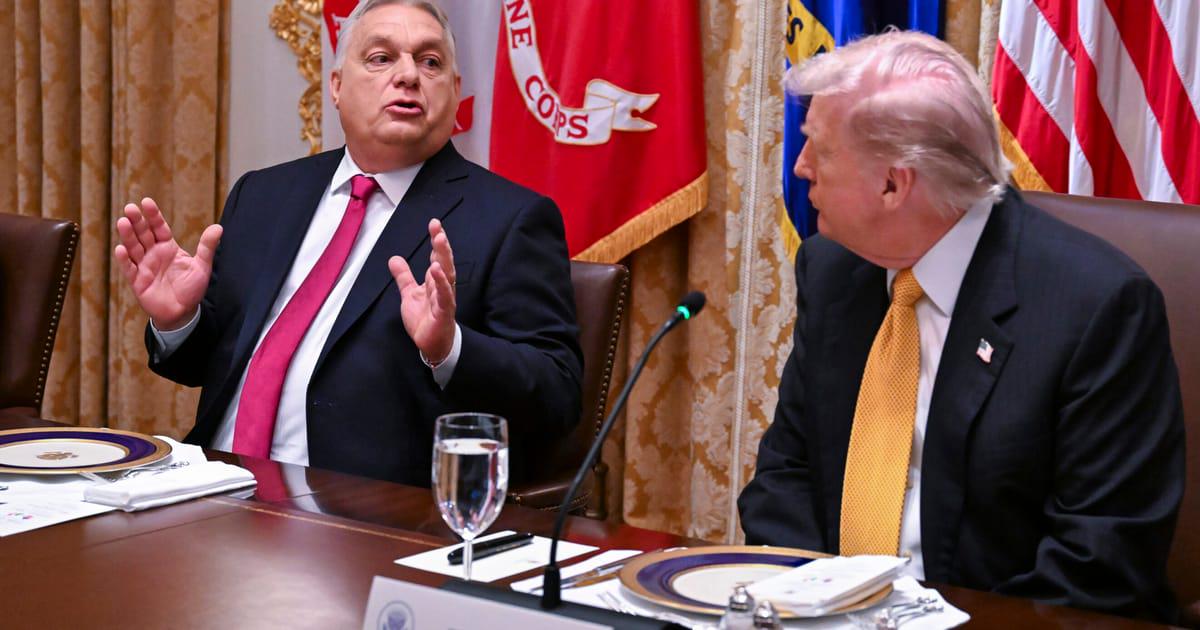
Hungary’s surging opposition is demanding Prime Minister Viktor Orbán explain a “bailout package” he hinted at securing from U.S. President Donald Trump.
Orbán, a longtime Trump ally, traveled to Washington last week to meet with the American leader. As he returned to Budapest, the populist-nationalist Hungarian premier told his delegation the U.S. had agreed to provide Budapest a “financial shield.”
“Certain Brussels instruments that could be used against Hungary can now be considered ineffective … The notion […] that the Hungarian economy can be strangled from the financing side, can now be forgotten,” he said, according to local media, adding, “We have resolved this with the Americans.”
After 15 years in charge, Orbán faces potential defeat in next spring's national election — and the specter of financial assistance from Washington closely echoes Trump's recent blockbuster move to save another ideological ally, Javier Milei in Argentina.
“Why was such a ‘financial shield’ necessary? Is there a near-state bankruptcy situation? What would Viktor Orbán spend the trillions of forints in American loans on? Why is he indebting his fellow citizens instead of bringing home the 8 trillion forints in EU funds owed to Hungarians?” Péter Magyar, leader of Hungary’s opposition, which is leading the ruling Fidesz party in the polls, demanded in a post on social media. In a separate missive, he added, “Why did Orbán secretly negotiate a huge bailout package?”
Hungarian media outlet Válasz Online reported that Trump and Orbán may have committed to a currency swap between their countries’ central banks — similar to the $20 billion exchange-rate stabilization agreement Argentina inked with the U.S. last month — essentially, a bailout package for Budapest.
If so, it would be the second time Trump provided financial assistance for a right-wing ally ahead of a crucial election, after he approved the bailout package for Milei, the chainsaw-wielding libertarian president of Argentina.
There are differences, too, though, which make any Washington-Budapest arrangement more difficult to understand. Hungary’s central bank does not have dollar swap arrangements with the U.S. Federal Reserve, nor does Hungary have a formal backstop — basically, an agreement to help financially in times of fiscal disaster — with the Fed.
Posted by John3262005
2 Comments
I thought Orban was counting on being Prime Minister of Russian Occupied Hungary.
Wow. Trump became the symbol and sponsor of Global Reactionary Revolution. But as Yoon realized, Trump has no interest in helping losers.
https://preview.redd.it/shrzsq863j0g1.jpeg?width=995&format=pjpg&auto=webp&s=382e049e5c066d71450e8044de4651e91696d4d3