
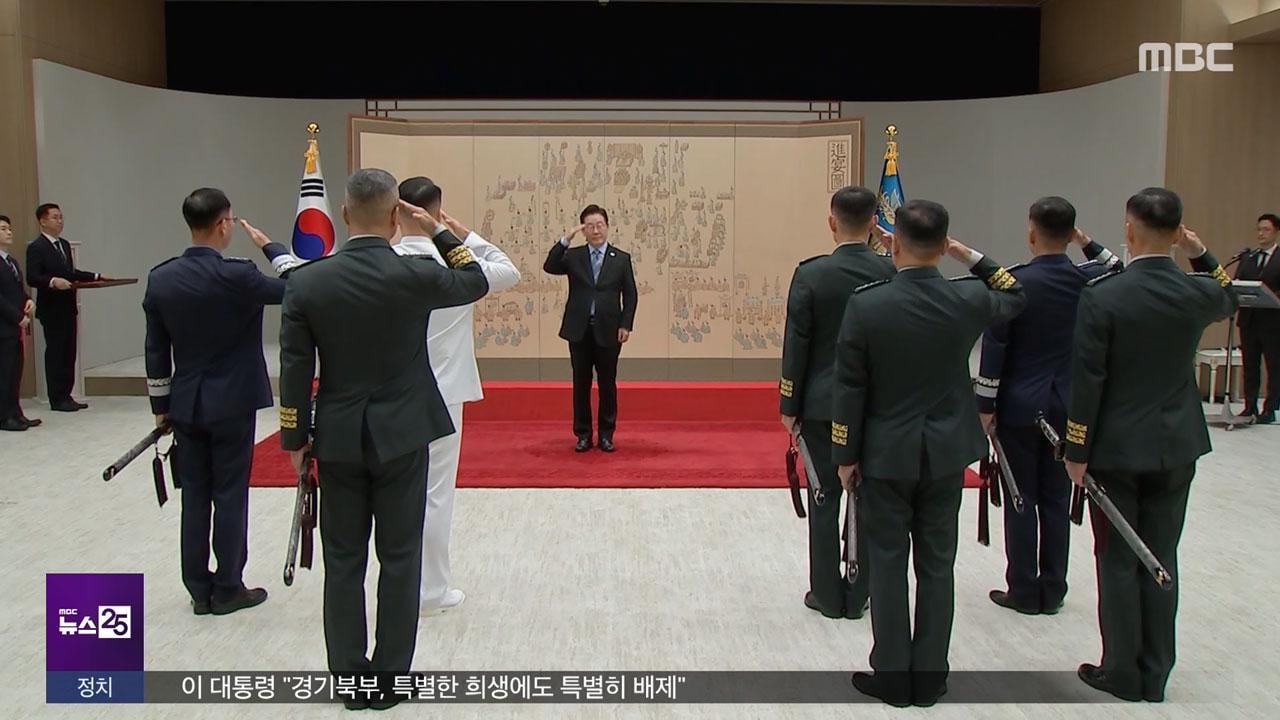
Government replaces 20 of 31 three-star Generals in major shake-up.
Applying the principle that “even if the degree was minor, anyone who took part in the insurrection will not be promoted,” the government excluded from promotion all generals who boarded the so-called “martial-law buses” that night.
Two months after replacing all seven four-star generals, the government has newly appointed 20 out of 31 three-star generals.
At the Joint Chiefs of Staff, four headquarters posts, including the Director of Operations and the Director of Strategic Planning, were changed at once. In the Army, all 15 lieutenant-general posts, including the commanders of six corps, were replaced.
The Ministry of National Defense explained that it “focused on personnel renewal to carry out the historic task of rebuilding a people’s military,” a move interpreted as a wholesale reshuffle to hold accountable senior officers deeply involved in the December 3 emergency martial law.
President Lee Jae-myung had earlier instructed, “Even if the involvement was minor, if someone took part in the insurrection, they must not be promoted,” and Defense Minister Ahn Kyu-baek stressed, “We must cut out everyone who is tainted or problematic and establish a fresh defensive line.”
[Ahn Kyu-baek / Minister of National Defense (two days ago)]
“While upholding the values of democracy and constitutional defense, we will rebuild a military that belongs to the populace…”
Even after the National Assembly voted to lift emergency martial law, five major generals who boarded the so-called “martial-law buses” under orders from then Martial Law Commander Park An-su were all denied promotion.
By appointing an officer-candidate-school (OCS) graduate as Special Warfare Command chief, and Reserve Officers’ Training Corps (ROTC) graduates as Army Deputy Chief of Staff and First Corps Commander, the reshuffle also targeted the breaking of the so-called “cartel” centered on the Korea Military Academy.
No separate appointment was made for the head of the Defense Counterintelligence Command (DCIC), which had been used to detain politicians; the command is expected to be downgraded to a one-star unit after organizational restructuring to reduce its authority by next year.
Since “punishing those who participated in the insurrection” has been set as the top principle guiding military personnel decisions, a large-scale shake-up is likewise expected in the year-end promotions for major generals and brigadier generals.
In addition, following the ministry’s own internal inspection, a “Constitution-Respect Task Force” formed at the direction of the Prime Minister’s Office is expected to begin a full investigation soon, raising the prospect of the largest military reform since President Kim Young-sam’s purge of the Hanahoe clique.
Posted by Freewhale98
1 Comment
[Context]
1. What is Hanahoe?
Hanahoe refers to a secret cabal of far-right generals which orchestrated Gwanju massacre and crushed 1980 Seoul Spring. Chun Doo-hwan was its leader. They got purged in 1990s by President Kim Young-Sam and harbored great hostility to Sixth Republic, believing they were betrayed.
So, when a secret cabal of generals are found, many always refer to this organization. Also, there are suspicions that this secret cabal is involved in December 3rd insurrection, too. Many former Hanahoe members are reportedly to have acted as an intermediary between Annie Chen of CPAC and shaman-controlled insurrectionist generals of “Choongam clique”.
2. Why is Democratic Party of Korea (DPK) government pushing for this purge?
DPK has a lot of bad experience with far-right military coups. Their first liberal government of PM Chang Myon got overthrown in 1961 right-wing military coup by Park Chung-hee. Kim Dae-Jung, their greatest president, got almost executed during 1979 coup. So, they were always suspicious of the military and security establishment…and this coup attempt just confirmed their paranoia. They are convinced that there are more rogue generals who are plotting second insurrection and decide to launch pre-emotive strike, destroying their ability to stage another coup.
3. Conclusion
This is the third time Seoul got violated by its own army but many generals just followed through with the illegal orders from the president who went insane. The level of obedience to this illegal order was high among the ranks of generals while mid-level officers and rank-and-file ignored orders or went in malicious compliance mode, subjecting themselves to rotation by protesters or eating ramen instead of heading to National Assembly.
This led to popular anger directing to the top generals but they are just claiming “they were just following orders”. So, the government is not happy with the explanation and kicking them out.