
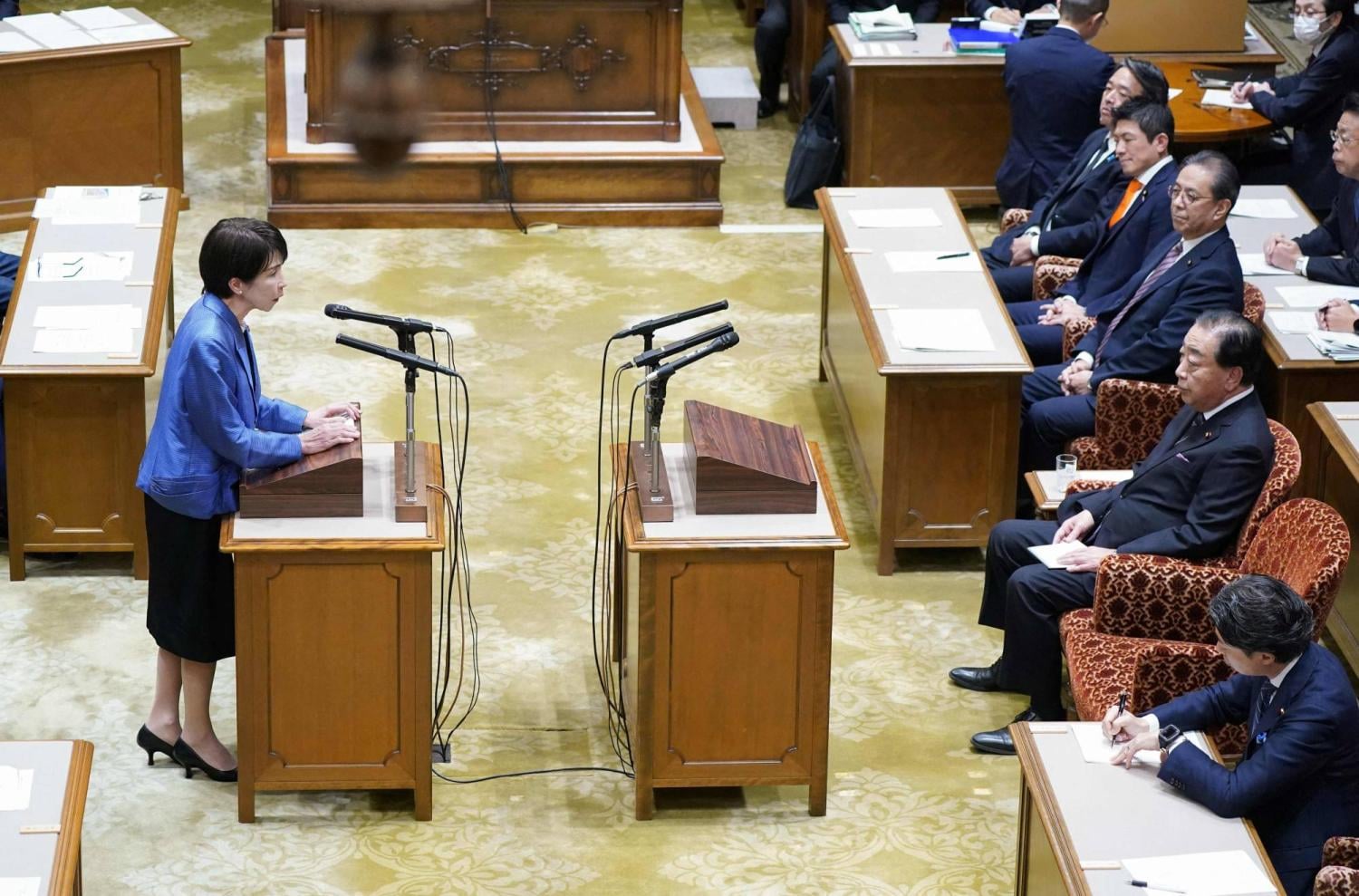
Prime Minister Sanae Takaichi on Wednesday hinted in parliament that she didn’t initially intend to refer to a specific case that Japan could consider a “survival-threatening situation” that would potentially allow it to deploy its military under the right of collective self-defense.
But, facing off with opposition leaders in parliament for the first time since taking office, Takaichi insisted that her position is in line with that of previous administrations and defended her Nov. 7 remarks in which she said a Chinese naval blockade of Taiwan could constitute an existential crisis for Japan.
“Merely repeating the government's previous position over and over again could, in certain circumstances, have led to the suspension of that session of the budget committee,” she said in reference to a practice sometimes employed by the opposition to halt parliamentary deliberations when the government’s answers are not deemed satisfactory.
”I was asked to provide specific examples, and I made an effort to respond faithfully,” she added.
Pressed by Constitutional Democratic Party of Japan leader Yoshihiko Noda on Wednesday, Takaichi said her government continues to keep the door “open” to dialogue with China, which has reacted with fury to her remarks, piling pressure on her to rescind her remarks. Amid the firestorm, a quick resolution to the dispute appears unlikely.
“Going forward, it is my responsibility to build a more comprehensive and positive relationship (with China) through dialogue, and to maximize our national interests,” she said.
Noda, in his exchange with the prime minister, noted that Takaichi’s remarks also didn’t appear to stem from prior coordination within her ruling Liberal Democratic Party or the government.
“I think you have had these thoughts since your days as a simple lawmaker,” he said. “But, as commander-in-chief of the Self-Defense Forces, there are things you cannot say. Inadvertently voicing your personal views is rather imprudent.”
Relations between Japan and China have dipped to fresh lows in the wake of Takaichi’s comments and Beiing’s subsequent retaliation, which came just a week after the prime minister’s meeting with Chinese leader Xi Jinping. In the meeting, the two had pledged to pursue stable and “mutually beneficial” ties.
The rift was all the more apparent when, at a recent Group of 20 summit in Johannesburg, there was no contact between Takaichi and Chinese Premier Li Qiang. Xi and Takaichi held back-to-back phone calls with U.S. President Donald Trump late Monday and Tuesday, with the Japanese leader revealing only that Trump had explained to her the “current state” of Sino-U.S. relations.
“I had a great talk, I have a very good relationship with her,” Trump told reporters on Air Force One on Tuesday, when asked about the phone call with Takaichi, calling her “smart and strong.” But Trump also had high praise for Xi, a day after the Chinese leader emphasized in his call with the U.S. president that Taiwan’s ultimate “return to China” is an integral part of the postwar international order.
It remains unclear if Trump directly offered Takaichi his backing in her row with China.
Noda also questioned the sustainability of the ¥21.3 trillion ($136 billion) stimulus package approved by the Cabinet last Friday, warning that the recent slide in bond prices and depreciation in the yen could lead to a crisis comparable to the one experienced by Britain in 2022 under then-Prime Minister Liz Truss.
Takaichi retorted that the measures do not constitute “irresponsible” fiscal policy.
“Without a growing economy it’s impossible to restore fiscal health,” she said.
Takaichi also faced a call from Komeito leader Tetsuo Saito to uphold the country’s three non-nuclear principles that ostensibly prevent Japan from possessing, producing or allowing nuclear weapons into its territory.
When she took office, Takaichi broke with her predecessors by sidestepping a commitment to the principles and even hinting they might be up for an overhaul as her government begins revising Japan’s security strategy.
Asked about the issue, Takaichi avoided giving a straight answer, insisting only that she had not explicitly instructed a formal review of the government’s position.
Posted by 2Lore2Law
1 Comment
I read this article with an eye for finding a back-down and I didn’t find one.
Takaichi sounded most conciliatory when she said that she has a responsibility to keep decent relations with China, but that just seems like a rather neutral statement of fact when coming from someone in her position.
I don’t think she’s backing off on this. Not yet, anyways.
!ping Japan