
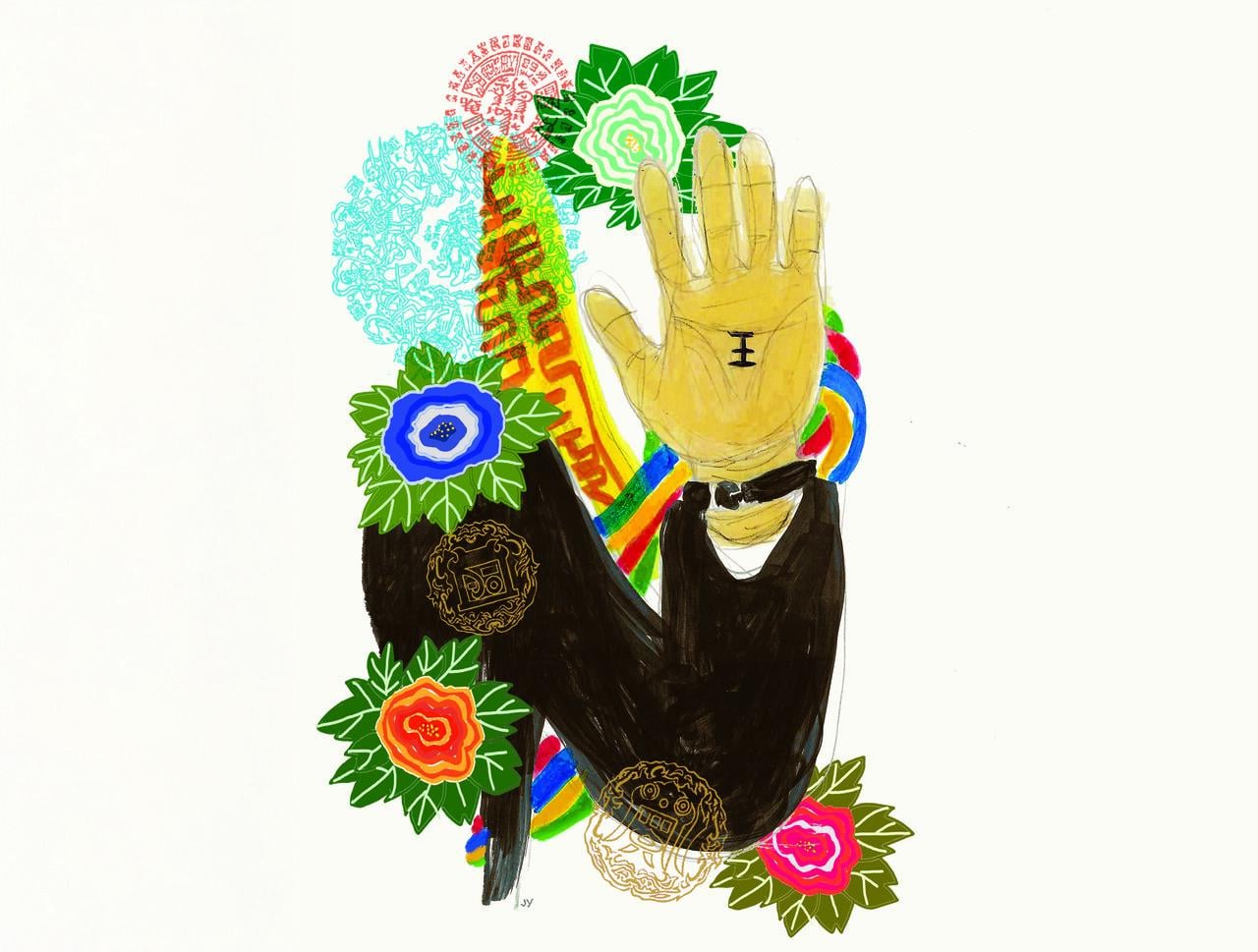
Kim Ga-hyun’s Shamanic Kingdom (Galmuri, 2025) uses the method of historical juxtaposition to identify common traits shared by three Joseon kings who ruined themselves through deep entanglement with shamanism, and by President Yoon Suk-yeol. The author presents a general law of “shamanistic politics”, a pattern through which both an individual and the state ultimately destroy themselves.
The first example, King Yeonsangun, silenced the daegan (the officials responsible for public remonstrance) and ruled through terror during the Literati Purges of 1498 and 1504. He not only summoned shamans and ritual performers into the palace to hold exorcistic rites for the vengeful spirit of his mother, the deposed Queen Yun, but even wore shamanic robes and acted as a shaman himself. Ultimately, he could not avoid the coup that dethroned him.
When confronted with unbearable realities, humans are naturally inclined to seek help from supernatural forces. But when the person doing so is not an ordinary individual but a king, the consequences are vastly different. King Seonjo, whose royal authority was diminished after the Japanese invasions (Imjin War), blamed the disaster on the geomantic faults of Hanyang (Seoul) and the royal palaces. His escapist refusal to face the true causes of national catastrophe, and his search for answers in supernatural signs, became even more extreme under his successor, King Gwanghaegun. Obsessed with superstition, Gwanghaegun accepted geomancers’ claims that Hanyang’s energy had been exhausted and planned to move the capital to Gyoha (modern Paju). When officials blocked the relocation, he built numerous new palaces in Seoul on lands said to hold auspicious royal energy. For matters requiring careful deliberation, he sought advice not from officials but from his favorite shaman, Bokdong. But even shamanic guidance could not save him from deposition by the 1623 coup.
For a long time, historians debated whether King Gojong should be seen as an enlightened monarch pursuing an autonomous modern nation, or a Neo-Confucian moral ruler defending classical ideals. Instead of taking sides, Kim Ga-hyun highlights Gojong and Empress Myeongseong’s deep dependence on shamanism. Of the 146 surviving letters written by the Empress, most concern her involvement in personnel matters, patronage, and government administration. Far beyond offering mere advice, she sat at the center of state decision-making—and she followed the words of the shaman Jinreonggun with blind devotion. Gojong, whose own power relied heavily on his wife’s aristocratic clan, depended greatly on her guidance.
During the critical era when the Korean Peninsula became a battleground for imperialist powers, Gojong and Empress Myeongseong repeatedly requested Chinese military intervention to safeguard the royal family and maintain royal authority. After the Imo Mutiny, Qing troops, invited by the Joseon court, crushed the rebellion and stationed themselves in Yongsan, intervening in domestic affairs. In 1884, reformist leaders, outraged by the Qing presence, launched the Gapsin Coup with Japanese support. As Japan and Qing China negotiated the Tianjin Convention during the coup’s aftermath, Japan gained equal rights to dispatch troops to Korea. When the Donghak Peasant Revolution broke out in 1894, Gojong again called in Qing forces, prompting Japan, invoking the Tianjin agreement, to land troops at Incheon.
The author argues that Gojong’s repeated appeals to Qing troops arose not from rational strategic calculation but from a shamanistic mindset. In 1887, Gojong built a new shrine in Myeongnyun-dong dedicated to the war deity Guan Yu and personally composed the inscription for its stele. In that inscription, he explains the reason for constructing the shrine: during the Imo Mutiny, Empress Myeongseong narrowly escaped the palace and hid while moving from house to house. One night, both the king and queen had the same dream, Guan Yu appeared and promised salvation. Since the Imjin War, the Joseon royal family had venerated Guan Yu, the Ming dynasty’s god of war, as a divine protector of the nation. The first shrine to Guan Yu, Dongmyo in Jongno, was built in 1601. Gojong built this new shrine in Myeongnyun-dong, near the residence of the shaman Jinreonggun, to honor the shaman’s guardian spirit.
The stele of the Northern Shrine, now standing near the rear entrance of the National Museum of Korea, demonstrates how shamanistic worldviews became intertwined with the royal governance of Joseon. The consequences were disastrous:
“Repeated reliance on foreign powers during crises invited new rounds of foreign interference, tightening the chains of dependency. The failure to resolve crises internally led to appeals for external help, and those appeals deepened Korea’s subjugation. This vicious cycle accelerated the collapse of Joseon during the era of forced opening.”
The Qing troops stationed in Yongsan at Gojong and Myeongseong’s invitation marked the beginning of more than 140 years of continuous foreign military presence.
Shamanic Kingdom proposes a “shamanism-dependent model of power collapse,” a framework found nowhere else in global political science. Identified in the cases of Yeonsangun, Gwanghaegun, and Gojong—and applied to Yoon Suk-yeol—this model consists of four interrelated stages:
1.  A ruler with fragile legitimacy or poor governing capacity becomes gripped by a sense of crisis and seeks the justification for his decisions in external sources.

2.  The ruler interprets criticism as a threat and comes to distrust public institutions that offer rational advice, losing the ability to perceive objective reality.

3.  Into the vacuum created at the core of power, irrational alternatives—shamanism, secret channels, conspiracy theories—enter and take root.

4.  As dependence on these irrational tools deepens, power drifts further from reality and becomes increasingly reliant on shamanistic belief. The end is catastrophe.
On page 199, the author discusses Yoon Suk-yeol’s “king (王)” character written on his palm, which he claimed was “accidentally caught on camera.” But the photo from the 5th People Power Party presidential primary debate on October 1, 2021, shows clearly that it was no accident—Yoon displayed the palm openly, almost as if compelled to ensure the character could not go unseen.
Shamanic prescriptions—whether from a pharmacist’s talisman or a shaman’s spell—always come with instructions and taboos: “You must do X” or “You must not do Y” to achieve the desired outcome. Yoon Suk-yeol appears to have received an instruction from Cheongong, Geonjin-beopsa, or another occult practitioner who wrote the character on his palm—an instruction that he must show his palm during the broadcast to declare “I am the king” in order to become president. If Yoon regarded shamanism as merely a harmless superstition, he would never have risked such damaging optics. His true religion, the author argues, is shamanism.
Even apart from his shamanistic inclinations, Yoon is described as “supernatural.” His rise to the presidency itself was surreal. When the Cho Kuk scandal erupted, people first joked, “At this rate, Yoon Suk-yeol might run for president.” He became president almost as if by a joke, despite being riddled with contradictions: he gained popularity investigating allegations of academic fraud and financial corruption involving Cho Kuk’s family, yet his own wife faced severe allegations of thesis plagiarism, resume falsification, and stock-manipulation involvement. Should a figure so steeped in contradiction suddenly adopt rational governance simply because he became president? Just as he became president as if by a joke, he seems to believe he could pull off martial law as if by a joke as well.
Posted by Freewhale98
1 Comment
This sub wanted a comprehensive book to understand how to understand the influence of shamanism in Korean politics. Recently a book named “Shamanic Kingdom” is published to understand this phenomenon.
This book claims this shamanic influence on Korean politics is rooted back in the feudal era of Joseon dynasty and suggests a new model of political crisis called “shamanism-dependent collapse of power”. According to this author, December 3rd insurrection was a weird phenomenon but a natural conclusion of Korean-style tyranny. The weak leader compensates his weak ego with shamanism which hollows out public institutions leading a political crisis.
The solution this phenomenon is more liberalism and democracy. The author suggests more decentralization powers and more transparency in politics and governance would stop next shaman crisis. Only a political system that doesn’t descend into chaos because one man went mad is the solution to this uniquely Korean crisis.